

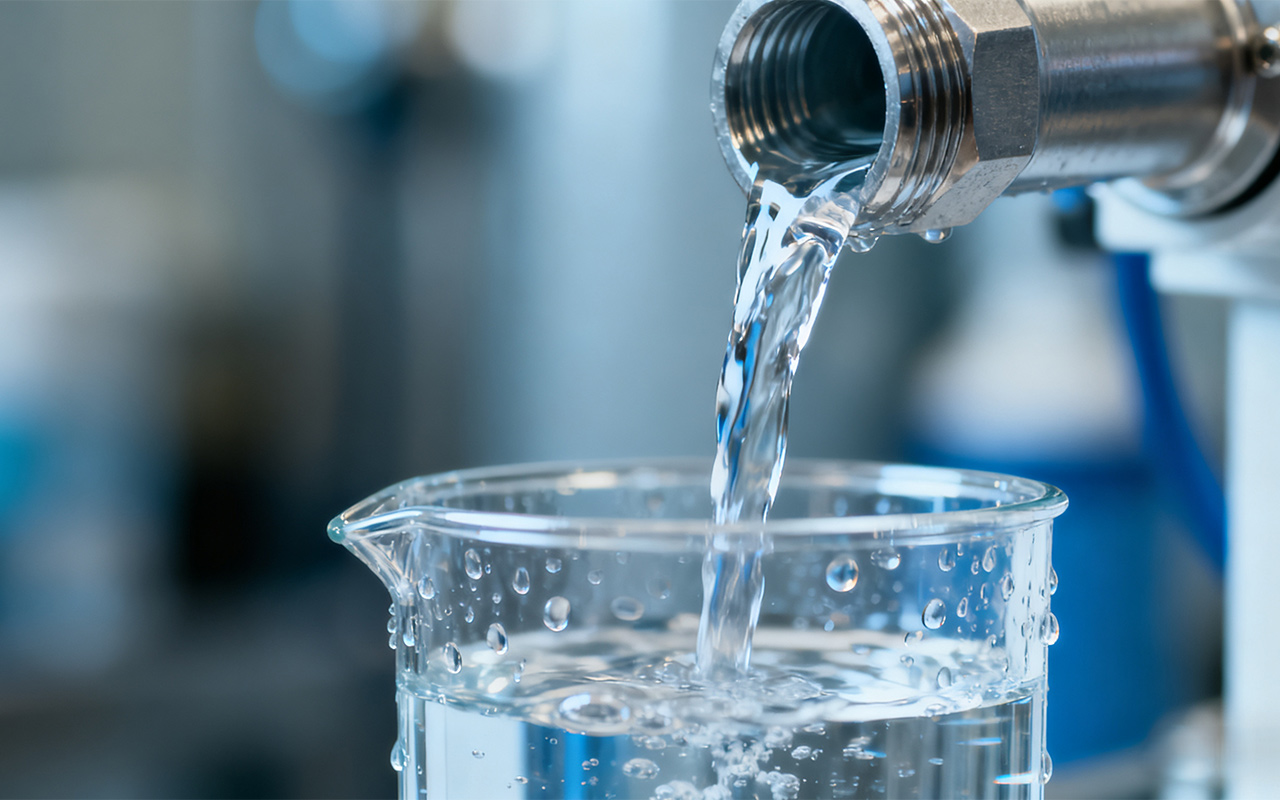
A purified water system is a chain of machines and pipes that strips dirt, chemicals, salts, and microorganisms out of water until it meets a specific quality target. That target varies enormously by industry: what counts as “pure enough” for a beverage plant is nowhere near strict enough for a semiconductor fab.
This guide covers what a purified water system is, how it works step by step, and why it quietly shapes far more of daily life than most people realize.
Key Takeaways
- Purity requirements span several orders of magnitude: tap water measures roughly 0.005–0.05 MΩ·cm resistivity, standard RO water 0.1–1.0 MΩ·cm, and semiconductor-grade ultrapure water must exceed 18.2 MΩ·cm (SEMI F63 standard).
- A new, well-maintained RO membrane typically rejects 97–99% of dissolved contaminants (AMPAC USA), but membranes themselves are wear parts — typical replacement runs 2 to 5 years depending on feed water and pretreatment quality (HID Membrane).
- Most people never see a purified water system, yet interact with its output daily — in medicines, contact lenses, baby formula, and the smartphone in their pocket.
What Is a Purified Water System?
A purified water system takes ordinary water, usually from a city supply or a well, and cleans it step by step: removing particles, dissolved minerals, organic compounds, and microorganisms until it’s far cleaner than typical tap water.
These systems run in pharmaceutical factories, hospitals, laboratories, electronics plants, food and beverage companies, and cosmetics manufacturers, and different industries need very different purity levels. Some need water that’s simply clean and free of harmful substances; others, like semiconductor fabs, need water with almost nothing left in it at all.
A typical system includes pretreatment equipment, reverse osmosis units, additional polishing steps, storage tanks, and a distribution network, with sensors and regular testing keeping the water within safe limits throughout. Designed and maintained well, it can run reliably for years.
Why Water Quality Matters So Much
Water is often the largest single ingredient in a medicine, and it’s also used to clean equipment and test product quality. Bacteria, heavy metals, or organic chemicals in that water can make a medicine less effective or genuinely dangerous.
Injected medicines and vaccines need to be especially pure, since any impurity enters the bloodstream directly. Even tablets and capsules are vulnerable: impurities can trigger chemical reactions that break down active ingredients before a product reaches its expiration date.
The same principle shows up well outside medicine. Dialysis machines clean the blood of people with kidney failure, so the water they use has to be extremely pure given how closely it contacts a patient’s blood. In electronics factories, microscopic chips get rinsed with ultrapure water, where a single stray particle or ion can ruin a chip and make a phone or computer fail down the line.
Clean water also protects everyday products people don’t think of as “pharmaceutical” at all: baby formula, contact lens solutions, eye drops, shampoos, and soft drinks all depend on water that won’t introduce bacteria or unwanted taste.

How a Purified Water System Works
Most purified water systems follow a clear sequence, with each step removing a different category of impurity and protecting the equipment that comes after it. (For a detailed, stage-by-stage breakdown of each technology, see our water purification devices guide.)
Pretreatment
Large filters remove sand, dirt, and visible particles; carbon filters strip out chlorine that would otherwise damage sensitive membranes downstream; softening systems remove calcium and magnesium so scale doesn’t build up inside pipes and membranes. This stage is simple but genuinely important — good pretreatment extends the life of everything that follows it.
Reverse Osmosis
Water is pushed under pressure through a membrane with extremely small pores. Water molecules pass through; most dissolved salts, organic compounds, and larger particles can’t. A new, well-maintained membrane typically rejects 97–99% of contaminants (AMPAC USA), but RO is rarely the only step — for very pure water, more cleaning follows.
Further Purification
Electrodeionization (EDI) uses electricity and special resins to remove the remaining charged particles without added chemicals, and many modern systems pair RO with EDI. UV light often comes next, damaging the DNA of microorganisms so they can’t reproduce while also helping reduce total organic carbon. In an ultrapure water system, UV oxidation is especially important for pushing TOC down to very low levels; final filters catch anything left over before storage.
Storage and Distribution
Clean water has to stay clean, which is just as much a part of system design as the purification stages themselves.
Storage Tanks
Water sits in smooth, stainless-steel tanks designed to limit bacterial growth, with a vent filter that lets air in but keeps dust and germs out, and a shape that avoids corners where water could sit still.
Distribution Pipes
Water travels through a carefully designed pipe network, often circulating continuously in a loop since moving water is far less hospitable to bacteria than stagnant water. Engineers avoid “dead legs,” the short sections of pipe where water can sit still and become a contamination risk.

Monitoring and Validation
Pharmaceutical companies test their water constantly, tracking conductivity (dissolved salts), TOC (organic pollution), bacteria count, temperature, and pressure — much of it through continuous sensors that let operators catch problems early. For an ultrapure water system, online monitoring matters even more, since quality has to stay extremely stable at all times.
Proving the system works consistently is called validation, and it follows the same four stages we cover in detail in our clear water treatment engineering guide: Design Qualification, Installation Qualification, Operational Qualification, and Performance Qualification. It takes time, but it’s what gives regulators documented proof that the system is reliable.
The Everyday Impact of Purified Water Systems
Most people never see a purified water system, yet they benefit from one almost every day.
Safe medicines: the water behind a pain reliever, antibiotic, or vaccine came from one of these systems — without it, the medicine might not be safe.
Contact lenses and eye drops: products that sit on or near the eye need ultrapure water so they don’t cause irritation or infection.
Baby formula: made with clean water because infants have weaker immune systems and are more vulnerable to contaminants than adults.
Electronics: the microchips inside smartphones, laptops, and TVs get rinsed with ultrapure water in cleanrooms; without it, modern electronics would fail far more often.
Cosmetics and personal care: shampoo, lotion, and toothpaste all contain large amounts of water that needs to stay free of unwanted microbes.
Food and beverages: bottled water, soft drinks, and many processed foods rely on treated water to remove unpleasant tastes, odors, and harmful substances.
Hospitals and dialysis: dialysis cleans a patient’s blood directly, so the water involved has to be extremely pure.

Key Benefits of a Well-Designed System
- Safety: removes contaminants that could harm patients or consumers.
- Consistency: medicines and other products perform the same way from batch to batch.
- Longer product life: fewer impurities mean fewer unwanted chemical reactions in the finished product.
- Regulatory compliance: helps manufacturers meet strict standards and pass inspections.
- Protection of equipment: clean water reduces scaling, corrosion, and fouling in production machinery.
- Public health support: from vaccines to dialysis, clean process water contributes directly to health outcomes.
Common Challenges and How They’re Managed
Most failures in these systems trace back to one of a handful of root causes rather than exotic ones: membrane fouling from weak pretreatment, microbial growth from infrequent sanitization, rising TOC from a tired UV lamp, or climbing conductivity signaling RO or EDI performance decline. Regular monitoring, scheduled sanitization, and timely replacement of filters and lamps prevent most of them before they become production problems. For the specific technology fixes, see our maintenance guide.
Choosing and Maintaining the Right System
A few concrete factors guide the decision when a company needs a purified water system: feed water quality (how much pretreatment is required), required purity (regular purified water or ultrapure), capacity (how much water is needed per day), and budget (purchase, installation, energy, consumables, and long-term service all factor in).
With proper care, the structural core of a well-built system, especially one built in 316L stainless steel, can remain in service for a decade or more. The wear parts don’t last nearly as long: RO membranes typically need replacement every 2 to 5 years depending on feed water and pretreatment quality, and can fail in as little as 18–24 months if pretreatment is inadequate (HID Membrane). Budgeting for that consumable replacement cycle up front avoids surprises later.

Conclusion
A purified water system is part of the hidden infrastructure behind modern healthcare, technology, and consumer products. Most of us will never operate one, yet every tablet, eye drop, soft drink, and smartphone we use depended on one somewhere upstream.
As technology and medicine keep advancing, demand for reliable, high-quality water will only grow. Understanding how these systems work, and why the purity ladder spans from ordinary tap water to 18.2 MΩ·cm ultrapure water, makes it easier to see why manufacturers invest in careful design, validation, and ongoing maintenance rather than treating water as an afterthought.
Frequently Asked Questions
What is a purified water system?
A set of equipment that cleans water for pharmaceutical, laboratory, or industrial use by removing salts, organic compounds, and microorganisms.
What is the difference between purified water and ultrapure water?
Purified water is clean enough for most pharmaceutical uses; ultrapure water goes further, reaching resistivity above 18.2 MΩ·cm for sensitive lab work and semiconductor manufacturing.
How do I know if my water is pure enough?
Test for conductivity, TOC, and bacteria, then compare against the standard that applies to your application — pharmaceutical use follows pharmacopeia limits specifically.
How often should a water system be sanitized?
It depends on the system and how it’s used; many run weekly, monthly, or quarterly, with the schedule set during validation based on ongoing monitoring results.
Can I use a small water system for my laboratory?
Yes — compact systems exist for lab-scale use; larger production needs a correspondingly larger system.
How long does a purified water system last?
The structural core of a well-built stainless system can last a decade or more, but wear parts like RO membranes typically need replacement every 2 to 5 years, and UV lamps more often still.
Does SKE&EAGLE provide maintenance services?
Yes — maintenance, support, spare parts, and technical advice to keep systems running smoothly.
For customized system engineering or integration of high-performance water treatment technologies, get in touch with SKE&EAGLE.