


Choosing the right purification technology for a pharmaceutical water system is only half the job. The other half is engineering: the materials, surface finish, and mechanical design that determine whether that system stays clean, compliant, and low-maintenance for the 15-plus years it’s expected to run.
For a stage-by-stage breakdown of RO, EDI, UF, and UV disinfection, see our guide to pharmaceutical water purification devices. This piece focuses on the engineering decisions that separate a system that passes its first audit from one that stays compliant for a decade: material selection, surface finish, sanitization strategy, and what actually drives project delivery timelines.
Key Takeaways
- ASME BPE electropolished (SF4) stainless surfaces hold a max Ra of 0.38 µm, versus 0.51 µm for mechanically polished (SF1) — smoother surfaces resist biofilm attachment (Rodem).
- Current USP guidance recommends thermal sanitization stay in the 65–80°C range and not exceed 80°C — a shift from the older “hotter is safer” assumption (SnowPure).
- Ozone sanitization only works reliably below about 35°C, since its half-life collapses at higher temperatures — it’s an option for cold/ambient loops, not hot-stored systems (ECA Academy).
Why Clear Water Treatment Matters in Pharmaceutical Production
Pharmaceutical manufacturers can’t use ordinary tap water. They need Purified Water (PW) or Water for Injection (WFI), each with its own regulatory limits:
- Purified Water (PW) covers most oral solid and liquid products, plus cleaning and preparation processes.
- Water for Injection (WFI) is the higher grade required for parenteral (injectable) products, with strict limits on endotoxins and microbial contamination.
Any chemical, microbial, or endotoxin impurity that reaches a pharmaceutical product is a real risk to patients, which is why the FDA, EMA, and pharmacopeias (USP, EP, JP) set firm quality standards that a system has to meet every day of operation, not just at commissioning.

Why 316L Stainless Steel Is Preferred for RO Systems
Material selection is where a lot of long-term reliability gets decided, which is why 316L stainless steel is the industry standard for serious pharmaceutical installations rather than plastic or PVC.
- Corrosion resistance in a constantly wet, frequently sanitized environment.
- Documented surface smoothness: ASME BPE grades the finish itself — SF1 (mechanically polished) allows a maximum Ra of 0.51 µm, while SF4 (electropolished) tightens that to 0.38 µm, with electropolishing also leaving a chromium-enriched passive layer that resists biofilm attachment (Rodem).
- High mechanical strength and tolerance for repeated high-temperature sanitization cycles.
- Compatibility with sanitary welding and passivation processes that plastic systems simply can’t match.
Plastic systems can look cheaper up front, but their surfaces tend to roughen over time, which makes them harder to clean and often shortens replacement intervals. For pharmaceutical applications, the long-term reliability and hygienic performance of 316L stainless steel, built with sanitary welding and the correct BPE surface finish, justifies the higher upfront cost.
Building a Complete System: Beyond the Purification Skid
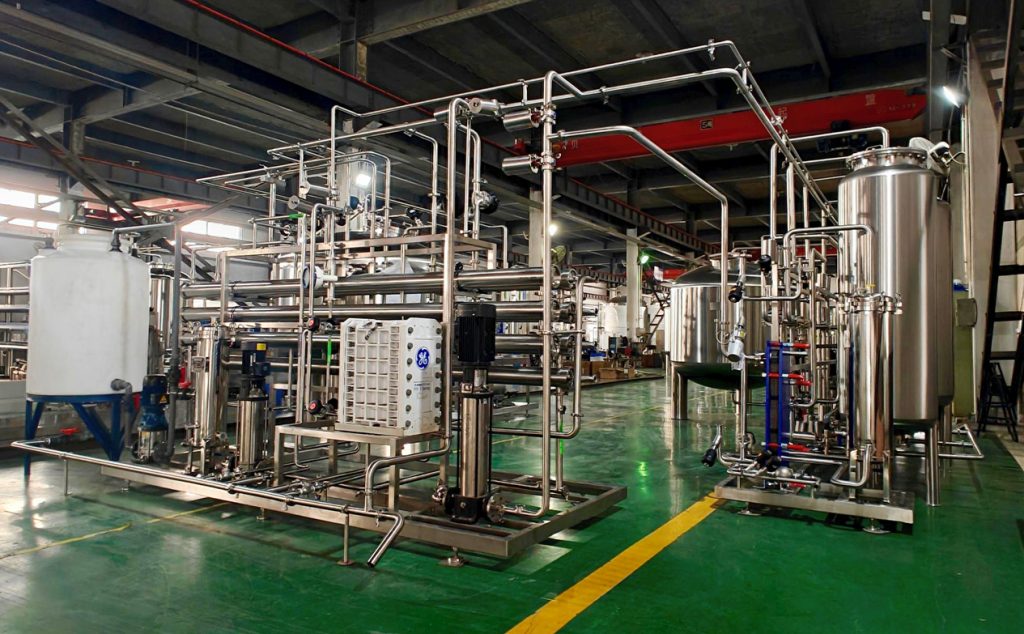
A pharmaceutical water system is an integrated installation, not just a purification skid. A complete build adds a pretreatment stage, the main purification unit (RO plus EDI, with UF where required — see our devices guide for how each stage works), a storage tank, a continuously circulating distribution loop, and a PLC-based monitoring and control system.
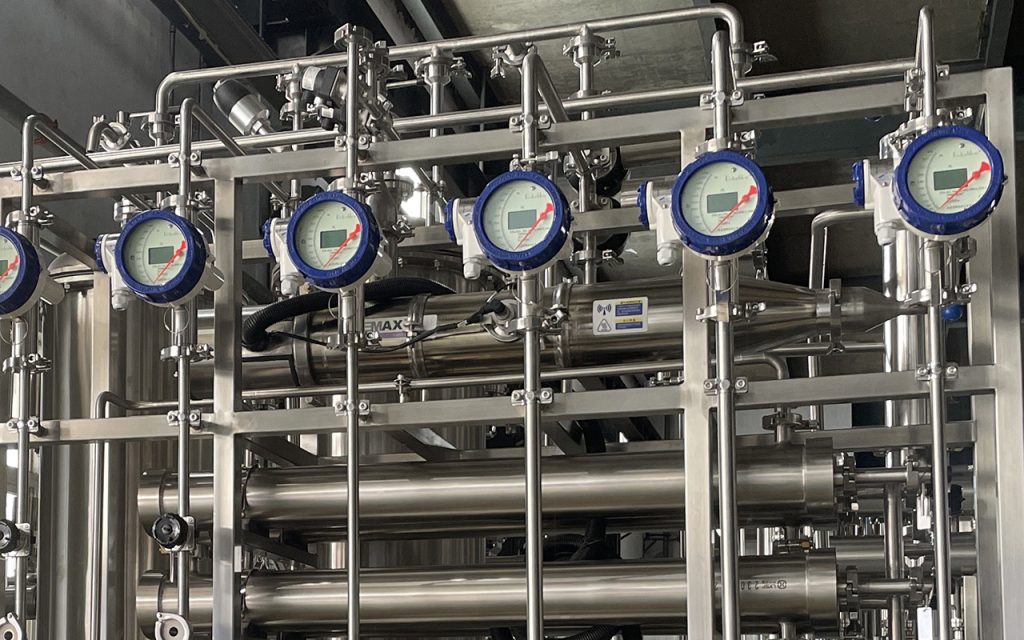
The distribution loop keeps water moving to prevent stagnation and microbial growth, while online sensors track conductivity, TOC, and temperature continuously and flag any deviation as an alarm. That constant monitoring also generates the electronic records regulators expect to see during an audit.
Sanitization: Getting the Method and Temperature Right
Sanitization strategy is where engineering choices meet day-to-day operating cost, and the guidance here has actually shifted in recent years.
Thermal sanitization used to be run as hot as a system could tolerate, on the assumption that hotter meant safer. Current USP guidance instead recommends staying in a 65–80°C range and not exceeding 80°C, since higher temperatures accelerate wear on gaskets, seals, and welds without a meaningful microbial-control benefit (SnowPure). Specifying a system rated well above that range isn’t future-proofing — it’s usually just added cost.
Ozone sanitization is the common chemical-free alternative, but it has a hard temperature ceiling: ozone’s half-life collapses above roughly 35°C, so it only works for loops stored and distributed cold or at ambient temperature (ECA Academy). Hot-stored systems already get a germicidal effect from their operating temperature, so adding ozone there is redundant rather than complementary. Choosing between hot storage plus periodic thermal sanitization, or ambient storage plus ozone, is a real design decision made early, not a setting adjusted later.
Validation and Documentation
Proper validation is what turns good hardware into a compliant system. The standard qualification stages are Design Qualification (DQ), Installation Qualification (IQ), Operational Qualification (OQ), and Performance Qualification (PQ) — each one building the paper trail that gives a facility (and its auditors) confidence in day-to-day water quality.
What Drives Delivery Timelines
A standard configuration typically takes 12 to 16 weeks for manufacturing, testing, and documentation; fully customized systems, with bespoke skid layouts, extended documentation packages, or non-standard capacities, usually run 20 to 24 weeks. The gap between those two numbers is mostly about factory acceptance testing (FAT) scope and how much of the validation documentation package has to be built from scratch versus adapted from a standard template — worth raising with a vendor early if a project has a hard installation deadline.
Frequently Asked Questions About Clear Water Treatment
Why is a stainless steel reverse osmosis system preferred over plastic in pharma?
316L stainless steel offers better corrosion resistance, a documented, gradeable surface finish (ASME BPE SF1/SF4), and the ability to withstand repeated hot-water sanitization without degrading — all of which simplify cleaning validation over the system’s service life.
How often should a clear water treatment system be sanitized?
Frequency is set in the system’s validation documents based on design, operating temperature, and risk assessment; many systems run weekly or more often. Systems can be configured for automatic sanitization on that schedule.
What is the typical delivery time for a clear water filtration system?
Standard systems: 12 to 16 weeks for manufacturing, testing, and documentation. Fully customized systems: 20 to 24 weeks.
Does SKE&EAGLE provide operator training for its systems?
Yes — on-site or remote training, detailed operating manuals, and ongoing technical support, so a facility’s team can operate and maintain the system confidently.
What’s the difference between Purified Water and Water for Injection?
See our full water purification devices guide for the technology-by-technology comparison and current USP chemical limits for both grades.
Why Choose SKE&EAGLE for Your Clear Water Treatment Needs
SKE&EAGLE builds pharmaceutical water systems around exactly these engineering choices: 316L stainless steel, sanitary welding, and BPE-graded internal surfaces that stay easy to clean and sanitize for the long haul. We support clients through the full project lifecycle, from system design and validation documentation packages to installation guidance, training, and after-sales service.
Conclusion
A well-designed clear water treatment system rests on more than the purification technology inside it. Material selection, surface finish, sanitization strategy, and validation discipline are what actually determine whether a system stays compliant, year after year, not just on commissioning day. If you’re planning a new system or upgrading an existing one, SKE&EAGLE would be glad to discuss your specific requirements.