


Water is an important raw material in pharmaceutical production and industrial manufacturing. Its quality can affect product safety, production efficiency, and equipment performance. For pharmaceutical companies, water treatment must also meet strict quality requirements.
An RO water purification system uses reverse osmosis technology to reduce dissolved salts and other impurities in feed water. It is widely used in pharmaceutical water treatment and many industrial processes.
However, reverse osmosis (RO) is usually one part of a complete water treatment process. The system may need additional treatment, storage, distribution, and monitoring equipment to meet the final water quality requirements.
This guide explains how an RO water purification system works, where it is used, and what to consider when choosing equipment for pharmaceutical and industrial applications.
What Is an RO Water Purification System?
An RO water purification system uses a semi-permeable membrane to separate water from many dissolved substances. A high-pressure pump pushes feed water against the membrane. Part of the water passes through it as permeate, while most rejected salts and other impurities remain in the concentrated stream.
RO can remove a high percentage of dissolved salts and reduce many other contaminants. Actual performance depends on membrane type, feed water quality, operating pressure, temperature, and system condition.
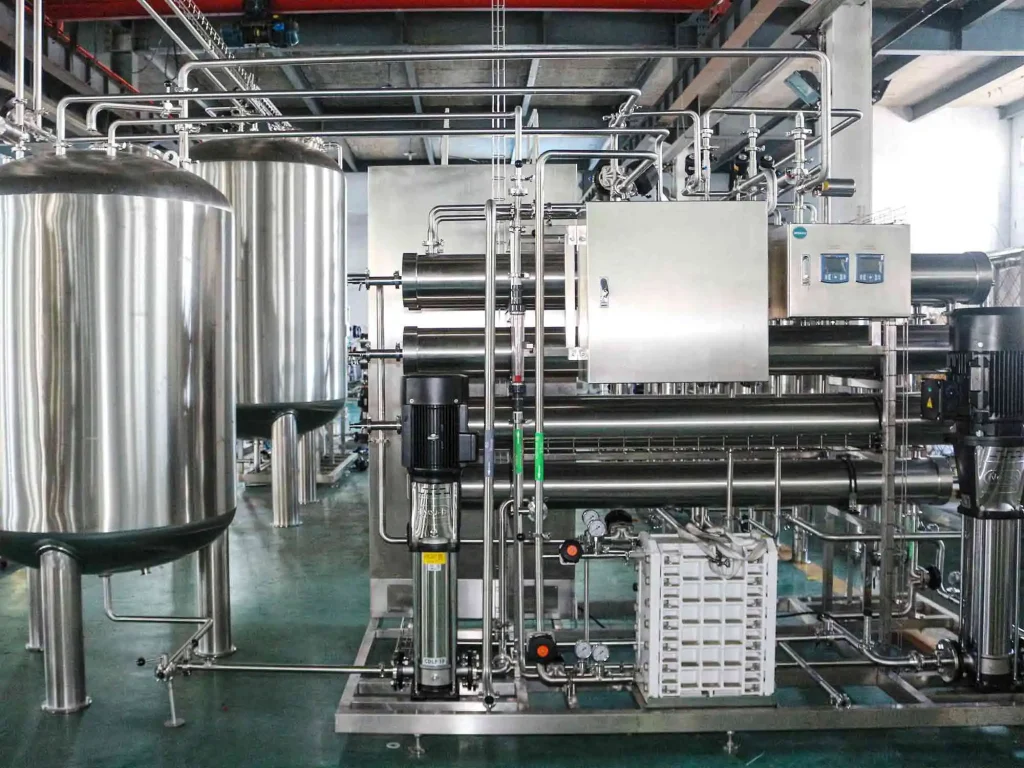
A typical RO water purification system includes the following components:
-
Pre-treatment filters: Remove particles and help protect the RO membranes.
-
Water softener or antiscalant dosing: Controls the risk of mineral scale when required.
-
Activated carbon or other dechlorination equipment: Removes chlorine when needed to protect chlorine-sensitive membranes.
-
High-pressure pump: Provides the pressure required for membrane separation.
-
RO membrane elements: Reduce dissolved salts and other contaminants.
-
Control and monitoring instruments: Track pressure, flow, conductivity, and other operating data.
-
Post-treatment equipment: Provides further purification when required.
-
Storage and distribution equipment: Delivers treated water to the points of use.
The exact configuration depends on feed water quality, required water output, production demand, and the final water quality target.

Why RO Is Important in Pharmaceutical Water Systems
Water is used for equipment cleaning, product formulation, and many other pharmaceutical processes. Different applications require different water quality levels, so a pharmaceutical water system must be designed around its intended use.
Two important water grades are Purified Water (PW) and Water for Injection (WFI).
Purified Water is used in many pharmaceutical manufacturing and cleaning processes. WFI is required for specific applications, including the manufacture of certain injectable products. Each water grade must meet the applicable pharmacopoeial requirements.
An RO water purification system is widely used as a major purification step because it reduces dissolved salts and helps lower the load on downstream equipment. Depending on the required water quality, the treatment process may combine RO with electrodeionization (EDI), ultrafiltration, distillation, or other suitable technologies.
RO in an Industrial Water Treatment System
An industrial water treatment system often includes an RO water purification system to supply water that meets the needs of a specific production process. RO is used in many industries because it can reduce dissolved salts and protect downstream equipment.
An industrial water treatment system may combine several technologies.
| Technology | Main Function | Typical Position |
|---|---|---|
| Sand or multimedia filter | Removes suspended particles | Pre-treatment |
| Activated carbon filter | Removes chlorine and some organic compounds | Pre-treatment, when suitable |
| Water softener | Reduces hardness | Pre-treatment, when required |
| RO system | Reduces dissolved salts and many contaminants | Main purification stage |
| EDI | Further reduces ionic impurities | Post-treatment |
| UV system | Supports microbial control or organic reduction, depending on type | Selected treatment stage |
| Ultrafiltration | Removes particles and many microorganisms, depending on membrane design | Selected treatment stage |
Not every RO water purification system needs all these components. The correct combination depends on feed water conditions and the required water quality.
How Does an RO Water Purification System Work?
An RO water purification system usually operates through four main stages.
Step 1: Pre-Treatment
In an RO water purification system, feed water first passes through suitable pre-treatment equipment. Filters remove suspended particles, while softening or antiscalant dosing may help control scale formation.
If the feed water contains chlorine, a suitable dechlorination step may be needed because chlorine can damage many thin-film composite RO membranes. Pre-treatment should be selected according to the actual water analysis.
Step 2: High-Pressure Pumping
A high-pressure pump sends water to the RO membrane. The pressure must be sufficient to overcome the osmotic pressure of the feed water and produce the required permeate flow.
Operating pressure depends on feed water salinity, temperature, membrane characteristics, and system design.
Step 3: Membrane Separation
Inside the RO membrane unit, part of the feed water passes through the membrane and becomes permeate. Dissolved salts and many other contaminants are concentrated in the remaining water.
The system produces two streams: permeate and concentrate. Recovery rate describes the proportion of feed water converted into permeate.
Higher recovery can reduce water waste, but excessive recovery may increase scaling and fouling risks. The target must be selected according to water chemistry and operating conditions.
Step 4: Post-Treatment and Distribution
RO permeate may need further treatment before use. Depending on the application, this may include EDI, ultrafiltration, UV treatment, or another suitable process.
For pharmaceutical applications, water storage and distribution are also important. Tank design, piping, circulation, sanitization, and monitoring help maintain water quality after purification.
The complete process—not just the RO membrane—determines whether the system can consistently meet its target.
How to Choose the Right RO Water Purification System
Choosing the right system requires a clear understanding of water quality, production demand, and operating conditions.
1. Define the Required Water Quality
When selecting an RO water purification system, start by identifying the intended use of the treated water. Pharmaceutical production requires a system designed around the applicable water grade and quality standards. Industrial applications may focus on conductivity, hardness, silica, or other process-specific requirements.
2. Analyze the Feed Water
A detailed water analysis helps determine the pre-treatment and membrane design. Important parameters may include total dissolved solids (TDS), hardness, alkalinity, silica, iron, chlorine, and microbiological quality.
Without this information, equipment selection may be inaccurate and operating costs may increase.
3. Confirm Capacity and Flow Rate
Consider both current and expected future demand. The system should provide sufficient water during normal production and peak usage.
Capacity planning should also consider the operating schedule, storage volume, and demand from multiple points of use.
4. Set a Suitable Recovery Rate
A higher recovery rate can reduce concentrate volume and water consumption. However, it may increase the risk of scaling, especially when feed water contains high levels of hardness or silica.
The final recovery target should balance water efficiency, membrane performance, and long-term operating stability.
5. Check Materials and Sanitary Design
Pharmaceutical water systems require careful attention to materials, surface finish, drainage, piping layout, and cleanability. Stainless steel may be appropriate for selected equipment and distribution components, depending on the system design.
Industrial systems can use different materials based on water chemistry, pressure, temperature, and process requirements.
6. Evaluate Automation and Monitoring
A PLC control system can support automatic operation, alarms, and process monitoring. Instruments may track conductivity, flow, pressure, and other critical parameters.
For pharmaceutical applications, the monitoring and control strategy should support the site’s quality requirements and documentation practices.
7. Consider Service and Maintenance
Ask the supplier about membrane cleaning, spare parts, operator training, technical support, and maintenance requirements. Good support can help reduce unplanned downtime and maintain stable performance.
Common RO Problems and Maintenance Tips
Even a well-designed RO water purification system needs regular monitoring and maintenance. The following problems are common in RO operation.
| Problem | Possible Cause | Recommended Action |
|---|---|---|
| Reduced permeate flow | Fouling, scaling, low temperature, or pressure changes | Check operating data and compare normalized membrane performance |
| High pressure drop | Feed-side fouling or blockage | Inspect pre-treatment and membrane operating conditions |
| Rising permeate conductivity | Membrane damage, seal problems, or changing feed water | Check conductivity readings, membrane integrity, and system conditions |
| Scale formation | High mineral concentration or unsuitable recovery | Review feed water chemistry and scale control |
| Chlorine damage | Inadequate dechlorination | Check chlorine removal and monitoring procedures |
SKE&EAGLE Pharmaceutical Water Treatment Solutions
SKE&EAGLE provides pharmaceutical water treatment equipment designed around project requirements, feed water quality, and production needs.
For facilities that need a new pharmaceutical water system, an RO water purification system upgrade, or a change in production capacity, equipment selection should consider the entire treatment process rather than the RO unit alone.
Depending on project scope, SKE&EAGLE solutions may include:
-
RO water purification systems
-
Purified Water and WFI systems
-
EDI and other suitable post-treatment equipment
-
Water storage and distribution systems
-
Control and monitoring equipment
-
Technical documentation and project support
The final system configuration depends on the required water grade, applicable standards, operating conditions, and project specifications.
A properly designed solution can help pharmaceutical manufacturers manage water quality, support stable production, and plan maintenance more effectively.

Frequently Asked Questions
Q1: What is the difference between RO water and Purified Water?
RO water is water treated by reverse osmosis. Purified Water is a defined pharmaceutical water grade that must meet applicable pharmacopoeial requirements. An RO water purification system may be a major treatment step, but additional treatment, storage, distribution, and monitoring may be needed.
Q2: Can an RO system remove bacteria and endotoxins?
RO membranes can reduce bacteria and endotoxin levels, but performance depends on membrane integrity and operating conditions. RO alone should not be assumed to provide complete microbial or endotoxin control. Additional treatment, such as ultrafiltration, may be needed for specific applications.
Q3: How long do RO membranes last?
Membrane life depends on feed water quality, pre-treatment, operating conditions, and maintenance. Regular monitoring and proper cleaning can help extend service life. Replacement should follow performance data and manufacturer guidance.
Q4: What is the recovery rate of an RO system?
Recovery rate is the percentage of feed water converted into permeate. The suitable rate depends on feed water composition, membrane configuration, and scaling risk. A higher recovery rate is not always the best choice for every application.
Q5: Why is pre-treatment important for RO?
Pre-treatment helps protect RO membranes from particles, scale, and chemical damage. Suitable filtration, softening, or dechlorination can improve membrane performance and help reduce maintenance costs.
Q6: Can SKE&EAGLE customize an RO water purification system?
SKE&EAGLE can assess project requirements and develop a suitable equipment configuration based on feed water analysis, required capacity, target water quality, and applicable standards. Contact the team to discuss your project specifications.
Conclusion
An RO water purification system is an important technology in pharmaceutical and industrial water treatment. It reduces dissolved salts and many contaminants while helping protect downstream purification equipment.
For pharmaceutical manufacturing, an RO water purification system should be selected as part of a complete water treatment system designed to meet the required water grade. Suitable post-treatment, storage, distribution, monitoring, and maintenance are all important for consistent water quality.
For industrial applications, the right RO configuration depends on feed water conditions, production demand, and process requirements.
SKE&EAGLE can help assess your water treatment needs and identify suitable equipment options for your facility.
Official Website: https://www.ske-eagle.com/
Contact Email: info@ske-eagle.com
Follow us on Facebook for the latest industry insights: SKE & Eagle Facebook
Business Inquiries: Visit our official website and submit the contact form at the bottom.