

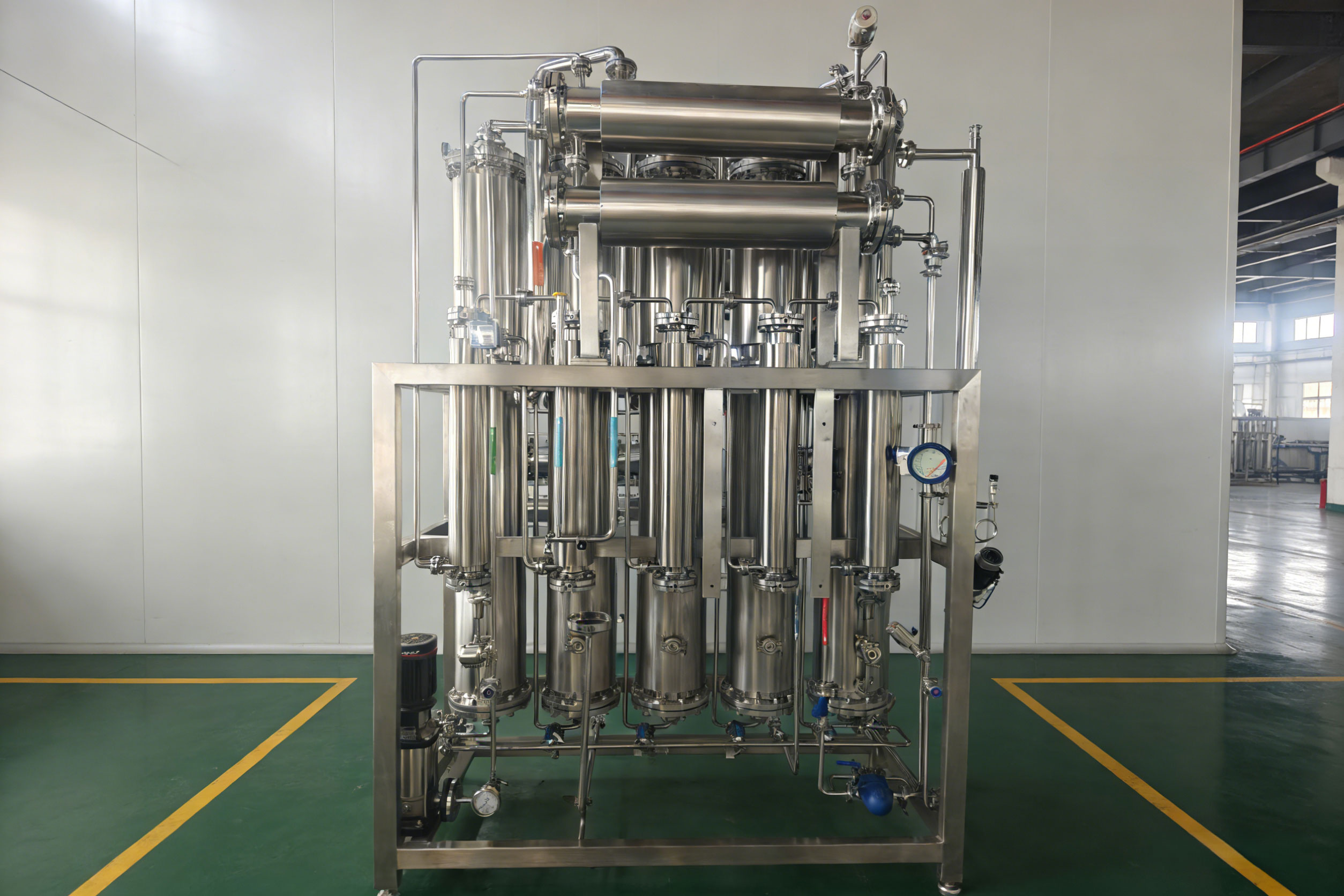
In pharmaceutical manufacturing, water quality is critical to product safety and process control. Water for Injection (WFI) is used in many pharmaceutical and biotechnology applications, so the water system must be carefully designed, operated, monitored, and maintained.
A multi-effect water distiller is a well-established technology for WFI production. It uses several evaporation and condensation stages to purify water while reusing thermal energy.
However, a WFI system is more than a distiller. Pretreatment, feed water quality, storage, distribution, monitoring, and validation all affect the final system performance.
This guide explains how a multi-effect water distiller works and how it fits into a complete pharmaceutical water system.
Key Takeaways
- A multi-effect distiller reuses the vapor from each stage to heat the next, so it needs less external steam than a single-effect distiller to produce the same volume of WFI.
- The distiller is only one part of the system: pretreatment (multimedia filtration, softening, RO) protects the equipment from scaling and fouling before feed water ever reaches it.
- Distillation gives strong microbial and endotoxin control through high-temperature operation, which is why it remains a standard route to WFI alongside validated membrane-based systems.
- A validated system tracks conductivity, TOC, temperature, pressure, flow, and microbiological/endotoxin quality against the limits in USP General Chapter <1231>.
What Is a Multi-Effect Water Distiller?
A multi-effect water distiller, also called a multi-effect distillation (MED) system, uses heat to evaporate and condense water through several stages called effects.
The main idea is simple: reuse heat.
In the first effect, external steam heats the feed water. The water evaporates and produces clean vapor. This vapor then provides heat for the second effect. The process continues through the following effects.
Each effect normally works at a lower pressure and temperature than the previous one. This allows vapor from one stage to heat the next stage without using the same amount of external steam again.
As a result, a multi-effect system can produce more distilled water from a given amount of heating steam than a single-effect distiller.
The exact number of effects depends on the required production capacity, steam conditions, energy targets, and project design. Pharmaceutical systems may use several effects to balance energy efficiency and equipment cost.

How Does Multi-Effect Distillation Work?
The multi-effect distillation process normally follows these basic steps:
- Pretreated feed water enters the distiller.
- Heating steam supplies energy to the first effect.
- Feed water is heated and partially evaporated.
- The generated vapor moves to the next effect.
- The vapor transfers heat to the water in the next effect and condenses.
- The process continues through the remaining effects.
- Distilled water is collected as the product stream.
- The product water is sent to the WFI storage and distribution system.
The pressure difference between the effects is important. Because the pressure decreases from one effect to the next, water can boil at a lower temperature in later stages.
This design allows the system to reuse latent heat. It can therefore reduce external steam demand compared with single-effect distillation.
Why Is Pretreatment Important?
A multi-effect water distiller does not normally receive untreated raw water directly.
Feed water may contain suspended solids, hardness, dissolved salts, organic matter, and other impurities. If these contaminants are not controlled, they can cause scaling, fouling, and reduced heat-transfer performance inside the distiller.
A suitable pretreatment system protects the distiller and helps maintain stable operation.
A typical pretreatment train may include:
- Multi-media filtration
- Water softening
- Activated carbon treatment when required
- Reverse osmosis (RO)
- Other purification or polishing steps based on the raw water quality
The exact design depends on the source water and the required feed water quality.
The Role of a Multi-Media Filter
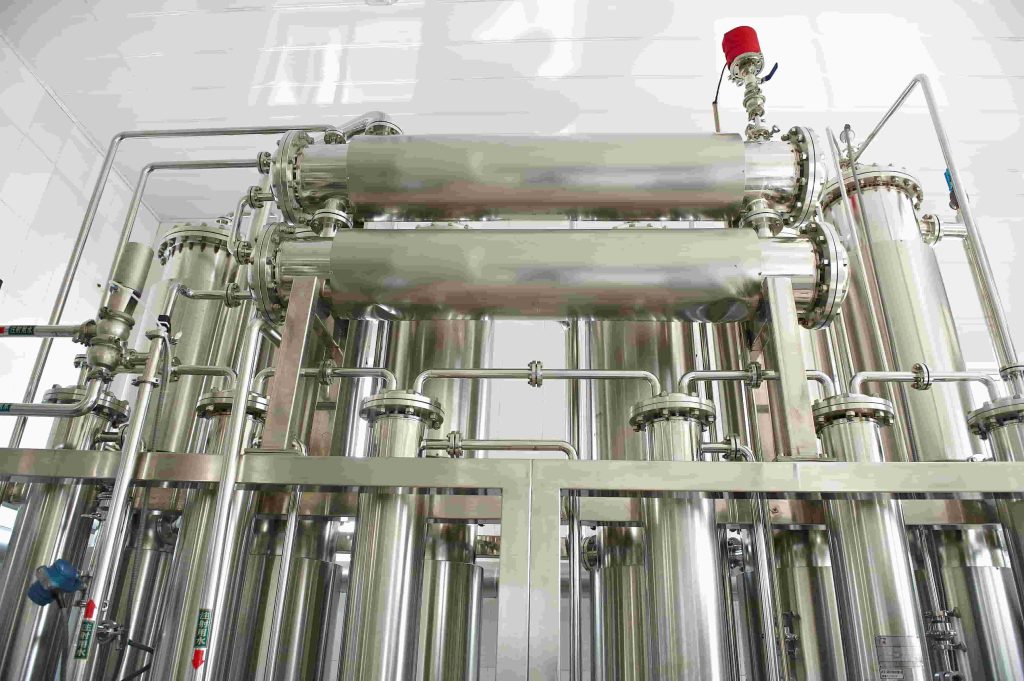
A multi-media filter is often used as an early pretreatment stage.
It normally contains several layers of filter media, such as anthracite, sand, and garnet. Different media sizes and densities allow the filter to capture suspended particles through the depth of the filter bed.
This can reduce the particle load entering downstream equipment.
For a pharmaceutical water system, effective pretreatment can help:
- Reduce particulate fouling
- Reduce scaling and deposits when combined with appropriate hardness control
- Protect downstream equipment
- Maintain heat-transfer efficiency
- Reduce cleaning requirements
- Support stable system operation
The multi-media filter is therefore not the final purification step. Its main role is to protect the later stages of the injection water equipment system.
Complete Injection Water Equipment for WFI Production
A complete injection water equipment system usually contains several connected stages. The exact configuration depends on the raw water, production capacity, WFI requirements, and facility design.
| Component | Main Function | Typical Position |
|---|---|---|
| Multi-media filter | Removes suspended solids | Early pretreatment |
| Softener | Reduces hardness and scaling risk | Pretreatment |
| Reverse osmosis system | Reduces dissolved salts and other impurities | Intermediate purification |
| Multi-effect water distiller | Produces WFI by distillation | WFI generation |
| WFI storage tank | Stores produced WFI under controlled conditions | After generation |
| Distribution loop | Circulates WFI to points of use | Final distribution |
Not every pharmaceutical facility needs exactly the same configuration. Engineers normally select the treatment stages according to feed water analysis, capacity, applicable regulations, and the overall validation strategy.
The goal is not simply to remove impurities. The complete system must consistently produce and maintain water of the required quality.
Key Advantages of a Multi-Effect Water Distiller
A multi-effect water distiller offers several important advantages for pharmaceutical manufacturers.
1. Proven Thermal Purification
Distillation uses evaporation and condensation to separate water from many non-volatile contaminants. When properly designed and operated, the process provides strong control of microorganisms and bacterial endotoxins, consistent with the microbial control approach described in FDA’s Guide to Inspections of High Purity Water Systems.
2. Reuse of Thermal Energy
The vapor produced in one effect becomes the heating source for the next effect. This reduces the need for fresh external steam at every stage.
The number of effects can therefore be selected to balance energy performance, steam availability, and capital cost.
3. Suitable for WFI Production
Distillation is a well-established technology for producing Water for Injection. A properly designed and validated system can consistently produce water that meets the applicable pharmacopoeial requirements, such as those in USP General Chapter <1231> Water for Pharmaceutical Purposes.
4. Potential Pure Steam Capability
Some pharmaceutical distillation systems can also be designed to produce pure steam. This can be useful for facilities that require both WFI and clean steam-related services.
5. Hygienic Operation
Pharmaceutical MED systems can be designed with sanitary materials, automated controls, cleanable surfaces, and monitoring functions. These features support GMP-oriented operation and system maintenance.
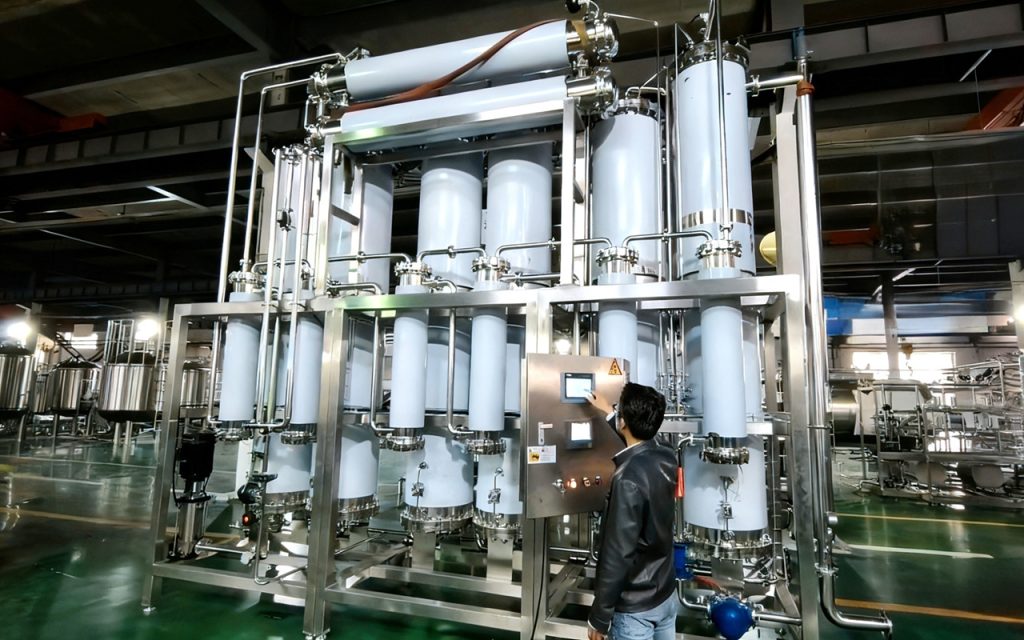
Multi-Effect Distillation vs. Membrane-Based WFI Production
Distillation is not the only technology used for pharmaceutical water production. Modern pharmaceutical water systems may also use membrane-based technologies when the process has been properly designed and validated to meet applicable requirements.
| Feature | Multi-Effect Distillation | Membrane-Based System |
|---|---|---|
| Main process | Thermal evaporation and condensation | Membrane separation |
| Energy source | Mainly thermal energy | Mainly electrical energy |
| Microbial control | Supported by high-temperature operation | Requires controlled system design and sanitization |
| Endotoxin control | Strong control through the distillation process | Depends on membrane configuration and validation |
| Steam requirement | Requires suitable heating steam | Generally lower steam demand |
| Pure steam production | Possible in some system designs | Not an inherent function |
| Typical application | WFI and pharmaceutical water production | Purified water and validated WFI applications |
The right solution depends on raw water quality, production capacity, available utilities, energy targets, facility design, and regulatory requirements.
For some facilities, a combination of RO, EDI, ultrafiltration, and other membrane technologies may be appropriate. For others, thermal distillation may provide the required process characteristics.
Validation and Monitoring of a Pharmaceutical Water System
A pharmaceutical water system must be more than technically capable. It must also be properly qualified, validated, monitored, and maintained.
Depending on the system design and applicable regulations, important parameters may include:
- Conductivity
- Total organic carbon (TOC)
- Temperature
- Pressure
- Flow rate
- Microbiological quality
- Bacterial endotoxins
Instrumentation should be suitable for the application and maintained according to the facility’s quality system.
Validation also helps demonstrate that the system can consistently produce water that meets the required specifications under defined operating conditions.
For this reason, equipment selection should consider not only production capacity but also automation, monitoring, documentation, qualification, and long-term maintenance.
Frequently Asked Questions
1. What is a multi-effect water distiller used for?
A multi-effect water distiller is mainly used to produce high-purity distilled water, including WFI in pharmaceutical applications. It uses multiple evaporation and condensation stages to reuse thermal energy.
2. How many effects does a pharmaceutical water distiller need?
There is no single number that fits every project. The number of effects depends on production capacity, heating steam conditions, energy targets, equipment cost, and facility requirements.
3. Why is pretreatment needed before distillation?
Pretreatment reduces suspended solids, hardness, and other contaminants that can cause scaling or fouling. This protects the distiller and helps maintain stable heat-transfer performance.
4. Can a multi-effect distiller produce WFI?
Yes. A properly designed, operated, and validated multi-effect distillation system can be used for WFI production when it meets the applicable pharmacopoeial and regulatory requirements.
5. Is distillation the only way to produce WFI?
No. Depending on the applicable pharmacopoeia and regulatory framework, validated membrane-based or combined purification processes may also be used. The selected process must consistently meet the required WFI quality standards.
6. What equipment is included in a complete WFI system?
A complete system may include pretreatment equipment, RO or other purification units, a multi-effect water distiller, WFI storage, a sanitary distribution loop, instruments, control systems, and monitoring equipment.
Written by Mandy, Marketing Specialist at SKE&EAGLE with two years of experience covering the company’s pharmaceutical water and steam equipment. Technical details in this guide were reviewed by SKE&EAGLE’s engineering team before publication.
Conclusion
A multi-effect water distiller is a proven technology for pharmaceutical WFI production. Its multiple evaporation stages allow thermal energy to be reused, while the distillation process provides strong control of many chemical and microbiological contaminants.
However, reliable WFI production depends on the complete water system. Proper pretreatment, hygienic equipment design, WFI storage, distribution, monitoring, qualification, and validation all play important roles.
SKE&EAGLE provides pharmaceutical water equipment and complete water treatment solutions for pharmaceutical and biotechnology facilities. Our systems can integrate pretreatment, reverse osmosis, multi-effect distillation, WFI storage, distribution, and automated control according to project requirements.
If you are planning a new pharmaceutical water system, expanding an existing facility, or upgrading WFI production equipment, contact the SKE&EAGLE technical team to discuss your application and system requirements.
Official Website: https://www.ske-eagle.com/
Contact Email: info@ske-eagle.com
Follow us on Facebook for the latest industry insights: SKE & Eagle Facebook
Business Inquiries: Visit our official website and submit the contact form at the bottom.