


Water is one of the most critical materials in pharmaceutical manufacturing. It serves as a raw material, solvent, cleaning agent, and ingredient in many drug products. For injectable medicines, water quality is especially important because it can directly affect product safety and quality.
This is why pharmaceutical manufacturers need reliable pharmaceutical water systems that can consistently produce water meeting strict quality requirements. Among the technologies used for high-purity water production, multiple distillation — commonly implemented as Multi Effect Distillation (MED) — has a long history in the pharmaceutical industry.
It relies on repeated evaporation and condensation to produce high-purity water and is widely used for Water for Injection (WFI) production. This article explains how the multi effect distillation process works, the main components of a multi effect water distiller, its key benefits, and what manufacturers should consider when selecting this technology.
Key Takeaways
- Multi effect distillation (MED) purifies water through repeated evaporation and condensation across several effects, reusing heat between stages to cut energy use.
- MED is a long-established, compendially recognized method for producing Water for Injection (WFI).
- Since a 2017 revision, the European Pharmacopoeia also allows reverse osmosis and related membrane methods for WFI, aligning with USP and Japanese Pharmacopoeia practice.
- No purification method removes every possible contaminant; volatile substances still require proper feed water pretreatment and system design.
What Is Multiple Distillation (Multi Effect Distillation)?
Multiple distillation, also known as Multi Effect Distillation (MED), is a thermal water purification process based on evaporation and condensation.
The basic principle is straightforward. When water is heated and evaporates, many non-volatile impurities remain in the feed water. The vapor is then condensed to produce purified water.
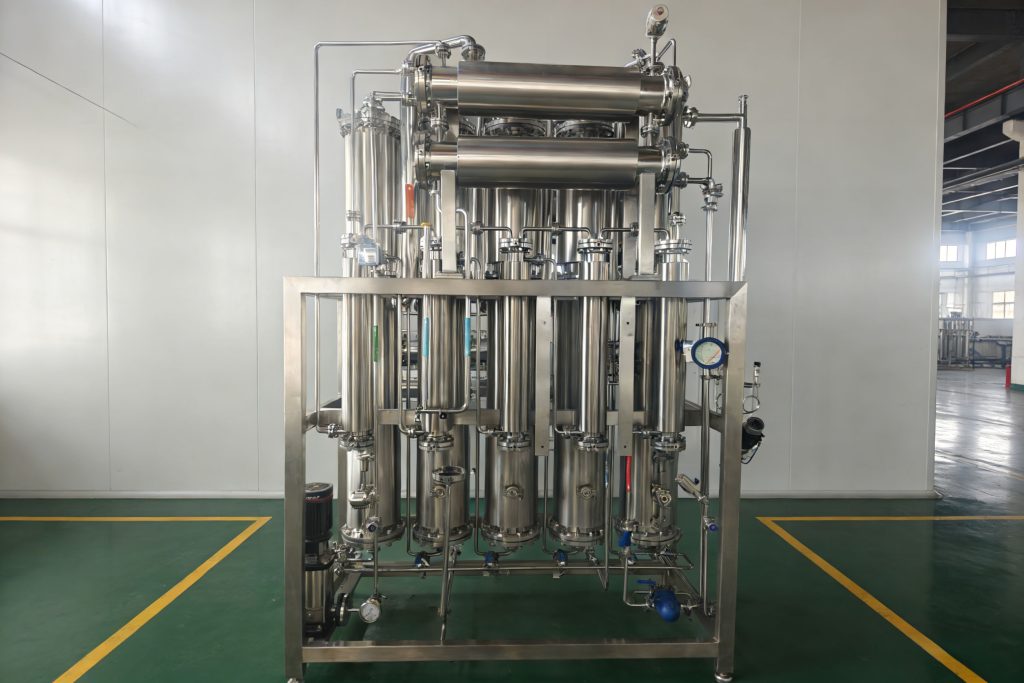
A multi effect water distiller uses several evaporation stages, called effects. The main purpose of these effects is to reuse heat.
In the first effect, external steam provides the primary heat source. The steam heats the feed water and generates vapor. This vapor is then used as the heating source for the next effect.
Because each effect operates at a lower pressure and temperature, the same heat can be reused several times. This makes the multi effect distillation process more energy-efficient than single-effect distillation. The number of effects depends on the required production capacity, available utilities, and energy efficiency goals.
How Does the Multi Effect Distillation Process Work?
The multi effect distillation process includes several connected steps.
1. Feed Water Pretreatment
Before entering the distiller, feed water normally receives suitable pretreatment. Reverse osmosis (RO) is commonly used to reduce dissolved salts and other impurities. Pretreatment helps reduce scaling, corrosion, and contamination risks inside the distillation system. The exact feed water requirements depend on the system design and the quality of the incoming water.
2. Heating in the First Effect
Pretreated feed water enters the first effect. Heating steam passes through heat-transfer tubes and transfers heat to the feed water. Part of the water evaporates and becomes vapor. The steam used for heating condenses and can be recovered as condensate, depending on the system design.
3. Heat Reuse Between Effects
The vapor produced in the first effect becomes the heating source for the second effect. The same principle continues through the following effects. Each effect works at a lower pressure than the previous one, allowing the vapor to condense and transfer its heat to the next stage. This heat-reuse principle is the key feature of a multi effect water distiller.
4. Final Condensation
At the end of the system, the remaining vapor is condensed. Heat exchangers can also recover heat from hot streams and transfer it to incoming feed water. This improves the overall thermal efficiency of the system. The final distillate is collected and sent to the appropriate storage and distribution system.
Main Components of a Multi Effect Water Distiller
A pharmaceutical multi effect water distiller normally includes several important components.
Evaporator Effects
The evaporator effects are the core of the system. Each effect provides a controlled environment for heat transfer, evaporation, and condensation. The equipment is normally designed with sanitary materials and surfaces suitable for pharmaceutical applications.
Steam Supply
The first effect requires a suitable heat source. Depending on the system design, this may include plant steam or another approved thermal source. For pharmaceutical applications, the steam and heat-transfer arrangement must be selected carefully to protect the quality of the final product.
Condenser and Heat Exchangers
The final condenser removes heat from the remaining vapor and converts it into liquid. Heat exchangers can also recover heat from hot process streams, reducing the amount of external energy needed by the system.
Control System
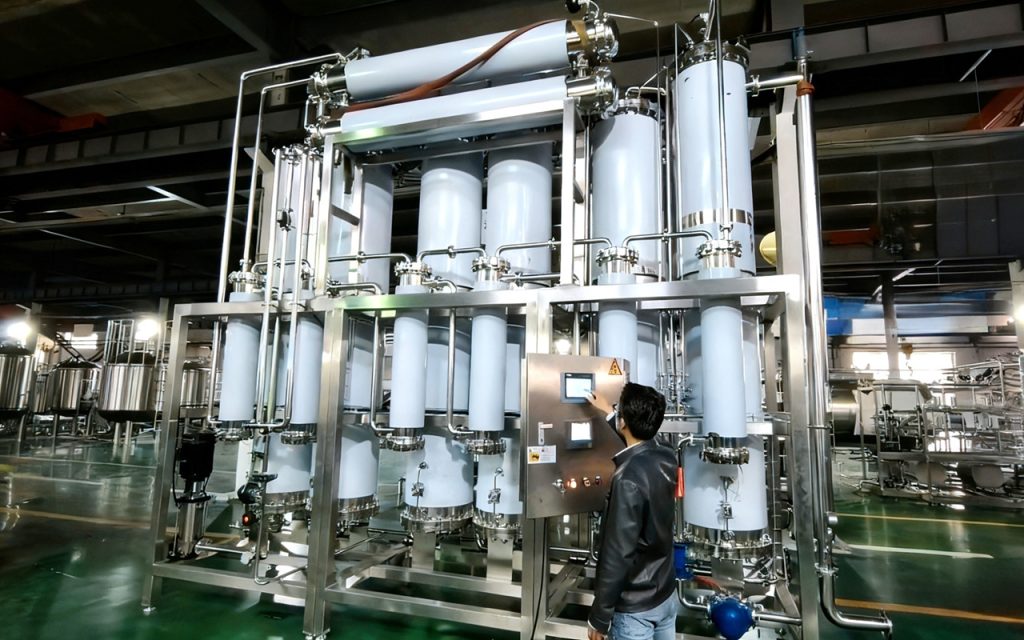
Modern multi effect distillation systems use automated controls to monitor important operating parameters such as pressure, temperature, flow, and other process conditions. Automation helps maintain stable operation and supports consistent production.
Why Is Multiple Distillation Used for WFI Production?
Water for Injection (WFI) is used in pharmaceutical manufacturing for applications where very high water quality is required. Multiple distillation offers several advantages for WFI production.
High Purity
The evaporation and condensation process can effectively separate water from many non-volatile impurities, including dissolved salts and microorganisms. A properly designed and operated distillation system can also provide strong control of bacterial endotoxin levels. However, distillation does not mean that every possible contaminant is automatically removed. Volatile substances may require additional control through feed water pretreatment and proper system design.
Proven Technology
Distillation has been used in pharmaceutical water production for many years. Its operating principles are well understood, and pharmaceutical manufacturers have extensive experience with system qualification, validation, operation, and maintenance.
Thermal Sanitization Benefits
The high temperatures used in the distillation process provide an important advantage for microbial control. When combined with suitable system design and sanitization procedures, thermal operation can help reduce microbial contamination risks.
Suitable for Continuous Production
Multi effect distillation systems can be designed for continuous production and integrated with pharmaceutical water storage and distribution systems. This makes them suitable for pharmaceutical plants with stable and high WFI demand.
Multiple Distillation vs. Other Water Purification Methods
Different pharmaceutical water technologies have different advantages. The best choice depends on water quality requirements, production capacity, available utilities, and regulatory requirements.
| Feature | Multiple Distillation (MED) | Vapor Compression Distillation | Membrane Systems |
|---|---|---|---|
| Main Principle | Evaporation and condensation | Vapor compression and condensation | Membrane separation |
| Main Energy Source | Steam or thermal energy | Electrical energy | Electrical energy |
| Heat Reuse | High | High | Not applicable |
| WFI Application | Widely used | Widely used | Accepted in some markets |
| Main Advantage | High purity and proven technology | Reduced external steam demand | Lower thermal energy demand |
| Main Consideration | Steam and cooling requirements | Higher electrical demand | Requires careful system design |
Membrane systems such as RO and EDI are widely used in pharmaceutical water treatment, especially for Purified Water production and as pretreatment for other processes.
For WFI production, the appropriate technology should be selected according to the applicable pharmacopoeia, local regulations, water quality requirements, and the overall pharmaceutical water system design. Regulatory acceptance of membrane-based WFI production has also evolved: the European Pharmacopoeia historically required distillation for WFI, but its April 2017 revision to monograph 0169 now allows reverse osmosis (single- or double-pass) combined with techniques such as electrodeionisation, ultrafiltration, or nanofiltration, aligning it with USP and Japanese Pharmacopoeia practice (PharmOut).
Applications of Multi Effect Water Distillers in Pharmaceutical Manufacturing
The main application of the multi effect distillation process in pharmaceutical manufacturing is WFI production.
WFI is used in different pharmaceutical processes, especially those related to injectable products and other applications with strict water quality requirements.
A multi effect water distiller can also be integrated with:
-
Pharmaceutical water pretreatment systems
-
RO systems
-
Purified Water systems
-
WFI storage tanks
-
WFI distribution loops
-
Automated water treatment control systems
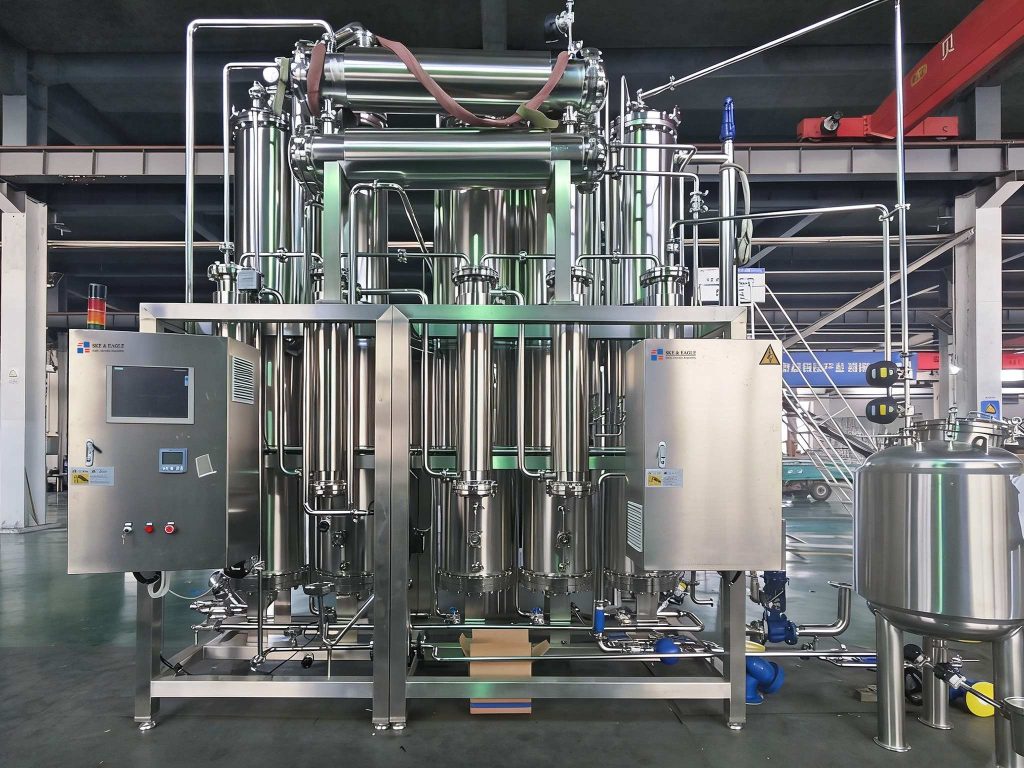
The complete system should be designed as one connected process rather than treating the distiller as an isolated piece of equipment.
How to Choose a Multi Effect Water Distiller
Selecting the right multi effect distillation system requires more than comparing equipment capacity. Pharmaceutical manufacturers should consider several factors.
Production Capacity
Determine the required WFI production rate. The system should provide enough capacity for normal production while allowing for peak demand and future expansion where necessary.
Feed Water Quality
Feed water quality affects pretreatment requirements and distiller performance. A supplier should review the source water and define suitable pretreatment before selecting the final configuration.
Energy Consumption
The number of effects and heat recovery design can affect energy efficiency. A system with more effects may reduce steam consumption, but it can also increase equipment cost and system complexity. The best configuration should balance capital cost, operating cost, and available utilities.
Automation and Documentation
For pharmaceutical applications, control and documentation are important. The system should support stable operation and provide suitable documentation for qualification and validation activities, depending on the project requirements.
Written by Mandy, Marketing Specialist at SKE Equipment / SKE&EAGLE with two years of experience covering the company’s pharmaceutical water and steam equipment. Technical details in this guide were reviewed by SKE&EAGLE’s engineering team before publication.
Reliable Multi Effect Distillation Systems from SKE&EAGLE
Specialized pharmaceutical water equipment providers such as SKE&EAGLE offer multi effect distillation systems designed around the specific requirements of manufacturers, including production capacity, feed water quality, utility conditions, automation, and system integration.
These systems can be integrated with pharmaceutical water pretreatment, storage, and distribution systems to create a complete water production solution. Project documentation and qualification support (including DQ, IQ, OQ, and PQ) are typically available according to project needs.
By combining thermal water purification technology with pharmaceutical system design experience, SKE&EAGLE helps manufacturers build reliable and efficient water systems for demanding production environments.
Frequently Asked Questions
1.What is the difference between single-effect and multiple distillation?
Single-effect distillation uses one main evaporation stage. Multiple distillation (multi effect distillation) uses several effects and reuses vapor heat between the stages. This heat-reuse design can reduce steam consumption and improve energy efficiency.
2.Why is the multi effect distillation process used for WFI?
The multi effect distillation process can produce high-purity water through repeated evaporation and condensation. It also has a long history of use in pharmaceutical water production and provides useful thermal control for microbial and endotoxin risks.
3.Can multiple distillation remove all contaminants?
No purification technology should be described as removing every possible contaminant under all conditions. Distillation is highly effective against many non-volatile impurities, microorganisms, and endotoxins. However, volatile substances may require additional control through pretreatment and proper system design.
4.What feed water is required for a multi effect water distiller?
The feed water normally needs suitable pretreatment. RO is commonly used to reduce dissolved salts and other impurities before distillation. The exact requirements depend on the source water and the design of the pharmaceutical water system.
Conclusion
Multiple distillation remains an important technology for pharmaceutical water production.
By using the multi effect distillation process — repeated evaporation, condensation, and heat recovery — a multi effect water distiller can produce high-purity water while reducing steam demand compared with single-effect distillation.
For pharmaceutical manufacturers, the right solution is not simply the distiller itself. Feed water pretreatment, energy efficiency, automation, storage, distribution, qualification, and long-term operation all need to be considered.
Contact SKE & Eagle for Advanced Solutions
For customized system engineering solutions or integration of high-performance water treatment technologies, please contact SKE & Eagle. Our professional team collaborates closely with industrial partners to design, implement, and maintain solutions tailored to your operational needs.
Official Website: https://www.ske-eagle.com/
Contact Email: info@ske-eagle.com
Follow us on Facebook for the latest industry insights: SKE & Eagle Facebook
Business Inquiries: Visit our official website and submit the contact form at the bottom.