

Industrial water purification in a pharmaceutical plant is not a single machine, it is a chain: pretreatment, membrane purification, ionic polishing, storage, and distribution, all working together to hold water at a defined purity level around the clock. Get any link in that chain wrong and the water quality problem shows up downstream, in a failed batch, a contaminated cleaning step, or a regulatory finding.
Untreated water can carry salts, organic matter, microbes, and chlorine. In daily use that is a minor nuisance. In drug manufacturing, those same impurities can alter a formulation’s chemistry or introduce contamination that regulators will flag immediately. This guide walks through how the technologies fit together, what “clean enough” actually means for pharmaceutical water grades, and what to check before you commit to a system design.
Key Takeaways
- Industrial water purification for pharma is a full-loop system (feed water, pretreatment, RO, polishing, storage, distribution), not a single piece of equipment.
- The global pharmaceutical water market is projected to grow from roughly $41.7 billion in 2025 to $46.2 billion in 2026, a 10.7% CAGR, which is pushing more plants to formalize water system design rather than treat it as a utility afterthought (Research and Markets, 2026).
- USP <1231> is being revised to favor online TOC and conductivity monitoring over offline testing, with a working TOC target near 500 ppb C (ECA Academy, 2025).
- Hygienic design details, dead-leg ratio and internal surface finish especially, matter as much as the purification technology itself; get them wrong and stagnant water becomes a biofilm risk no membrane can fix later.
Design the Whole System, Not Just the Machines
It’s tempting to focus purchasing decisions on the purification machines themselves, the reverse osmosis (RO) skid, the distillation column. Those units matter, but they’re only one part of the picture. Water quality can still degrade in a poorly designed storage tank or a badly routed distribution pipe, even when the purification stage performs exactly as specified.
A complete pharmaceutical water purification system works as a continuous loop:
Feed Water → Pretreatment → Main Purification → Polishing → Storage → Distribution → Point of Use
Every stage depends on the one before it. A problem introduced early, say, chlorine breakthrough in pretreatment, can surface much later as membrane fouling or an out-of-spec conductivity reading. That’s why a sound industrial water purification project is scoped as one integrated system rather than a shopping list of individual water purifying equipment.

Why Water Quality Must Be Controlled So Strictly
Water quality affects medicine quality directly. When water is part of a drug formula, the chemistry of that water becomes the chemistry of the drug. When water is used to clean equipment, any residue it leaves behind can carry into the next batch. Industrial water purification exists specifically to prevent both failure modes.
Raw water can carry several categories of impurity:
- Dissolved ions: calcium, magnesium, and sodium, among others.
- Organic compounds: natural or synthetic material dissolved or suspended in the source water.
- Microorganisms: bacteria and fungi that can multiply in stagnant conditions.
- Residual chemicals: chlorine and other disinfectants added upstream by a municipal supply.
Demand for tighter control of these variables is a big part of why the sector is expanding: the global pharmaceutical water market is projected to grow from about $41.7 billion in 2025 to $46.2 billion in 2026, and toward $68.7 billion by 2030 (Research and Markets / GII Research, 2026). [UNIQUE INSIGHT] That growth rate is faster than general industrial water treatment spending, which suggests regulatory pressure and expanding biologics production, not just plant expansion, is driving the investment.
Pharmaceutical Water Grades: PW and WFI
The pharmaceutical industry works with more than one water grade, and the required purity depends entirely on how the water will be used. A workable industrial water purification plan starts from that end use, not from a catalog of available equipment.
Purified Water (PW)
Purified Water is the most widely used grade. It’s specified for non-sterile products, general cleaning, and solutions that won’t be injected directly into the body. PW carries defined limits on conductivity and total organic carbon (TOC), plus microbial purity requirements.
Water for Injection (WFI)
WFI is the higher grade, required for products administered by injection. Its chemical purity limits match PW, but its microbial and endotoxin limits are much stricter. Endotoxins are fragments of dead bacterial cell walls that can trigger a fever response even after the bacteria themselves are gone. WFI was historically produced by distillation only; some regulatory regions now permit a validated membrane-based system to produce WFI as well, which is one sign of how the underlying standards keep evolving.
USP <1231>, the chapter governing water for pharmaceutical purposes, is itself mid-revision: the current draft favors online TOC monitoring (per USP <643>) and online conductivity monitoring (per USP <645>) over periodic offline sampling, with a working TOC target near 500 ppb C, though the exact figure depends on your reference standard and instrument background carbon (USP <1231>; ECA Academy summary, 2025).
How Purification Technologies Work
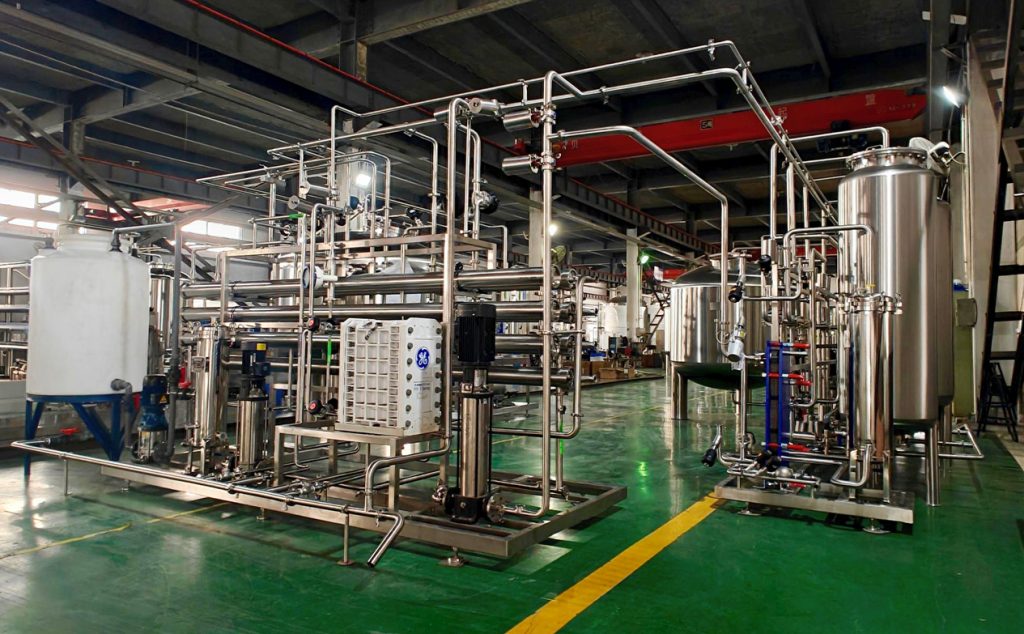
Every technology in a pharmaceutical water purification system does one job well and leaves the rest to the next stage. No single unit removes every contaminant class, so the real engineering skill is sequencing the right mix for your feed water and target grade.
1. Pretreatment: Protecting the Main System
Pretreatment prepares raw water for the purification stages that follow. Skip it or undersize it, and the more expensive downstream equipment fails faster, this stage gets overlooked more often than it should.
- Multimedia filtration: removes large particles and suspended solids.
- Activated carbon filtration: removes chlorine and some organics; chlorine in particular will degrade RO membranes over time.
- Water softening: removes calcium and magnesium before they can scale a membrane surface.
- Cartridge filtration: a final fine filter immediately ahead of the RO unit.
2. Reverse Osmosis (RO): The Main Purification Step
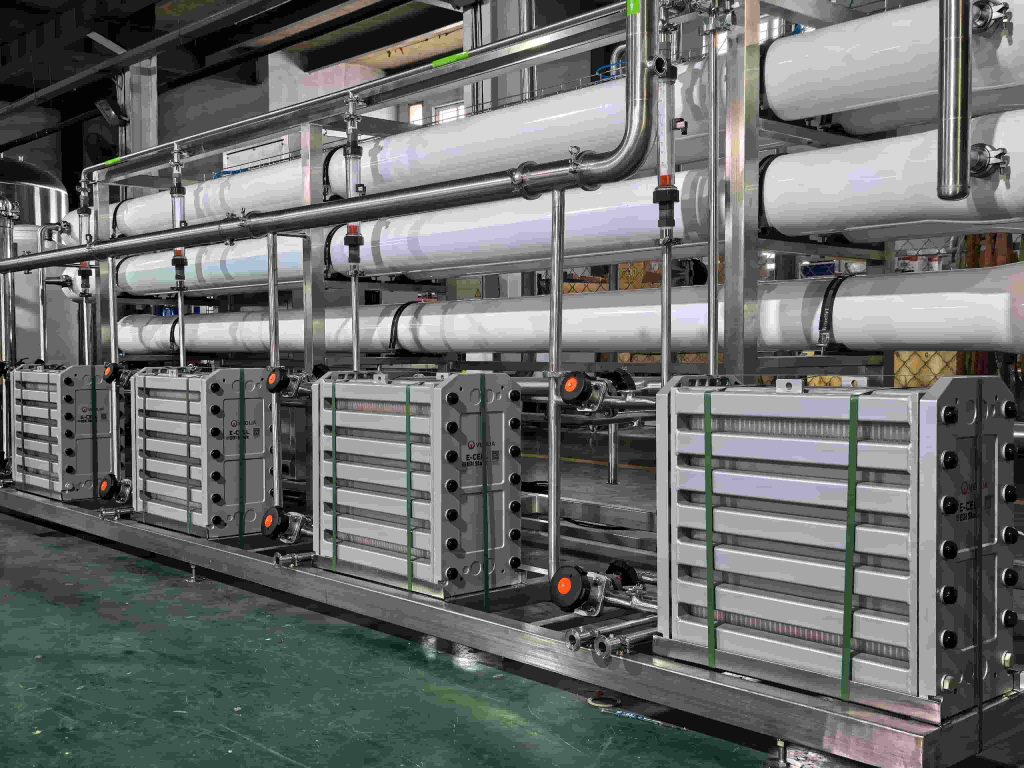
RO is typically the core of the process. It forces water through a semi-permeable membrane under pressure, and the membrane blocks the large majority of dissolved salts, bacteria, and organic matter, RO systems are commonly specified to reject on the order of 95-99% of total dissolved solids, though the exact rejection rate depends on membrane type, feed water chemistry, and operating pressure. Engineers track that rejection rate over time as a proxy for membrane fouling or damage, and use it to schedule cleaning or replacement.
3. CEDI/EDI: The Final Ionic Polish
Water leaving RO is already clean, but a small amount of dissolved ions remains. Continuous Electrodeionization (CEDI) uses an electrical field and ion-exchange resin to strip out that last trace. Unlike older ion-exchange systems, CEDI regenerates itself continuously and doesn’t need hazardous regeneration chemicals, which is part of why it has become standard in high-purity applications. It does need consistent RO water quality as feed; if the incoming water is too hard or carries too much dissolved CO2, the CEDI unit underperforms.
4. Extra Barriers: UV and UF
- Ultraviolet (UV) treatment: damages microbial DNA rather than physically removing organisms, stopping them from reproducing. It’s a chemical-free control point in the distribution loop.
- Ultrafiltration (UF): a membrane with pores small enough to physically remove bacteria, viruses, and endotoxins. It acts as a final safety barrier before point of use, useful for higher-risk applications where any microbial breakthrough is unacceptable.
Technology Summary
| Technology | Main Job | Key Design Consideration |
|---|---|---|
| Pretreatment | Protects downstream equipment | Must be sized to your actual feed water quality |
| RO | Removes most dissolved contaminants | Needs effective pretreatment to avoid scaling and fouling |
| CEDI/EDI | Final ionic polishing | Needs stable RO water quality as feed |
| UV | Microbial control | Requires scheduled lamp replacement to stay effective |
| UF | Removes bacteria and endotoxins | Must be sized correctly for peak flow rate |
Why Hygienic Design Is So Important
A water purification system can produce perfectly clean water and still let it get contaminated inside the tank or the pipework afterward. “Hygienic design” is the set of engineering practices that prevents that second failure. Ignore it, and every dollar spent on the purification stage is at risk.
Materials and Construction
- 316L stainless steel: the standard material for pharmaceutical water contact surfaces because it resists corrosion and cleans easily.
- Minimizing dead legs: a “dead leg” is a section of pipe where water sits without flowing, and stagnant water is exactly where bacteria establish themselves. ASME BPE guidance is commonly cited around a 2:1 length-to-diameter (L/D) target for these branch legs, tighter than the 3:1 figure that circulates informally in some older references, so it’s worth confirming which edition and project spec your engineering team is actually designing to (ASME; Lesico, high-purity piping guidance).
- Surface finish: rougher internal surfaces give bacteria more places to establish a biofilm. ASME BPE’s SF designations set maximum roughness (Ra) for mechanically polished finishes: SF1 at 20 µin (0.51 µm), SF2 at 25 µin (0.64 µm), and SF3 at 30 µin (0.76 µm); electropolished finishes (SF4-SF6) go further still (Astro Pak, ASME BPE surface finish designations).
- Sanitary welding: orbital welding produces a consistent, smooth internal joint, reducing the crevices where contamination can start.
Storage and Distribution
The storage tank needs its own protection: a vent filter to keep airborne contaminants out, and a spray device that keeps the interior walls wetted and clean between fills.
The distribution loop has to keep water moving. Once flow stops, bacteria get the opportunity to establish a biofilm. Engineers generally design the loop for turbulent flow specifically to prevent that buildup on pipe walls. Temperature is part of the same control strategy: some loops run hot, commonly cited around 80°C, to kill bacteria continuously, while others run cold to slow bacterial growth instead. [UNIQUE INSIGHT] Both approaches work, but they trade off differently against the CEDI and RO equipment upstream, which is why the distribution strategy should be picked before, not after, the purification technology is finalized.
How to Choose the Right Industrial Water Purification System
This is a decision that will shape your facility’s operations for years, so it’s worth treating as a system design exercise rather than an equipment purchase.
1. Analyze your feed water. Start with a full chemical and microbial analysis of your raw water. That data determines which pretreatment and purification technologies your specific industrial water purification project actually needs.
2. Define your water demand. Calculate both average and peak usage. These numbers size the RO unit and the storage tank, and the system has to cover peak demand during your highest-output production runs.
3. Determine the required water grade. PW or WFI changes the entire system design. WFI needs either distillation or a validated membrane-based system with the appropriate additional barriers; this decision sits at the center of your industrial water purification strategy.
4. Plan for lifecycle costs. Purchase price is the beginning, not the total. Factor in electricity, water consumption, spare parts (RO membranes, UV lamps), and cleaning chemicals. Engineering references commonly cite a typical RO membrane service life of two to five years given proper pretreatment, and a system with better energy recovery can cost less to run even at a higher purchase price.
5. Prepare your site. Confirm space and utilities, power, steam, cooling water, and drainage, before equipment arrives. Delivery delays caused by an unready site are avoidable and expensive.

Frequently Asked Questions
Q1: What is the difference between PW and WFI?
A: PW is specified for non-sterile products like tablets. WFI is required for injectable drugs. Both share similar chemical purity targets, but WFI carries much stricter endotoxin and bacterial limits.
Q2: How often should we sanitize our system?
A: There’s no single fixed interval. Many manufacturers sanitize weekly or monthly, but your own validation data should set the actual frequency for your system.
Q3: How long do RO membranes last?
A: Typically two to five years, depending on feed water quality and how well the pretreatment stage is performing. Strong pretreatment extends membrane life meaningfully.
Q4: Can one system produce both PW and WFI?
A: It’s possible but uncommon in practice. WFI needs additional steps such as UF, and most manufacturers prefer dedicated systems for WFI to keep risk contained.
Q5: Why use 316L stainless steel?
A: It resists corrosion, doesn’t leach metals into the water, and takes a smooth, cleanable surface finish, all of which matter for a pharmaceutical-grade water contact surface.
Q6: Is the pharmaceutical water market actually growing, or is this a mature, stable industry?
A: It’s growing at a meaningful clip: market researchers put the global pharmaceutical water market at roughly $41.7 billion in 2025, rising to about $46.2 billion in 2026 and a projected $68.7 billion by 2030 (Research and Markets / GII Research, 2026), so system design and standards in this space are still actively evolving rather than settled.
Conclusion
Industrial water purification is the foundation pharmaceutical quality is built on. It combines chemical engineering, mechanical design, and microbial control into one working system, and a system that’s designed well does more than filter water: it protects the patient at the end of the supply chain.
Get the technology sequencing right, follow current hygienic design standards for materials and surface finish, and plan for the system’s full lifecycle rather than just its purchase price, and the result is a facility that runs safely and predictably for years.
For customized system engineering or integration of high-performance water treatment technologies, contact SKE & Eagle. Our team works directly with industrial partners to design, implement, and maintain solutions built around each site’s actual operating requirements.
Official Website: https://www.ske-eagle.com/
Contact Email: info@ske-eagle.com
Follow us on Facebook for the latest industry insights: our Facebook page
Business Inquiries: Visit our official website and submit the contact form at the bottom.