

Water for Injection (WFI) is a key utility in pharmaceutical manufacturing. Its quality affects product safety and compliance. But producing high-quality water is only one part of the challenge. The water must also stay under control during storage and distribution.
A WFI preparation system may use a multi-effect distiller or another permitted technology. The choice depends on the applicable pharmacopoeia. Yet even a well-designed generation unit cannot guarantee consistent water quality alone. The tank, piping, valves, and points of use also matter.
This is why engineers need to look beyond the generation equipment. Dead legs, poor drainage, and weak sanitization can all let microorganisms grow. This guide explains the main risks in a WFI preparation system and gives practical advice for manufacturers selecting or upgrading water equipment.
1. Dead Legs: A Common Risk in WFI Distribution Loops
A dead leg is a section of pipe where water does not flow, or flows very little. These branches often appear around sampling points, unused connections, and valves. When water sits still, microorganisms can grow on the inner surfaces. They can form biofilms that release contamination into the moving water.
The problem may not appear immediately. That is why you need both routine monitoring and good piping design. A common guideline is the 3D principle, which limits branch length compared with pipe diameter. However, the exact limit depends on your design standard. The 3D value is not a universal regulatory rule.
For a new WFI preparation system, review the piping layout before fabrication. Avoid unnecessary branches and remove unused connections. During installation qualification (IQ), check the installed piping against approved drawings. During operational qualification (OQ), confirm that circulation and sanitization work as intended.
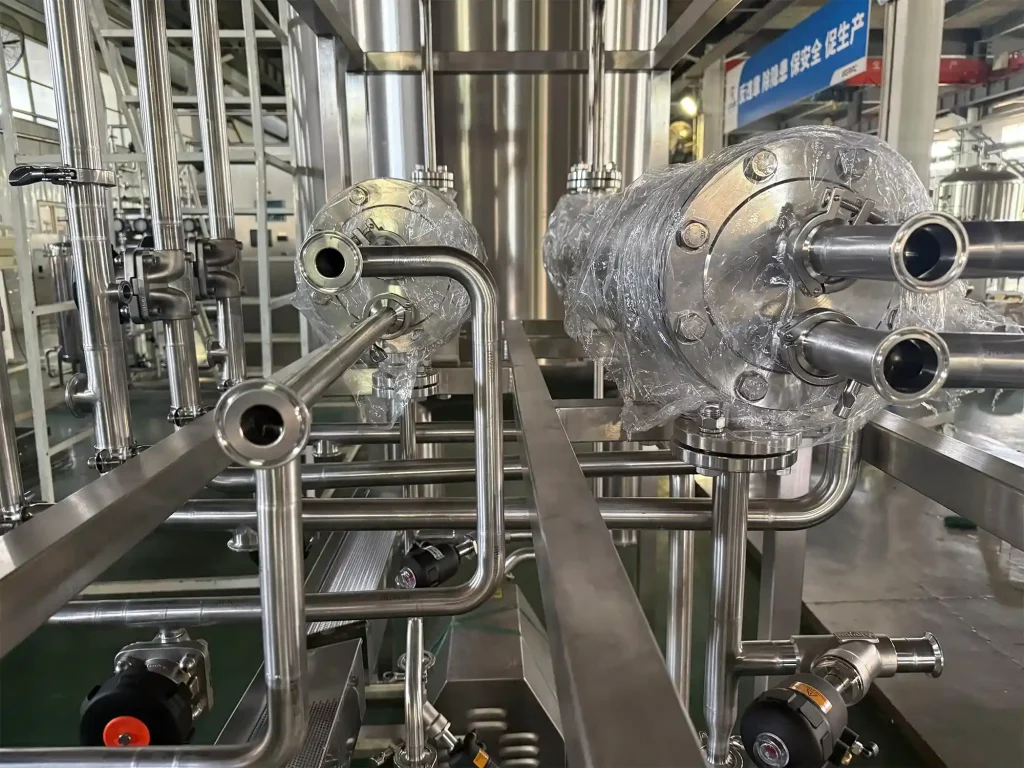
2. Pipe Slope and Drainability: Keeping WFI Water Moving
Drainability is another important design point in any WFI preparation system. If water collects in low points after drainage, these areas become hard to sanitize. They can also raise the risk of microbial growth.
Horizontal piping is often installed with a defined slope to support drainage. A slope of 0.5% is a common engineering design target. But the right value should come from your design specification. It is not a universal pharmacopoeial limit.
Problems often appear between design and installation. Pipes may need to pass around beams or other utilities. If supports are installed without checking the slope, some sections may become nearly level. These defects are hard to find by eye and may only show up during drainage tests.
To reduce these risks, teams should define drainage needs during engineering. Check pipe elevations during installation and add drains at low points. Finally, verify drainability during commissioning. This matters even more for ambient-temperature WFI loops, which depend on a validated microbial control strategy.
3. The Distiller Is Important, but the Whole System Matters
A multi-effect distiller separates water from many impurities through evaporation and condensation. Under suitable conditions, distillation is an effective barrier against microorganisms and endotoxins. However, no generation technology can replace complete system control.
Water quality depends on feedwater conditions, equipment integrity, and monitoring. Pretreatment protects downstream equipment and keeps conditions stable. For example, an exhausted carbon bed may let chlorine pass through. Feedwater monitoring and proper maintenance are therefore essential.
Leaks in heat exchangers and condensers may also compromise water quality. A loss of separation between cooling water and product water creates a contamination risk. Inspection and integrity testing should follow equipment design and risk.
After generation, water enters a storage and distribution system. This system must protect its quality until the point of use. This is where equipment choice and loop design must be considered together. SKE&EAGLE works with customers at this stage to fit the distiller, tank, and loop into one control strategy.

4. Key WFI System Risks and Practical Solutions
The table below summarizes common engineering concerns in a WFI preparation system and suitable control measures.
| Potential risk | Possible impact | Practical control | Where to check |
|---|---|---|---|
| Dead legs and stagnant branches | Biofilm formation and contamination | Minimize branches and verify hygienic design | Design review, IQ |
| Poor drainage or low points | Water retention and weak sanitization | Define slope and verify drainability | IQ, commissioning |
| Condenser or heat-exchanger failure | Possible contamination of product water | Set risk-based integrity testing | Routine maintenance |
| Pretreatment performance decline | Changes in feedwater quality | Monitor trends and maintain components | Routine monitoring |
| Incomplete sanitization coverage | Weak microbial control at some points | Map the path and verify worst cases | OQ, periodic review |
| Inadequate point-of-use monitoring | Late detection of quality changes | Set a justified sampling plan | Routine monitoring |
These risks should be assessed as part of the overall water system design. One corrective measure cannot replace a coordinated approach. SKE&EAGLE reviews these risk points with customers during WFI preparation system design and qualification planning.
5. What to Consider When Selecting or Upgrading a WFI Preparation System
When selecting a WFI preparation system, manufacturers should evaluate more than the rated output. The design should support the required water quality throughout the system’s working life.
First, define the water-quality requirements. Confirm the applicable pharmacopoeia, feedwater specifications, and intended points of use. Set the permitted generation method before you choose equipment.
Second, review the complete system layout. Consider the generation unit, storage tank, distribution loop, and sampling points. Piping design should support good circulation, effective drainage, and access for maintenance.
Third, set a suitable sanitization strategy. Hot-water circulation, periodic thermal sanitization, and ozone may fit different designs. The choice should reflect the materials and regulatory expectations. Sanitization effectiveness must be shown, not assumed.
Finally, plan qualification and monitoring from the beginning. Checks should confirm that the system matches its approved design. Ongoing monitoring should provide evidence that water quality stays under control.

Frequently Asked Questions
1. What is the difference between WFI and Purified Water?
They are different pharmaceutical water grades. WFI has specific bacterial endotoxin requirements in addition to chemical and microbiological controls. The required grade depends on the process and intended use.
2. Can a multi-effect distiller be used with an ambient-temperature WFI loop?
Yes, if your regulations allow it and a WFI preparation system has a validated microbial-control strategy. Cooling, storage, circulation, and sanitization must be considered together.
3. How often should a WFI distribution loop be sanitized?
There is no single frequency that fits every system. The schedule should come from system design, risk assessment, and routine monitoring. Microbial trends should guide the strategy.
4. Why is sampling at the point of use important?
Water quality at the generation outlet does not always match quality at every point of use. Piping and valves may add contamination risks. Point-of-use sampling helps assess the system where water is actually used.
5. Does SKE&EAGLE support complete pharmaceutical water system projects?
Yes. As a pharmaceutical water equipment manufacturer, SKE&EAGLE supports customers in evaluating WFI preparation system equipment and design. Scope may include feedwater conditions, generation capacity, storage, and distribution.
Conclusion
Reliable WFI water quality depends on more than the performance of a distiller. Dead legs, poor drainability, equipment integrity, and point-of-use monitoring all influence the complete WFI preparation system.
For manufacturers, the best approach is to treat generation, storage, and distribution as interconnected parts of one control strategy. A well-designed WFI preparation system, supported by proper qualification and monitoring, helps reduce contamination risks.
If you are selecting, upgrading or validating a WFI preparation system, welcome to connect with the technical team of SKE&EAGLE. We will develop integrated solution proposals covering distillation equipment through distribution loops, tailored to your feed water conditions, capacity requirements and point-of-use layout.
Contact Email: info@ske-eagle.com
Follow us on Facebook for the latest industry insights: SKE & Eagle Facebook
Business Inquiries: Visit our official website and submit the contact form at the bottom.