


Learn how a pharmaceutical grade water system makes PW, WFI, and high-purity water. It uses purification, storage, distribution, monitoring, and validation.
A pharmaceutical grade water system is designed to produce, store, distribute, and monitor water for pharmaceutical use. It is much more than a normal water purifier. A complete system usually includes pretreatment, reverse osmosis (RO), electrodeionization (EDI), ultrafiltration (UF), distillation, storage tanks, distribution loops, online instruments, and sanitation systems.
The right system depends on the water grade, the product type, the manufacturing process, the feed water quality, and pharmacopoeia rules. This guide explains how a water system in pharma is designed and what manufacturers should think about when they choose a pharma water system.
What Is a Pharmaceutical Grade Water System?
A pharmaceutical grade water system is an integrated treatment system. It produces water that always meets defined pharmaceutical quality standards.
The system starts with a suitable feed water source. Then the water goes through treatment steps. These steps reduce suspended solids, hardness, chlorine, dissolved salts, organic compounds, microorganisms, and other contaminants. Depending on the final grade, more polishing or distillation may be needed.
Producing high-purity water is only one part. Pharmaceutical water must also be protected after purification. Storage tanks, pipes, valves, pumps, instruments, and points of use all affect final quality. So a water system in pharma must control the whole chain from generation to final use.
A well-designed pharmaceutical grade water system usually does four main things:
-
Feed water pretreatment
-
Purification and polishing
-
Storage and distribution
-
Monitoring and sanitation
The system should also support qualification, validation, maintenance, change control, and long-term performance monitoring. Design decisions must be based on the intended use of the water. They should not be based only on choosing the highest purification technology.

Why Is a Water System in Pharma Different?
A normal industrial water treatment system mainly reduces contaminants. It protects equipment or makes water suitable for general use. A pharmaceutical grade water system has stricter goals. It must control both chemical and microbiological quality. Some applications also need tight control of bacterial endotoxins.
A general industrial RO unit may produce low-conductivity water. But that alone does not make it suitable for pharmaceutical manufacturing. The pharma water system must also deal with storage, distribution, sampling, sanitation, monitoring, and documentation.
Water quality can change after purification. Poorly designed tanks create contamination risks. Long piping runs increase the chance of microbial growth. Dead legs allow stagnant water to collect. For these reasons, a pharmaceutical grade water system must be treated as a complete process system. Equipment selection, hygienic design, operating conditions, monitoring, cleaning, sanitization, and validation must all work together.
Main Pharmaceutical Water Grades
Pharmaceutical manufacturers do not use one water grade for every process. The required grade depends on the product, the manufacturing step, the route of administration, and regulatory requirements. The system must be chosen to match the correct grade.
The most important grades are:
-
Purified Water (PW)
-
Water for Injection (WFI)
-
Highly Purified Water (HPW) (European Pharmacopoeia)
Purified Water (PW)
PW is widely used in non-sterile applications. These include oral products, process solutions, and cleaning where WFI is not required. It is made from suitable feed water using RO, ion exchange, EDI, UF, or combinations of these technologies. A PW system focuses on chemical and microbiological quality. Conductivity and TOC are often monitored online. Microbial quality is controlled through design, sanitation, sampling, and trend analysis.
Water for Injection (WFI)
WFI is required when strict control of microbial quality and bacterial endotoxins is essential. It is typically used for parenteral manufacturing and final rinsing of equipment used in injectable production. Endotoxins come from the outer membrane of Gram-negative bacteria. They can cause serious biological reactions if present at high enough levels. So a pharmaceutical grade water system for WFI must provide reliable endotoxin control.
Production methods depend on the regulatory framework. Distillation is a well-established technology. In some markets, properly designed and validated membrane-based systems are also accepted. Always check target-market requirements before choosing generation technology.
Highly Purified Water (HPW)
HPW is defined in the European Pharmacopoeia. It is used for applications that need high biological quality where WFI is not specifically required. Membrane-based technologies (RO, EDI, UF, UV) can be used when the complete process is properly designed, qualified, monitored, and validated.
PW vs WFI vs HPW
| Water Grade | Typical Use | Main Quality Focus | Common Technologies |
|---|---|---|---|
| PW | Non-sterile processes | Chemical and microbiological | RO, EDI, UF, ion exchange |
| WFI | Parenteral and high-risk uses | Chemical, microbial, and endotoxin | Distillation or qualified membrane systems |
| HPW | Selected high-purity uses | High chemical and biological quality | Qualified membrane processes |
This table is general guidance only. Final grade selection must follow the product, process, applicable pharmacopoeia, and regulatory requirements.
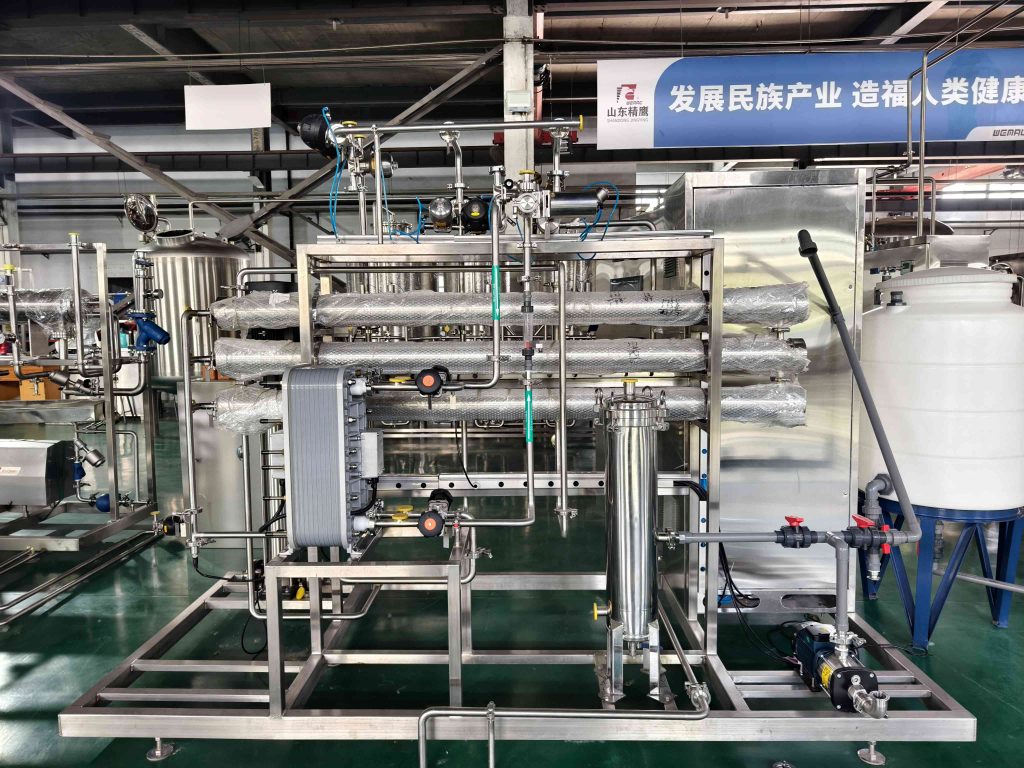
How Does a Pharmaceutical Grade Water System Work?
A complete system normally uses several treatment stages:
Raw Water → Pretreatment → RO → EDI / Polishing → Final Treatment → Storage → Distribution → Point of Use
1. Feed Water Pretreatment
Pretreatment protects downstream membranes and improves stability. Common equipment includes multimedia filters, activated carbon filters, water softeners, cartridge filters, and chemical dosing systems. Selection must be based on actual feed water analysis. RO and other high-purity technologies do not work well with uncontrolled feed water.
2. Reverse Osmosis
RO is one of the most widely used technologies in a modern pharmaceutical grade water system. Pressure pushes water through a semipermeable membrane. The membrane rejects dissolved salts, organics, microorganisms, and other contaminants. Performance depends on feed water quality, pressure, temperature, recovery rate, membrane condition, and pretreatment. RO alone is never a complete pharmaceutical solution. Polishing, microbial control, storage, distribution, monitoring, and sanitation are still essential.
3. Electrodeionization and Polishing
After RO, EDI reduces remaining ionic contaminants continuously without chemical regeneration. Other polishing steps may include UF, UV, additional RO, or final filtration. The exact combination depends on feed water quality and the required final grade.
4. Distillation
Distillation is still important for WFI. In multi-effect systems, water is vaporized and condensed. Successive effects reuse heat for efficiency. The unit must control temperature, pressure, flow, and separation performance. It is always integrated with pretreatment, storage, and distribution.
Pharmaceutical Water Storage Tanks
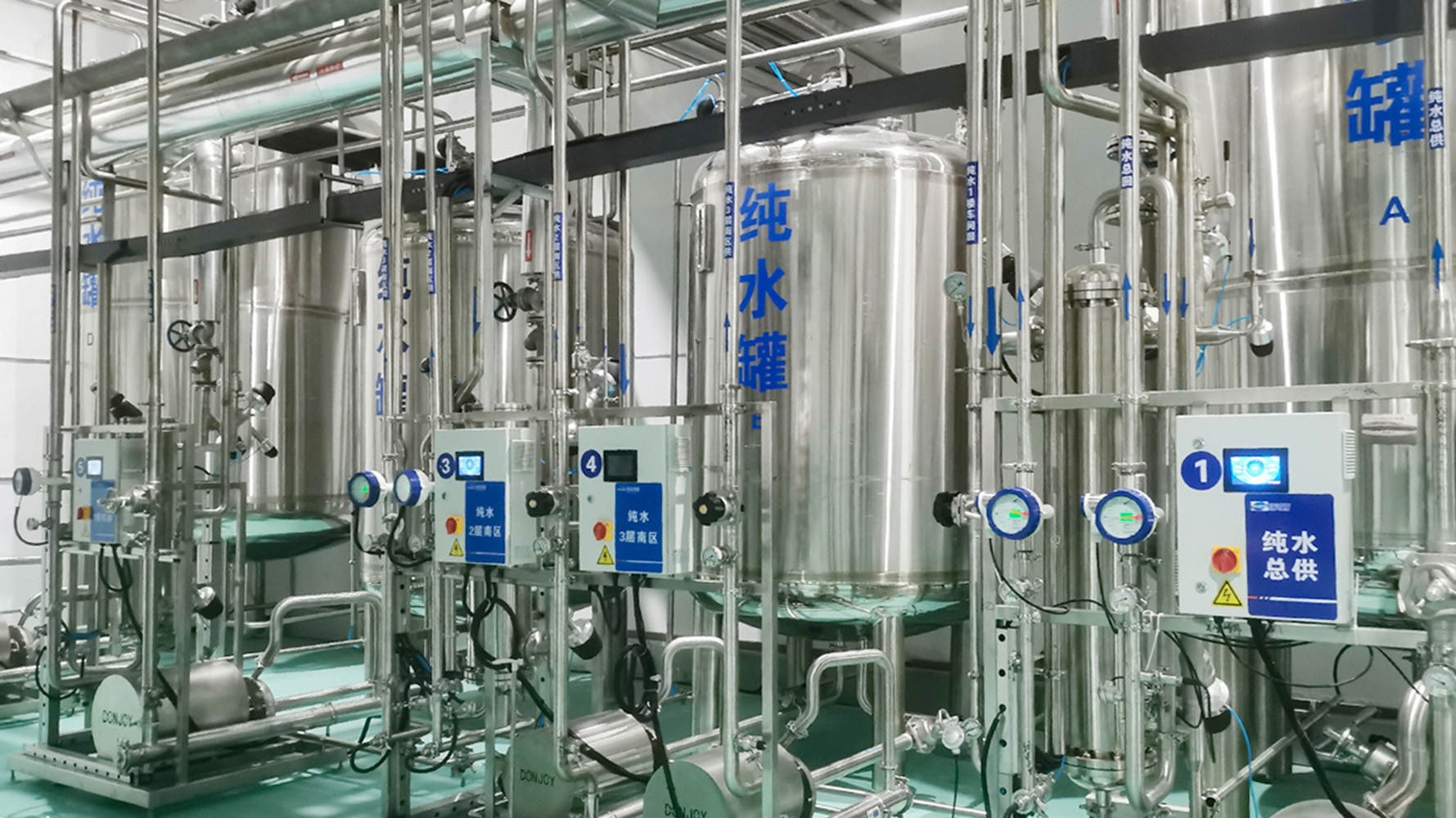
Water quality can be lost after purification if storage is poorly designed. Tanks are usually sanitary 316L stainless steel. They have hygienic internal surfaces, proper drainage, sanitary spray devices, vent filtration, low dead volume, level and temperature measurement, and cleaning/sanitization capability. For hot systems, temperature control is a key part of the microbial control strategy.
Pharmaceutical Water Distribution Systems
The distribution loop moves purified water from the storage tank to points of use. It uses sanitary pumps, 316L stainless-steel piping, hygienic valves, sampling points, and instruments for pressure, temperature, and flow. Loop design must maintain continuous circulation and minimize dead legs. Some systems use hot-water circulation. Others use chemical or ozone sanitization. The chosen approach must be proven through qualification and validation.
Monitoring a Pharma Water System
Key parameters include:
-
Conductivity (online ionic contamination)
-
Total Organic Carbon (TOC)
-
Microbial quality
-
Bacterial endotoxins (especially for WFI)
-
Temperature, pressure, and flow
Trend analysis is as important as individual results. Gradual rises in conductivity, TOC, microbial counts, or endotoxin levels often signal developing problems before a major failure occurs.
Validation of a Pharmaceutical Grade Water System
Validation shows that the system consistently produces water meeting specifications under defined conditions. Qualification usually includes Design Qualification (DQ), Installation Qualification (IQ), Operational Qualification (OQ), and Performance Qualification (PQ). The entire system must be covered: pretreatment, purification, storage, distribution, instruments, sampling points, sanitization procedures, and control systems. Ongoing monitoring, maintenance, change control, and periodic review remain essential after initial qualification.
Sanitation and Microbial Control
Microbial control is one of the greatest challenges in a water system in pharma. Even after purification, microorganisms can enter or grow in tanks and loops. Common methods include hot-water sanitization, chemical sanitization, ozone, UV treatment, and regular flushing. Some hot WFI systems circulate water at about 70 °C or higher. The selected method must be proven effective under actual operating conditions.
How to Select a Pharmaceutical Grade Water System
Selection should start with the pharmaceutical process, not with a specific machine. Define:
-
Required water grade
-
Product and process requirements
-
Applicable pharmacopoeia and local regulations
-
Feed water quality
-
Average and peak demand
-
Storage volume and distribution-loop needs
-
Sanitization and monitoring requirements
-
Validation and documentation needs
Capacity must match production demand without being too large. Future expansion should also be considered. Modular designs make later growth easier when space, capacity, and control flexibility are planned from the start.
Why Choose SKE&EAGLE for Pharmaceutical Water Systems?
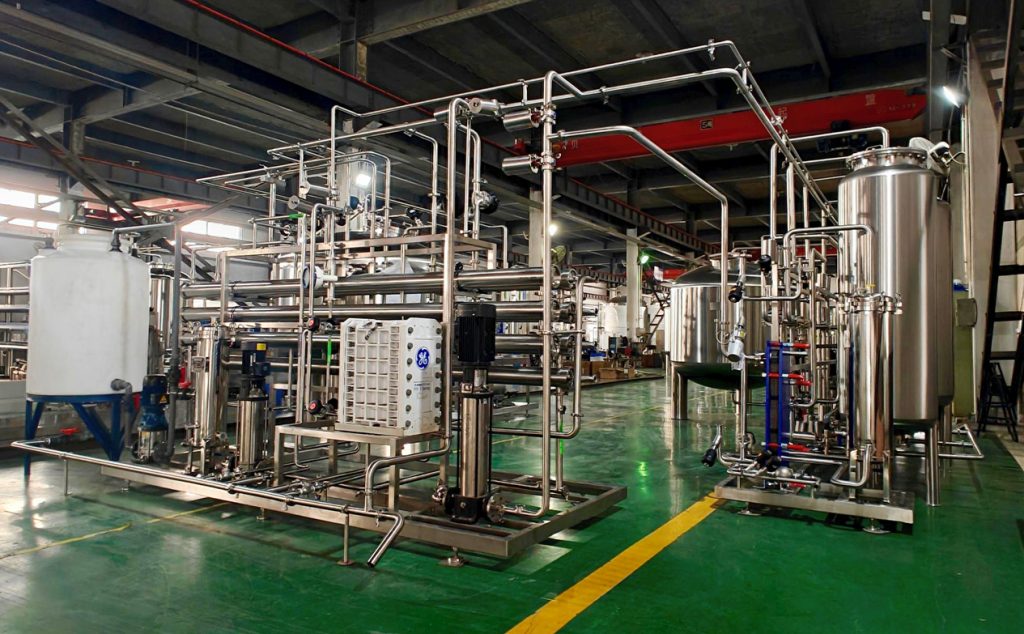
SKE&EAGLE supplies complete pharmaceutical water purification and treatment solutions. A pharmaceutical grade water system from SKE&EAGLE can combine pretreatment, RO, EDI, UF, distillation, stainless-steel storage tanks, sanitary distribution loops, online conductivity and TOC monitoring, CIP/sanitization, and automated PLC control.
Each system is engineered to the required water grade, feed water conditions, capacity, site constraints, and regulatory requirements. Documentation support for DQ/IQ/OQ is available.
The goal is not simply to produce pure water. The goal is to maintain consistent quality from generation through storage, distribution, and final use.
Frequently Asked Questions
Q1: What is a pharmaceutical grade water system?
An integrated system that produces, stores, distributes, and monitors water for pharmaceutical manufacturing. It includes pretreatment, RO, EDI, UF, distillation, tanks, loops, instruments, and sanitation.
Q2: What is a water system in pharma used for?
It supplies water for manufacturing, cleaning, formulation, laboratory work, and other pharmaceutical processes. The grade depends on the product and step.
Q3: How does a pharma water system differ from a normal water treatment system?
It must control microbiological quality and, in some cases, bacterial endotoxins. It also includes storage, distribution, sanitation, monitoring, and validation.
Q4: Can RO produce pharmaceutical-grade water?
Yes, but the complete system must be designed for the required grade. Additional polishing or distillation may be needed.
Q5: Can RO be used for WFI?
It depends on the regulatory framework. Some markets accept validated membrane-based systems. Distillation remains established. Check local requirements before specifying the system.
Q6: Why is 316L stainless steel used?
It provides a hygienic, cleanable product-contact surface suitable for pharmaceutical applications.
Conclusion
A pharmaceutical grade water system is a complete process system, not just a filtration machine. Reliable production of pharmaceutical water requires controlled pretreatment, purification, polishing or distillation, sanitary storage, hygienic distribution, monitoring, sanitation, and validation.
PW, WFI, and HPW serve different applications. The correct choice depends on the product, process, pharmacopoeia, and regulations. For any modern water system in pharma, design must focus on long-term performance. Feed water variation, microbial control, loop design, online monitoring, sanitation, maintenance, and validation all determine the final result.
A properly engineered pharmaceutical grade water system helps manufacturers maintain consistent water quality and supports reliable pharmaceutical production. SKE&EAGLE provides customized solutions built around water quality, capacity, process needs, monitoring, and validation requirements.
Contact SKE & Eagle for Advanced Solutions
For customized system engineering solutions or integration of high-performance water treatment technologies, please contact SKE & Eagle. Our professional team collaborates closely with industrial partners to design, implement, and maintain solutions tailored to your operational needs.
Official Website: https://www.ske-eagle.com/
Contact Email: info@ske-eagle.com
Follow us on Facebook for the latest industry insights: SKE & Eagle Facebook
Business Inquiries: Visit our official website and submit the contact form at the bottom.