

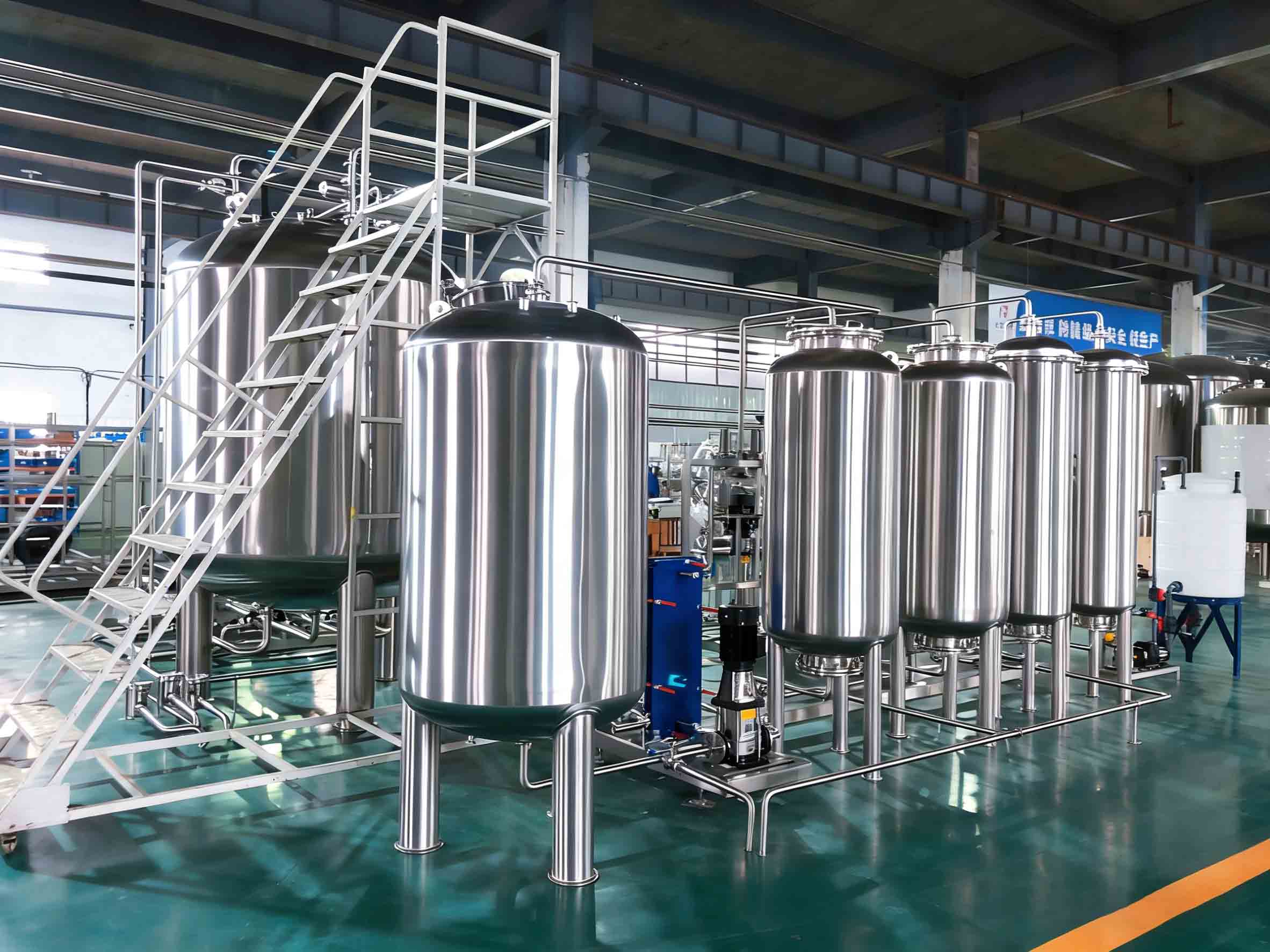
Water is essential in pharmaceutical manufacturing. Companies use it to make products, clean equipment, and rinse containers. Because water quality directly affects patient safety, manufacturers need water purification equipment they can trust and verify, not just install and forget.
After purification, water still has to be stored, moved through piping, and monitored around the clock. A single failed sensor, a worn pump seal, or a stuck valve can quietly change water quality without anyone noticing. That’s why modern plants build integrated systems: water purification equipment, storage tanks, distribution loops, and a water treatment control system that checks conditions in real time and helps operators catch problems before they reach a batch record.
Key Takeaways
- RO membranes typically remove 85-98% of dissolved salts and up to 95-99% of total dissolved solids, according to the FDA’s Reverse Osmosis inspection guide. Actual performance depends on membrane type, feed water, and operating pressure.
- USP <645> sets a three-stage online conductivity limit (Stage 2 threshold: 2.1 µS/cm at 25°C), and USP <643> caps total organic carbon at 500 ppb carbon. Both are the numbers a water treatment control system should alarm against, not a general “looks clean” judgment.
- Full lifecycle qualification, Design, Installation, Operational, and Performance Qualification (DQ/IQ/OQ/PQ), follows the ISPE Baseline Guide for water and steam systems rather than an internal ad hoc checklist.
- Hot-water sanitization loops commonly run 65-80°C. The 80°C figure is a historical benchmark chosen because it tolerates cold-spot temperature loss better, not a fixed regulatory requirement.
The equipment matters, but compliance is measured against specific numbers: conductivity, TOC, and microbial limits at defined checkpoints, not just whether the machine is switched on. The rest of this guide connects each piece of water purification equipment to the limit it’s actually responsible for controlling.
Why Pharmaceutical Water Must Meet Strict Purity Limits
Untreated water carries a mix of impurities:
- Suspended particles and dirt
- Calcium and magnesium (hardness)
- Dissolved salts
- Residual chlorine or chloramine
- Organic matter
- Microorganisms and their byproducts, including endotoxins
None of this is a problem in daily use. In drug manufacturing, it’s a compliance and patient-safety risk. Salts raise conductivity readings. Organic matter raises total organic carbon (TOC). Bacteria and their breakdown products can trigger a fever response if they reach an injectable product.
Pharmacopeial water grades are defined by enforceable limits, not a general “clean” standard:
- Conductivity is governed by USP General Chapter <645>, which runs a three-stage online test. Stage 1 uses a temperature-indexed table (roughly 0.6-3.1 µS/cm across 0-100°C); Stage 2 applies a fixed 2.1 µS/cm threshold at 25°C; Stage 3 is pH-dependent. A control system should flag an exceedance the moment inline conductivity crosses the applicable stage.
- Total organic carbon is governed by USP <643>, which sets a 500 ppb carbon (0.500 mg/L) response limit measured against a USP-traceable sucrose standard.
Water purification equipment that isn’t monitored against these two numbers isn’t reliably pharmaceutical grade, regardless of what the membrane spec sheet claims.
Beyond removing impurities, a good system also:
- Maintains water quality in storage tanks
- Keeps water clean while it circulates through piping
- Monitors conductivity and TOC continuously, not just at periodic grab-sample intervals
- Logs data for quality review and batch release
- Supports scheduled cleaning and sanitization

Main Types of Water Purification Equipment
A complete pharmaceutical water purification system usually includes several treatment stages. Each type of equipment has a specific job, and a water treatment control system monitors its performance continuously.
| Equipment | Main Function | How Control Systems Help |
|---|---|---|
| Multimedia Filter | Removes sand, rust, and large particles | Monitors pressure drop to know when to backwash |
| Water Softener | Reduces calcium and magnesium | Tracks water hardness and triggers regeneration |
| Activated Carbon Filter | Removes chlorine and some organics | Checks flow rate and alerts if flow is too low |
| Reverse Osmosis (RO) | Removes 85-98% of dissolved salts and up to 95-99% of total dissolved solids (FDA RO inspection guide) | Monitors conductivity against USP <645> and pressure differential to detect membrane fouling |
| EDI / CEDI | Removes remaining ions for high-purity water | Tracks voltage and flow to ensure stable operation |
| UV System | Controls bacteria and may reduce TOC | Monitors lamp status and intensity |
| Storage Tank | Holds purified water safely | Measures water level and controls inlet/outlet valves |
| Distribution Loop | Circulates water to usage points | Controls pumps and monitors flow, temperature, and pressure |
Not every system needs all these components. The exact design depends on the source water quality and the final water grade required.
Pretreatment: Protecting the Main Equipment
Pretreatment is the first barrier. It prepares raw water so the main water purification equipment can work effectively.
- Multimedia filters catch large particles and protect RO membranes from clogging.
- Water softeners remove hardness to prevent scale buildup on membranes.
- Activated carbon filters remove chlorine, which can damage RO membranes.
Without good pretreatment, RO systems fail faster and need more frequent cleaning, which raises costs and can interrupt production. A water treatment control system tracks pressure and flow at this stage. If the pressure drop across a filter climbs too far, the system flags that it’s time for cleaning or replacement.
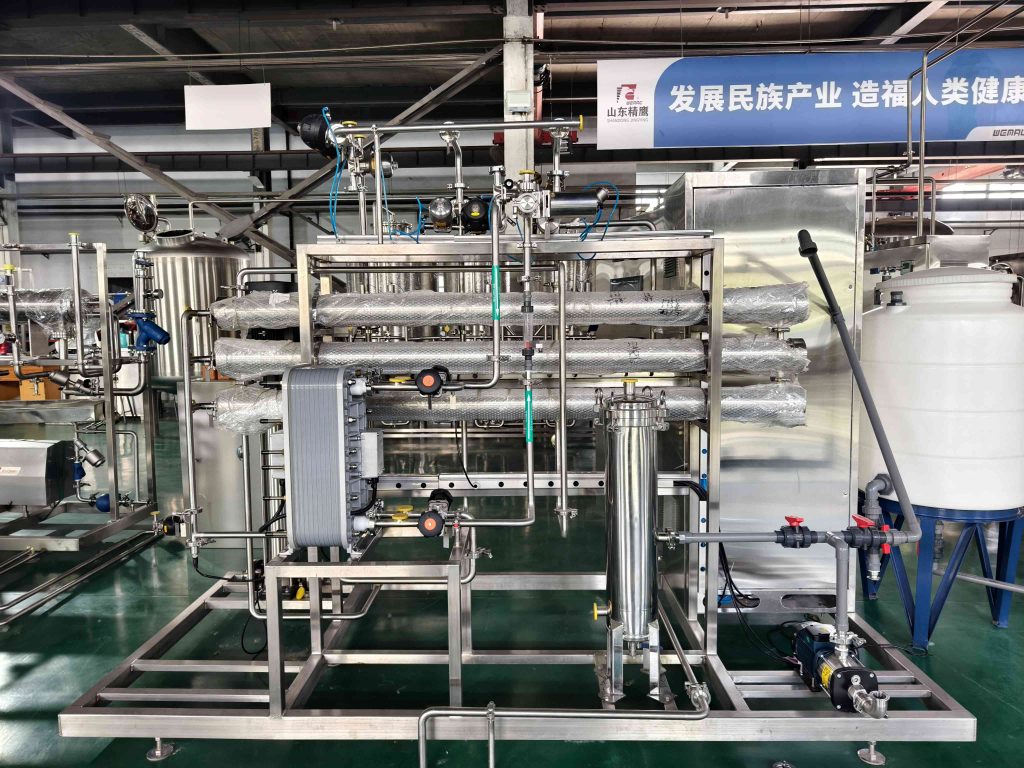
Reverse Osmosis (RO): The Core Purification Technology
Reverse osmosis is one of the most important parts of modern water purification equipment. It uses pressure to push water through a fine membrane that blocks most salts, organic compounds, and microorganisms.
According to the FDA’s Reverse Osmosis inspection guide, membrane rejection for common ionic salts typically runs 85-98%, and removal of total dissolved solids can reach 95-99%. The exact figure depends on membrane type, feed water chemistry, operating pressure, and temperature, so a single “up to 99%” number on a spec sheet doesn’t tell the whole story.
For pharmaceutical use, RO is usually combined with other purification equipment. The water treatment control system monitors:
- Conductivity after RO, checked against the USP <645> limits described above; a rising number often means the membrane is fouled or damaged
- Pressure differential across the membrane, where a high reading often means the membrane needs cleaning
- Water temperature and flow rate, which affect how much water the RO unit produces
If the control system detects a problem, it can raise an alarm or divert off-spec water so it never reaches the storage tank.
EDI and CEDI: Making Water Even Purer
For applications that need very pure water, such as injectable drugs, RO alone isn’t enough. Electrodeionization (EDI) or Continuous Electrodeionization (CEDI) is added after RO.
EDI uses electrical current and ion-exchange materials to remove the last traces of salts. Unlike older systems, it doesn’t need chemical regeneration, which cuts maintenance. The FDA’s guide to high-purity water systems recognizes RO-EDI trains, alongside distillation, as an accepted route to producing high-purity pharmaceutical water when the process is validated as equivalent.
Here too, water treatment control systems matter. They check:
- Electrical current and voltage
- Flow rate through the EDI unit
- Product water conductivity
If conductivity rises above the set limit, the control system can adjust the power or alert the operator, keeping the high-purity water consistent.
UV Treatment and Microbial Safety
UV light is another useful tool in water purification equipment. It inactivates microorganisms that pass through the system, and some UV wavelengths also help reduce TOC.
UV works best paired with good system design. The control system monitors the UV lamp for three things: whether it’s on, whether its intensity is strong enough, and whether it has reached the end of its service life. If the lamp fails, the control system sends an immediate alarm so the team can replace it before untreated water reaches the distribution loop.
How Intelligent Control Systems Make Everything Work Together
A modern water treatment control system is the coordination layer of the purification plant. It connects sensors, pumps, valves, and water purification equipment into one response chain:
Sensors → PLC → Equipment → HMI (screen) → Data Storage
- Sensors measure conductivity, TOC, pressure, flow, temperature, and tank level.
- The PLC (Programmable Logic Controller) receives this data and makes decisions based on programmed rules.
- Equipment such as pumps, valves, and heaters receives commands from the PLC.
- The HMI (Human-Machine Interface) is the screen where operators see system status.
- Data storage records everything for quality audits.
In practice: if the tank level runs low, the control system starts the RO pump. If pressure climbs too high, it opens a bypass valve. If conductivity goes abnormal, it closes a valve to keep bad water out of the tank.
This kind of automated response is becoming the industry default rather than a premium option. The global industrial water treatment market was valued at roughly $46.1 billion in 2024, and pharmaceutical-grade applications are among the fastest-growing segments as biologics and injectable production raise purity requirements, according to Grand View Research’s industrial water treatment market report. ISPE’s own Pharma 4.0™ digitalization track reflects the same shift toward networked sensors and data-driven process control across the industry.
Storage and Distribution: Keeping Water Pure After Treatment
Purification is wasted effort if the water becomes contaminated afterward. Key design points for storage and distribution include:
- Using sanitary materials such as 316L stainless steel
- Avoiding dead legs, sections of pipe where water sits still
- Designing pipe slope for drainage
- Using sanitary valves and fittings
- Installing vent filters on tanks

Most systems circulate water continuously in a loop from the tank to usage points and back, which prevents the stagnation that drives bacterial growth. According to the World Health Organization’s GMP guidance for pharmaceutical water systems (TRS 970, Annex 2), distribution loops are generally designed for turbulent flow, commonly in the range of 1-2 m/s, to discourage biofilm formation.
Many loops also rely on hot-water sanitization. Current USP guidance points to a working range of roughly 65-80°C. The 80°C figure is a long-standing industry benchmark chosen because it tolerates cold-spot temperature loss across a large loop better than lower temperatures, but it also accelerates wear on gaskets and passivation layers, which is why some newer designs sanitize at the lower end of that range instead.
The water treatment control system watches this loop for flow rate, temperature in hot-water systems, and pressure. If flow drops, the system alerts the operator to check for a stuck valve or a failing pump.
Qualification, Maintenance, and Calibration
Pharmaceutical water systems go through formal qualification before they’re allowed to run production water. The ISPE Baseline Guide for Water and Steam Systems defines the four stages most manufacturers follow:
| Qualification Stage | Description |
|---|---|
| Design Qualification (DQ) | Does the design meet user requirements? |
| Installation Qualification (IQ) | Is everything installed correctly? |
| Operational Qualification (OQ) | Do all components and control sequences work? |
| Performance Qualification (PQ) | Does the system consistently produce quality water over time? |
After qualification, maintenance has to continue on schedule: replacing filters and UV lamps, cleaning RO membranes, inspecting EDI units, and checking pumps and valves.
Sensor calibration matters just as much. If a conductivity sensor reads wrong, the control system makes decisions based on bad data. Calibration frequency depends on the device, the manufacturer’s recommendation, and site procedures, but regular checks aren’t optional, and every calibration and maintenance activity needs to be documented under the site’s quality system.
Conclusion
Reliable water purification equipment is the foundation of a pharmaceutical water system, but equipment alone doesn’t guarantee quality. Water has to be stored, distributed, and monitored correctly against defined limits, USP <645> for conductivity, USP <643> for TOC, and a validated microbial control strategy for the distribution loop.
An intelligent water treatment control system ties these pieces together: it monitors conductivity, TOC, pressure, and flow, controls pumps and valves automatically, and records the data regulators and quality teams need to see.
SKE&EAGLE designs pharmaceutical water purification equipment and control systems around each customer’s source water, production volume, and required water grade, rather than selling a fixed package. If you’re scoping a new system or auditing an existing one against USP and GMP limits, our engineering team can walk through the design with you.
Official Website: https://www.ske-eagle.com/
Contact Email: info@ske-eagle.com
Follow us on Facebook for the latest industry insights: SKE & Eagle Facebook
Business Inquiries: Visit our official website and submit the contact form at the bottom.
Frequently Asked Questions
1. What is the most important part of water purification equipment in a pharmaceutical plant?
Reverse osmosis is usually the core technology, removing 85-98% of dissolved salts per the FDA’s RO inspection guide. But the full system, including pretreatment, EDI, UV, storage, and distribution, has to work together, and a water treatment control system is what keeps every stage inside its USP limit.
2. Why do we need water treatment control systems?
They monitor water quality against USP <645> conductivity and USP <643> TOC limits in real time, control pumps and valves automatically, alarm when a limit is exceeded, and log the data auditors will ask for. Without automated monitoring, operators can’t react fast enough to keep an off-spec batch out of the tank.
3. How often should sensors be calibrated?
There’s no single fixed interval. Calibration frequency depends on the sensor type, the manufacturer’s recommendation, and site procedures, and it should be documented in the system’s validation package. Conductivity and TOC sensors typically need the most frequent checks because they’re tied directly to release limits.
4. Can one water purification system serve different water grades?
Yes, in some cases. Many systems produce Purified Water (PW) and feed a Water for Injection (WFI) system downstream. The exact design depends on source water and the final quality target; the FDA’s high-purity water systems guide accepts both distillation and validated RO-EDI trains as routes to WFI-grade water.
5. What happens if a UV lamp fails?
The control system detects the failure immediately and raises an alarm so operators can replace the lamp quickly. Continuous monitoring is what prevents untreated water from reaching the distribution loop in the meantime.
6. Why is 65-80°C used for hot-water sanitization instead of a single fixed temperature?
USP guidance describes a working range rather than one number. 80°C became the traditional benchmark because it tolerates temperature loss at cold spots in a large loop, but running at the lower end of the 65-80°C range reduces wear on gaskets and passivation layers, so the right point depends on loop design and validation data.
7. Is remote monitoring possible?
Yes. Modern water treatment control systems support remote access and trend analysis, so plant managers can check system status from other locations while keeping critical data secure and within the site’s compliance scope.