


Water is important in pharmaceutical manufacturing. It is not just a utility. Water is a raw material. It is used to make drugs, clean equipment, and run laboratory tests. If water is not pure enough, it can affect product quality. It can also harm patient safety.
This is why pharmaceutical companies need a reliable pharmaceutical water purification system. The system must produce water that meets strict quality standards every day.
Two main technologies are used today: RO water treatment and distillation. Reverse osmosis uses pressure and a membrane to clean water. Distillation uses heat to boil water and then cool it back to liquid. Both methods can produce high-purity water, but they work in different ways.
This guide explains how each technology works. It compares their strengths and weaknesses. It also helps you decide which system is best for your facility.
At SKE&EAGLE, we design water treatment systems for pharmaceutical companies around the world. We help our customers build reliable, compliant, and cost-effective systems that perform well for many years.
Key Takeaways
- RO membranes typically reject 95-99% of dissolved salts, per manufacturer technical data (Puretec Water, 2024).
- USP Purified Water requires conductivity ≤ 1.3 µS/cm at 25°C and TOC ≤ 500 ppb (AXEON Water).
- As of October 2025, major pharmacopoeias are aligned in accepting reverse osmosis (with validation) as an approved production route for Water for Injection, alongside traditional distillation.
- WFI must contain no more than 0.25 USP endotoxin units (EU) per mL, regardless of which production method is used.
What Is RO Water Treatment?
RO water treatment is a process that uses pressure to push water through a special membrane. The membrane has very small holes. Water molecules can pass through, but most contaminants cannot.
This membrane can remove many things from water, including:
-
Dissolved salts
-
Bacteria and viruses
-
Organic compounds
-
Large molecules
A typical RO water purification system has several main parts:
Pretreatment equipment. This includes filters and softeners. They remove chlorine, hardness, and large particles. Pretreatment protects the RO membrane from damage.
A high-pressure pump. This pump creates the force needed to push water through the membrane.
RO membranes. These are the core of the system. They do the actual separation.
Instruments. These measure pressure, flow, and water quality. They help operators monitor system performance.
A control system. This automates the process and alerts operators if something goes wrong.
RO systems are efficient: membranes typically reject 95% to 99% of dissolved salts, depending on membrane type, feed water composition, and system design (Puretec Water technical data). RO operates at room temperature, so it uses less energy than thermal processes. When paired with EDI, RO can meet USP Purified Water requirements of conductivity ≤ 1.3 µS/cm at 25°C and TOC ≤ 500 ppb.
However, RO has some limitations. It does not remove dissolved gases well. It also produces a reject stream. This is water that contains the concentrated contaminants. This reject water must be managed properly.
In pharmaceutical applications, RO is often used to produce Purified Water (PW). It is also used as a pretreatment step before other technologies, such as distillation or electrodeionization (EDI).

What Is a Distillation System for Water Purification?
A distillation system for water purification uses heat to clean water. The process is simple to understand.
First, the system heats water until it becomes steam. Contaminants like salts, metals, and bacteria do not turn into steam. They stay behind in the boiling chamber. Next, the system cools the steam. When it cools, it turns back into liquid water. This liquid is very pure.
This method is very effective. A good distillation unit for purified water can remove almost all non-volatile contaminants. It is especially good at removing pyrogens and endotoxins. These are heat-stable molecules that can cause fever in patients.
Many modern pharmaceutical facilities use multi-effect distillation. This type of system uses several chambers, or “effects.” Each effect reuses heat from the previous one. This design reduces energy consumption significantly.
Distillation offers several important advantages:
-
It removes nearly all contaminants.
-
It operates at high temperatures, which kills bacteria.
-
It has a long history of use in the pharmaceutical industry.
-
It is well accepted by regulatory agencies.
However, distillation also has some downsides. It uses a lot of energy. It requires heat to boil water and cooling to condense steam. It also needs regular maintenance of boilers and condensers.
Because of its energy needs, distillation is usually reserved for high-purity applications. It is most commonly used to produce Water for Injection (WFI).
RO Water Purification System vs. Distillation: A Comparison
Both RO water purification systems and distillation units can produce high-quality water. But they are different in many ways. The table below shows how they compare.
| Feature | RO Water Purification System | Distillation System |
|---|---|---|
| How it works | Uses pressure and a membrane | Uses heat, evaporation, and condensation |
| Energy use | Low | High |
| Removes salts | 95% to 99% | Nearly 100% |
| Removes bacteria | Yes | Yes |
| Removes pyrogens | Partially | Yes, very effectively |
| Removes gases | No | Yes |
| Common use | Purified Water (PW) | Water for Injection (WFI) |
| Operating temperature | Room temperature | High temperature |
| Maintenance | Membrane cleaning and replacement | Boiler and condenser maintenance |
| Produces reject water | Yes | Minimal |
Neither system is always better. The right choice depends on your needs. For general purified water, RO is often the better choice. For WFI, distillation is the traditional standard. Many facilities now use both technologies together.
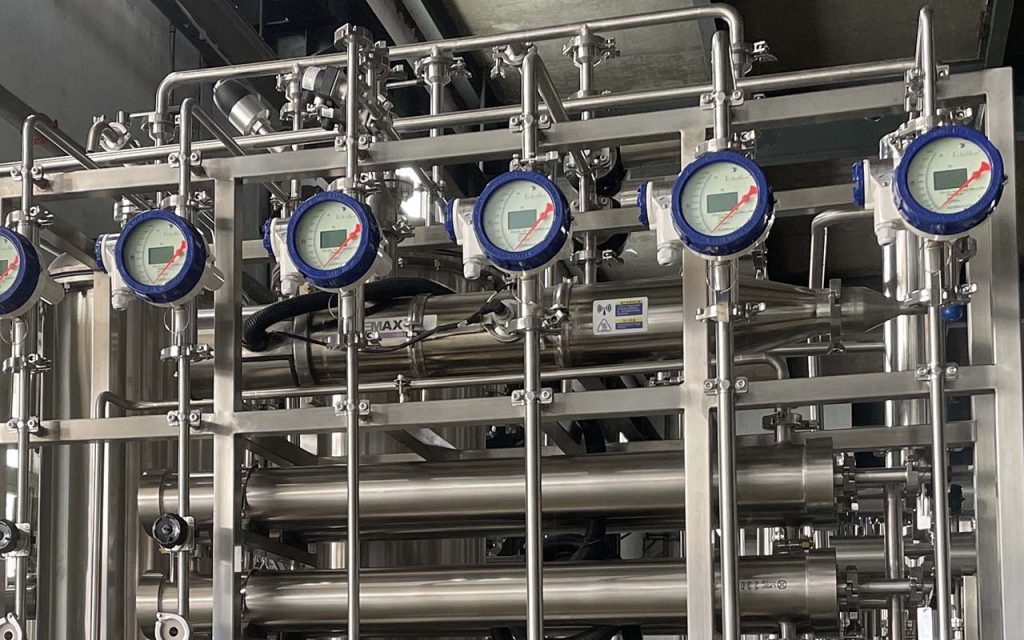
Advanced Pure Water Solutions: Combining RO and Distillation
The best advanced pure water solutions often use more than one technology. By combining RO and distillation, you can get the benefits of both.
Here is a common system design for WFI production:
Feed Water → Pretreatment → RO → EDI → Storage → Distillation → WFI Storage → Distribution
In this design, RO and EDI remove most contaminants first. This reduces the load on the distillation unit. The distillation unit then acts as a final polishing step. It ensures that the water is free from pyrogens and endotoxins.
This combined approach has several benefits:
-
Lower energy costs. RO removes contaminants before distillation. This means the distiller does not have to work as hard.
-
Better reliability. If one system has a problem, the other can often continue operating.
-
Flexibility. The system can produce both PW (after RO) and WFI (after distillation).
-
Easier validation. Multiple purification steps provide strong evidence of water quality.
At SKE&EAGLE, Integrated designs like this treat pretreatment, RO, EDI, distillation, storage, and distribution as one connected water pathway rather than a set of standalone machines, so each stage is sized correctly for the ones before and after it.
Important Design Considerations for Pharmaceutical Water Systems
Choosing the right equipment is only one part of the project. You also need to think about the complete system design.
Feed water quality. You should test your incoming water. Know its hardness, salt content, pH, and chlorine level. This information helps you design the right pretreatment system.
Required water grade. Do you need Purified Water (PW) or Water for Injection (WFI)? This decision affects your choice of technology.
Production capacity. How much water do you need per hour? Plan for peak demand, not just average use.
Storage and distribution. Purified water must stay clean after it leaves the purification system. Use sanitary storage tanks. Design distribution loops with proper flow and slope. Minimize dead legs where water can stagnate.
Monitoring and control. You should monitor conductivity, total organic carbon (TOC), temperature, and flow. Continuous monitoring helps you catch problems early.
Validation. Regulatory agencies expect you to validate your system. This usually includes Design Qualification, Installation Qualification, Operational Qualification, and Performance Qualification.
A good system supplier will help you with all these steps. They will provide documentation and support for validation.
Frequently Asked Questions
Can RO produce Water for Injection (WFI)?
Yes. As of October 2025, the major pharmacopoeias (USP, Ph. Eur., JP) are aligned in accepting reverse osmosis, typically combined with electrodeionization and ultrafiltration, as a validated production route for WFI, alongside distillation. Whichever method is used, WFI must still meet the USP limit of no more than 0.25 endotoxin units (EU) per mL. Distillation remains widely used because of its long regulatory track record; membrane-based (“cold”) WFI systems need more rigorous monitoring and periodic sanitization to manage contamination risk at ambient temperature.
How long do RO membranes last?
Membranes usually last 3 to 5 years. Their life depends on feed water quality and pretreatment. Regular cleaning can extend their life. If conductivity increases or pressure drops, it may be time to replace them.
Is distillation more expensive to run than RO?
Yes. Distillation uses more energy because it requires heat and cooling. But when you combine RO with distillation, the total energy cost can be lower. RO removes contaminants first, so the distiller works less.
What is the biggest problem with distillation units?
Scaling and corrosion are common issues. Minerals can build up in the boiling chamber. This reduces efficiency. Proper pretreatment helps prevent scaling. Regular cleaning is also important.
Should I choose RO or distillation for my facility?
It depends on your needs. For Purified Water, RO with EDI is usually the best choice. For WFI, distillation is the traditional choice. Many facilities use both. Talk to a qualified supplier to find the best solution for your specific situation.
Get Expert Help from SKE&EAGLE
Designing a pharmaceutical water system is a complex task. You need technical knowledge and regulatory expertise. At SKE&EAGLE, we provide complete advanced pure water solutions for pharmaceutical manufacturers.
We offer:
-
Pretreatment systems (filters, softeners, carbon)
-
RO water purification systems
-
EDI systems for further ion removal
-
Distillation systems for water purification (multi-effect stills)
-
Storage tanks and distribution loops
-
Automation and monitoring systems
-
Validation documentation and support
Whether you need a single RO water purification system or a complete plant with RO and distillation, SKE&EAGLE can help. We design systems that are reliable, efficient, and easy to maintain.
Contact us today to discuss your project. We will help you build a water treatment system that meets your quality goals and regulatory requirements.
Official Website: https://www.ske-eagle.com/
Contact Email: info@ske-eagle.com
Follow us on Facebook for the latest industry insights: SKE & Eagle Facebook
Business Inquiries: Visit our official website and submit the contact form at the bottom.