


Water is one of the most important raw materials in pharmaceutical production. It is used in drug formulations, cleaning equipment, rinsing processes, and many other critical operations.
Reverse osmosis, or RO, is a key technology in modern pharmaceutical water systems. An RO pure water system can remove dissolved salts, organic compounds, particles, and most microorganisms. However, it alone is usually not enough for pharmaceutical-grade applications. The complete system must include pretreatment, post-treatment, storage, and distribution.
At SKE&EAGLE, we design and manufacture complete pharmaceutical water purification systems. Our systems combine reverse osmosis technology with other purification steps like EDI, UV, and ultrafiltration. We use hygienic materials and provide full validation support.
This article explains how a multi-stage reverse osmosis system works. It also helps you understand what to look for when selecting the right water purification system for your pharmaceutical facility.
Key Takeaways
- RO removes most dissolved salts and organics, but RO permeate alone does not automatically meet USP or Ph. Eur. Purified Water limits — the full system, not just the membrane, has to be validated.
- A two-pass (multi-stage) RO design cuts the load on downstream EDI polishing and keeps quality stable when feed water conditions vary.
- EDI, UV, and ultrafiltration each target a different risk: trace ions, microbial growth, and endotoxins/bacteria respectively — skipping one leaves a gap the others cannot cover.
- Validation follows the standard DQ/IQ/OQ/PQ sequence described in USP General Chapter <1231> Water for Pharmaceutical Purposes.
What Is RO Pure Water?
Reverse osmosis uses pressure to push water through a special membrane. This membrane has very small pores. Water molecules pass through, but most dissolved salts, ions, and organic compounds are blocked. These contaminants are washed away in a separate waste stream.
The water that comes out is called RO permeate or RO pure water.
RO is popular because it removes a wide range of contaminants in a single step. It does not require heat, so it uses less energy than distillation. However, the quality of the permeate depends on many factors:
-
The quality of your incoming feed water
-
The type and age of the RO membrane
-
The operating pressure and water temperature
-
How well the pretreatment system works
-
How regularly the system is maintained
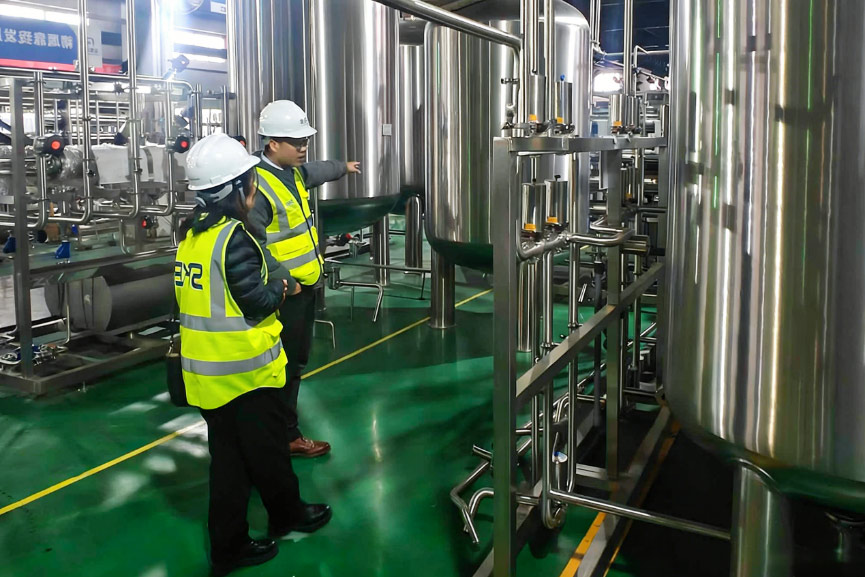
For pharmaceutical use, you cannot simply buy an RO system and expect pharmaceutical-grade water. You must design the whole system around your specific water quality targets and production needs. This is why the best water purification system is always a custom-engineered solution.
Is RO Pure Water the Same as Pharmaceutical Purified Water?
No. This is a very common misunderstanding.
RO is a technology. Purified Water (PW) is a quality standard. The USP and European Pharmacopoeia define strict limits for conductivity, total organic carbon (TOC), and microbes in pharmaceutical water. USP General Chapter <1231> Water for Pharmaceutical Purposes lays out the source water, design, validation, and monitoring expectations behind those limits.
A system that produces RO permeate can be a major part of a PW system. But the final water must be tested and proven to meet pharmacopoeia requirements. You cannot assume that it is automatically pharmaceutical grade.
This is why you need a complete system approach. The right system for pharmaceuticals is not just a high-rejection membrane. It is an engineered solution that includes the right pretreatment, polishing steps, monitoring instruments, and hygienic distribution.
Why Multi-Stage Reverse Osmosis Purification of Water Matters
A single-pass RO system removes about 95% to 98% of dissolved solids. This is good for many industrial uses. But for pharmaceuticals, you often need higher purity. This is where a multi-stage RO system becomes essential.
In a two-pass RO system, the permeate from the first RO pass goes through a second RO membrane. The second pass removes more ions and contaminants. The result is much purer RO pure water. This reduces the load on downstream polishing equipment like EDI.
A multi-stage RO system also provides better reliability. If one membrane needs cleaning or replacement, the other can continue operating. This reduces downtime in your production schedule.
For facilities with challenging feed water—like high silica or high TDS—a multi-stage RO system is often the best choice. It gives you consistent quality even when feed water conditions change.
The Complete Pharmaceutical Water System
A pharmaceutical water system is not just an RO machine. It is a series of treatment steps. Each step has a specific job.
Here is a typical system layout:
Raw Water → Pretreatment → RO → EDI Polishing → UV → Storage Tank → Distribution Loop
Let us look at each stage in detail.
1. Pretreatment
Pretreatment protects the pure water reverse osmosis filter. This is one of the most important parts of the system. Many RO failures happen because pretreatment is poorly designed.
Typical pretreatment equipment includes:
-
Multimedia filters: These remove sand, dirt, and suspended particles.
-
Activated carbon filters: These remove chlorine and organic matter. Chlorine damages the membrane very quickly.
-
Water softeners: These remove calcium and magnesium. These minerals cause scaling on the membrane surface.
-
Cartridge filters: These catch any remaining particles before water enters the RO pump.
A good pretreatment design extends the life of your RO membrane. It also reduces cleaning frequency. For a system running 24/7, proper pretreatment can save thousands of dollars in membrane replacement costs.
2. Reverse Osmosis
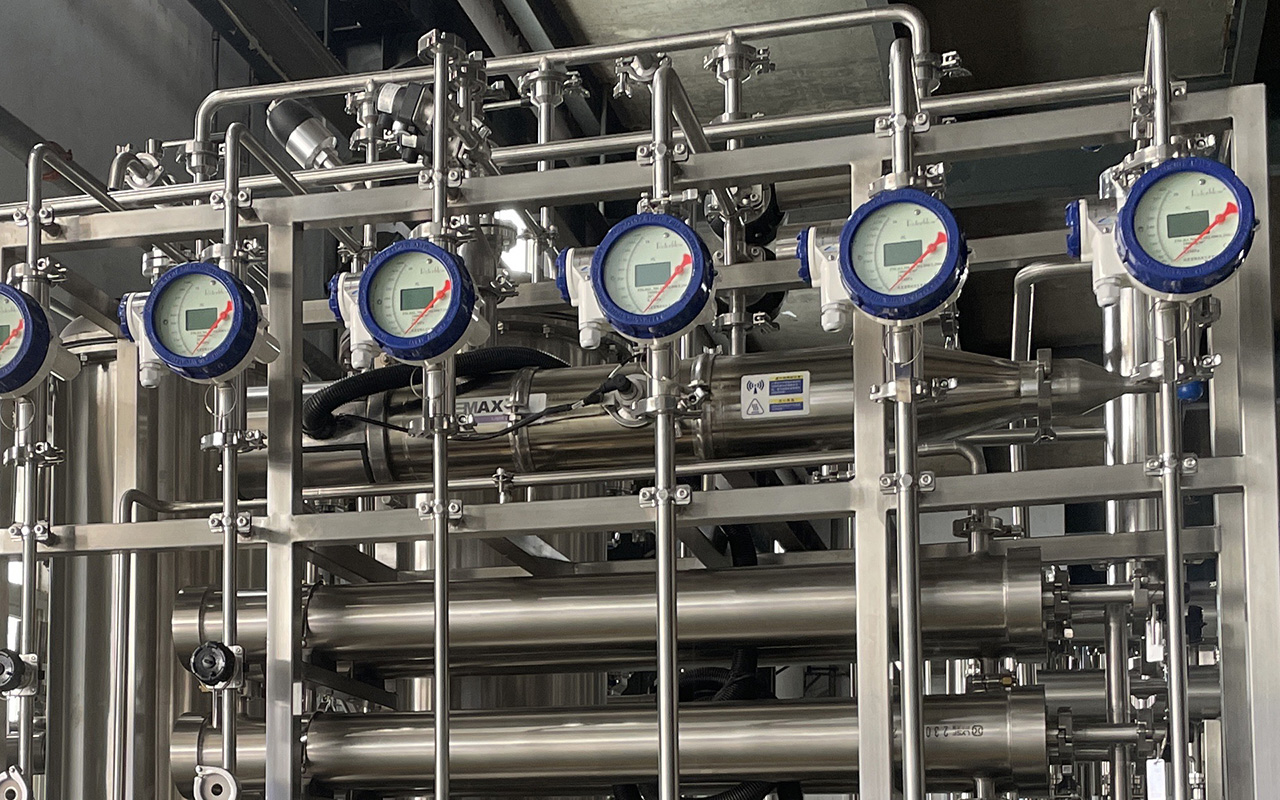
The RO stage is the main purification step. Feed water is pressurized and sent through the RO membrane. The purified water (permeate) goes to the next stage. The concentrated waste stream (reject) is drained or partially recycled.
For pharmaceutical systems, we often use double-pass RO, a common form of multi-stage treatment. The first pass removes most contaminants. The second pass polishes the permeate further. This gives more stable quality and better protection for downstream equipment.
Key operating parameters to monitor include:
-
Permeate conductivity: This tells you how well the membrane is rejecting ions.
-
Feed pressure: This shows if the membrane is fouling.
-
Pressure drop across the membrane: A rising pressure drop indicates fouling or scaling on the membrane.
Monitoring these parameters daily helps you schedule cleaning before performance drops too much.
3. EDI Polishing
After RO, the RO pure water is very pure but may still contain trace ions. Electrodeionization (EDI) removes these remaining ions.
EDI uses electricity and ion-exchange resins. It continuously removes ions without needing chemical regeneration. This makes it very convenient for pharmaceutical systems.
However, EDI works best when the feed water is already highly purified. RO permeate provides exactly this. The combination of RO + EDI is one of the most reliable ways to produce Purified Water. Many experts consider this combination ideal for PW production.
4. UV and Ultrafiltration
UV light is used to control microorganisms. It damages the DNA of bacteria and prevents them from reproducing. UV is often installed in the distribution loop to keep the water clean as it circulates.
Ultrafiltration (UF) uses a membrane with tiny pores. It removes bacteria, particles, and even endotoxins. Endotoxins are fragments of dead bacteria that can cause fever in patients. UF is very important if you are producing Water for Injection (WFI).
Hygienic Design and Materials
Purifying water is only half the job. You must also protect the RO pure water after purification. This is why hygienic design is critical.
SKE&EAGLE systems use pharmaceutical-grade stainless steel. We use SUS304L for most applications. For more corrosive environments or higher temperature sanitization, we use SUS316L.
Key design features include:
-
Smooth internal surfaces (Ra < 0.6 µm) to prevent bacteria from attaching.
-
No dead legs: Dead legs are areas where water does not flow. Bacteria can grow there.
-
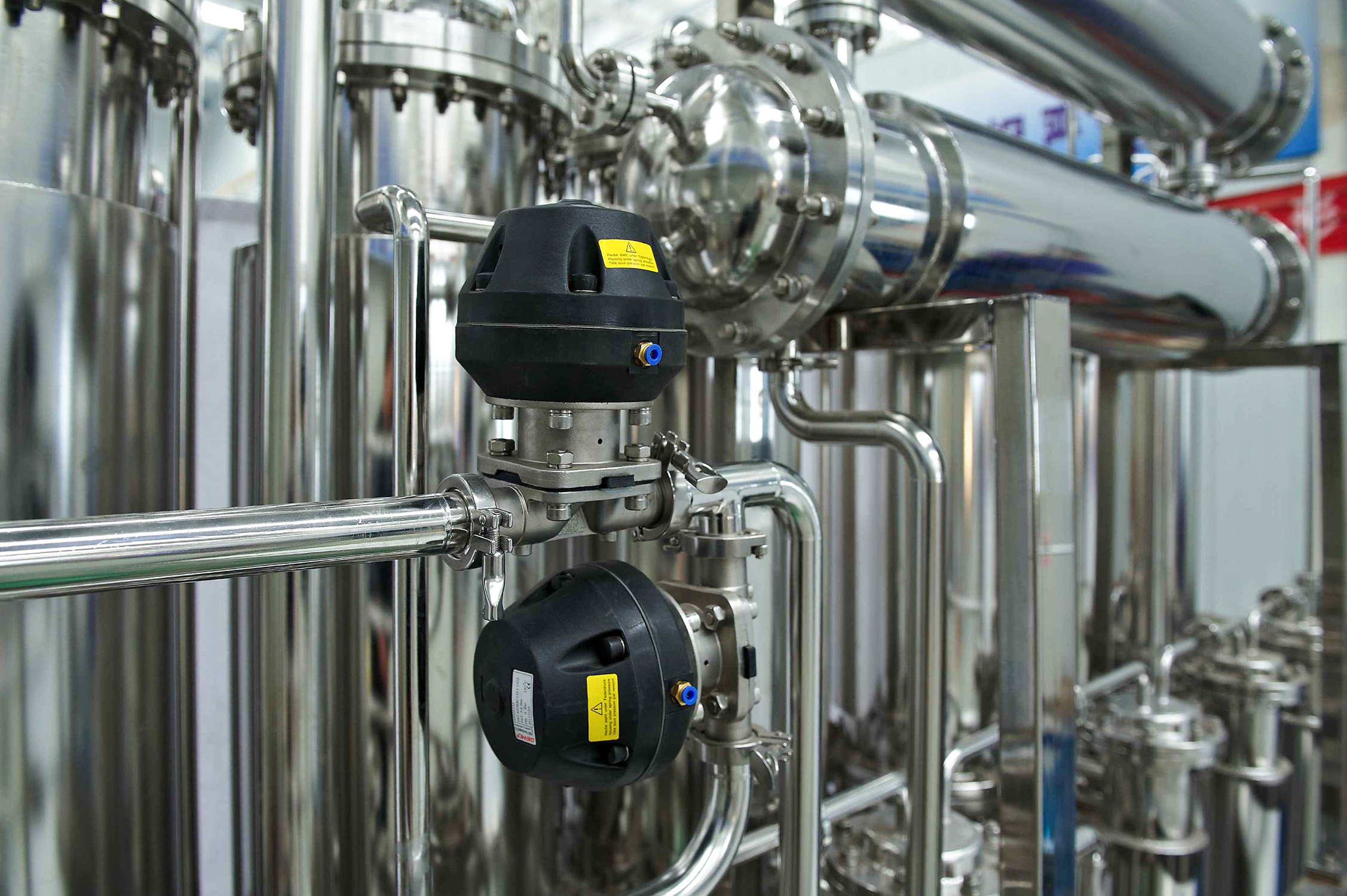
Sanitary fittings and valves: These are easy to clean and sanitize.
-
Sloped piping: This allows complete drainage during cleaning.
These features are not optional for pharmaceutical use. They are required by regulators and align with the sanitary design criteria published by 3-A Sanitary Standards, Inc., which governs cleanability requirements for equipment used in hygienic processing. A system with poor hygienic design cannot deliver reliable results, no matter how good the RO membrane is.
Storage and Distribution
After purification, the RO pure water is stored in a tank and circulated through a distribution loop. The water must be kept at the right temperature and flow rate.
For Purified Water, the system often circulates at ambient temperature with periodic sanitization. For WFI, the system usually circulates at 80°C to prevent microbial growth.
The distribution loop should maintain turbulent flow. Turbulent flow means the water moves fast enough to prevent biofilm formation. A velocity of 1.5 to 3 meters per second is typical.
Online instruments monitor conductivity and temperature continuously. If any parameter goes out of range, the system can send an alarm. This ensures that the water stays pure until it reaches the point of use.
Automation and Monitoring
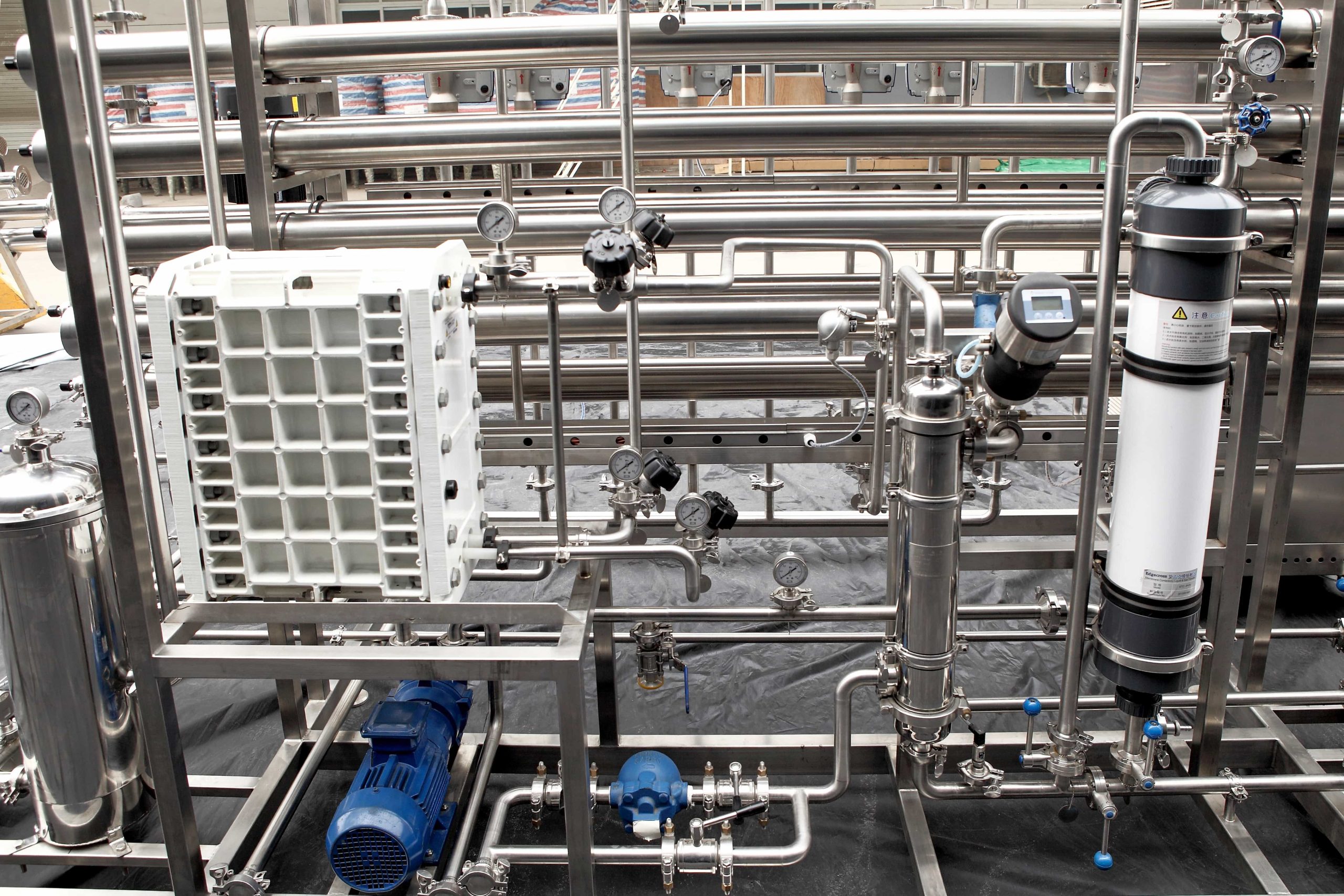
Modern pharmaceutical water systems are highly automated. SKE&EAGLE systems use PLC controllers with touchscreen interfaces. Operators can see real-time data for all critical parameters.
Typical monitored parameters include:
-
Conductivity (in-line)
-
Temperature
-
Flow rate
-
Tank level
-
RO feed pressure and permeate pressure
-
UV intensity
Automation reduces human error. It also provides data for audits. Regulators expect to see records of system performance over time. Our systems log this data automatically. This is an important feature of a well-designed system for regulated industries.
Validation and Documentation
Validation is required for all pharmaceutical water systems. You must prove that the system consistently produces RO pure water of the required quality.
The validation process includes:
-
DQ (Design Qualification): Confirm the system design meets your requirements.
-
IQ (Installation Qualification): Verify that the system is installed correctly.
-
OQ (Operational Qualification): Test that the system operates as designed.
-
PQ (Performance Qualification): Monitor the system over time to prove consistent performance.
SKE&EAGLE provides full documentation to support validation. We supply user manuals, test reports, and calibration certificates. We also help you develop your PQ protocol.
Comparison of Purification Technologies
The table below compares the main technologies used in pharmaceutical water systems. This will help you understand the role of each stage in producing high-purity permeate.
| Technology | What It Removes | Typical Location | Maintenance Frequency | Relative Cost |
|---|---|---|---|---|
| Multimedia Filter | Suspended solids | Pretreatment | Backwash daily | Low |
| Activated Carbon | Chlorine, organics | Pretreatment | Replace carbon every 1-2 years | Low |
| Water Softener | Calcium, magnesium | Pretreatment | Regenerate with salt as needed | Low |
| Pure Water Reverse Osmosis Filter | Ions, organics, microbes | Main purification | Clean every 3-6 months; replace every 3-5 years | Medium |
| EDI | Trace ions | Polishing | Inspect annually | Medium-High |
| UV | Microorganisms | Distribution | Replace lamp annually | Medium |
| Ultrafiltration | Bacteria, endotoxins | Final polishing | Replace membrane every 2-3 years | High |
Common Operational Issues and Solutions
Even the best water purification system can have problems. Here are some common issues and practical solutions.
High permeate conductivity: This usually means the membrane is damaged or fouled. First, check the feed water quality and pretreatment. Then, clean the membrane. If conductivity does not improve, the membrane may need replacement.
Low permeate flow: This often indicates fouling or scaling on the membrane. Check the pressure drop. If it is higher than normal, clean the membrane. Also check the feed water temperature—cold water reduces flow.
High pressure drop across the membrane: This is a sign of fouling. Increase the cleaning frequency. Also check your pretreatment—it may not be removing enough contaminants.
Bacteria detected in the water: This usually means sanitization is not working effectively. Check your UV system and sanitization schedule. Also inspect the storage tank and distribution loop for dead legs.
Frequently Asked Questions
1. Can RO pure water be used directly in pharmaceutical production?
No, not usually. RO permeate must meet pharmacopoeia standards. Most systems need additional polishing like EDI or UF to reach the required purity. A multi-stage RO system provides a better foundation.
2. How often should I clean my pure water reverse osmosis filter?
It depends on your feed water and pretreatment. Many systems need cleaning every 3 to 6 months. Monitor pressure drop and conductivity to decide the right schedule. Regular cleaning extends membrane life.
3. What is the difference between single-pass and multi-stage reverse osmosis purification of water?
Single-pass RO sends water through one membrane. A multi-stage system sends the permeate through a second membrane, giving higher purity and better reliability.
4. Is EDI better than mixed-bed ion exchange for RO pure water polishing?
EDI does not require chemical regeneration, so it is safer and easier to operate. Mixed-bed resins need acid and caustic for regeneration, which creates hazardous waste. EDI is the preferred choice for polishing this water.
5. Can the pure water reverse osmosis filter remove endotoxins?
The membrane removes some endotoxins, but not all. If you need full endotoxin control, you should add ultrafiltration or distillation after RO.
6. What happens if my pure water reverse osmosis filter stops working?
A good system has alarms and automatic shutdown to protect the product. For critical production, we recommend having a backup system or spare membranes on site.
7. How long does a pure water reverse osmosis filter last?
With good pretreatment and regular cleaning, a well-maintained membrane lasts 3 to 5 years. Hard water or poor pretreatment can reduce this to 1 to 2 years.
8. Does SKE&EAGLE provide validation support for RO pure water systems?
Yes. We provide full documentation for DQ, IQ, OQ, and PQ. We also help you develop your testing protocols. This ensures your system passes regulatory inspections.
Written by Mandy, Marketing Specialist at SKE&EAGLE with two years of experience covering the company’s pharmaceutical water and steam equipment. Technical details in this guide were reviewed by SKE&EAGLE’s engineering team before publication.
Conclusion
RO is a powerful technology for pharmaceutical water purification. But it is only one part of a complete system. Producing high-quality RO pure water requires careful attention to pretreatment, membrane selection, polishing, and distribution.
The best water purification system combines a reliable pure water reverse osmosis filter with appropriate pretreatment and post-treatment technologies. For most pharmaceutical applications, a multi-stage reverse osmosis purification of water system provides the best balance of purity, reliability, and cost.
At SKE&EAGLE, we design complete systems that meet pharmacopoeia standards and fit your specific production needs. We focus on reliability, hygiene, and long-term value. Our systems consistently deliver high-quality purified water for demanding pharmaceutical applications.
If you are planning a new water system or upgrading an existing one, contact us. We can help you find the right solution for your facility. Let us build the right system for your pharmaceutical manufacturing needs.
Official Website: https://www.ske-eagle.com/
Contact Email: info@ske-eagle.com
Follow us on Facebook for the latest industry insights: SKE & Eagle Facebook
Business Inquiries: Visit our official website and submit the contact form at the bottom.