


Meta Description: Learn how reverse osmosis filtration works, how RO membranes remove contaminants, and why membrane technology is essential for pharmaceutical water systems.
Reverse osmosis filtration is often described as forcing water through a fine filter. However, this description does not fully explain how the process works. Reverse osmosis (RO) uses a semipermeable membrane to separate water from dissolved salts, organic compounds, and many microorganisms. A semipermeable membrane is a special film that lets water pass through but blocks many dissolved substances. Unlike conventional filters, RO can remove a large proportion of dissolved substances that are too small for ordinary mechanical filtration.
For pharmaceutical water production, this reverse osmosis filtration process is especially important. Water quality must meet strict requirements, and every purification stage must work as part of a controlled system. Understanding how RO membranes work helps pharmaceutical manufacturers select suitable water treatment technologies and maintain consistent water quality.
The Core Principle: Osmosis, Reversed
Natural osmosis occurs when water moves through a semipermeable membrane from a solution with a lower concentration of dissolved substances toward a solution with a higher concentration. This movement is driven by the difference in osmotic pressure between the two sides. Osmotic pressure is the pressure that naturally pushes water toward the more concentrated side.
Reverse osmosis filtration reverses this natural process. External pressure is applied to the concentrated feed water. When the applied pressure exceeds the osmotic pressure difference, water moves through the membrane toward the permeate side. Most dissolved substances stay behind in the concentrate stream. The permeate is the cleaned water that passes through the membrane; the concentrate is the leftover water that carries the rejected substances.
RO is not simply a mechanical sieve. Its separation performance depends on several things: membrane structure, material properties, operating pressure, and how water interacts with dissolved substances.
Operating pressure varies according to feed water quality and application. Brackish water systems generally require lower pressure than seawater desalination systems. Pharmaceutical RO systems also need suitable pressure settings based on feed conductivity, membrane specifications, target output, and recovery rate.

Inside the Semipermeable Membrane
Most industrial RO systems use thin-film composite membranes. These membranes generally contain two main layers:
-
Support layer: A porous polysulfone layer provides mechanical strength and supports the active membrane.
-
Active layer: A very thin polyamide layer performs the main separation function.
This structure allows the membrane to keep enough mechanical strength while still providing effective water separation.
Membrane material is an important factor in system selection. Cellulose acetate membranes were widely used in earlier RO applications. Modern industrial systems commonly use polyamide membranes because they reject salt well and produce water efficiently.
However, polyamide membranes are sensitive to free chlorine and other strong oxidizing agents. Even relatively low chlorine exposure can damage the active layer, depending on concentration and contact time. Such damage may reduce salt rejection, and routine cleaning normally cannot reverse it.
Effective reverse osmosis filtration therefore depends on protecting the membrane. This is why membrane technology in pharmaceutical water systems must be supported by effective pretreatment.
What Does Reverse Osmosis Filtration Remove?
A properly selected and operated membrane is the heart of effective reverse osmosis filtration. It can reject a high percentage of dissolved salts and many other contaminants. However, actual rejection performance varies with membrane type, feed water composition, operating pressure, temperature, and recovery rate.
The following table summarizes the typical treatment behavior of RO membranes.
| Contaminant | RO Treatment Performance | Important Considerations |
|---|---|---|
| Dissolved salts | High rejection | Depends on membrane type and operating conditions |
| Heavy metals | Generally high rejection | Chemical form and ionic charge affect rejection |
| Bacteria | Effective physical barrier | System integrity and downstream control remain essential |
| Endotoxins | Can achieve significant reduction | Endotoxins are fragments of bacterial cell walls; performance depends on membrane and system conditions |
| Organic compounds | Variable rejection | Molecular size, charge, and chemical properties matter |
| Free chlorine | Not reliably removed | Requires suitable pretreatment |
RO membranes provide an important barrier against bacteria and endotoxins. However, this does not mean that the complete water treatment system is sterile.
Microorganisms can enter or grow in pretreatment equipment, storage tanks, pipelines, and distribution loops. Therefore, pharmaceutical water systems require proper sanitization, hygienic design, and continuous monitoring to maintain microbiological quality.
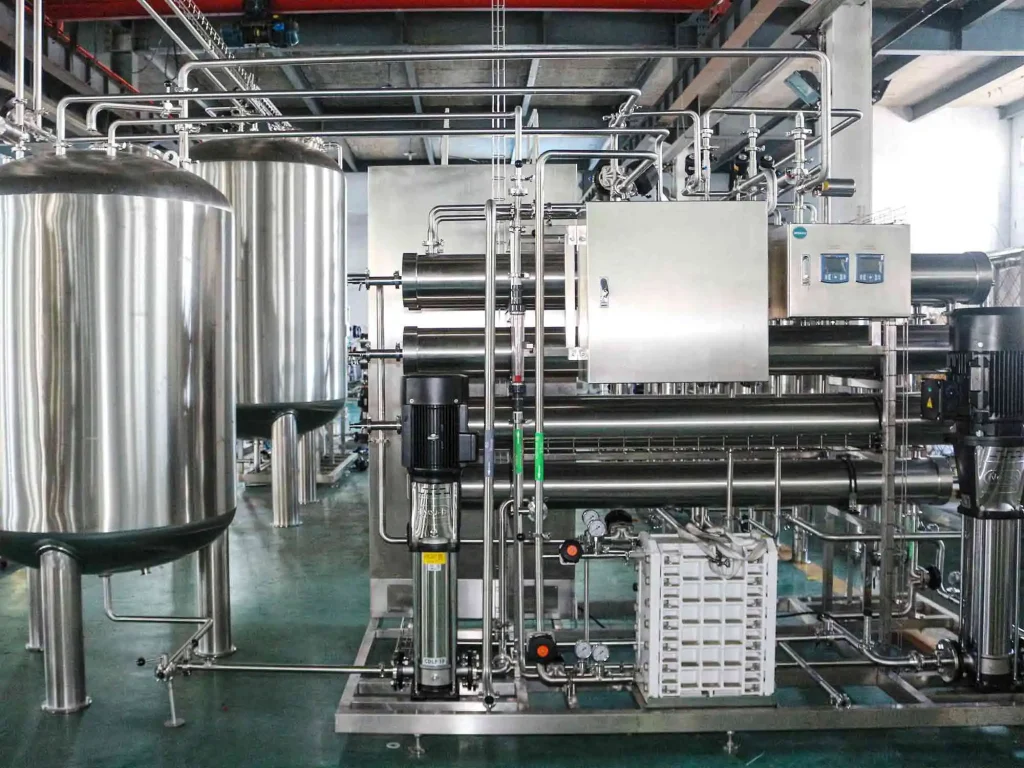
Membrane Technology in Pharmaceutical Water Systems
Membrane technology has become an important part of modern pharmaceutical water production. Reverse osmosis filtration is commonly used to remove dissolved ions and reduce the contaminant load before further purification.
In 2017, the European Pharmacopoeia introduced an alternative approach. It allows appropriately designed membrane-based processes for Water for Injection (WFI) production under defined conditions. These processes may combine reverse osmosis with additional purification technologies, such as electrodeionization (EDI) and ultrafiltration (UF). EDI uses an electric field and ion-exchange resin to remove ions continuously. UF is a fine filtration step that can hold back particles and certain large molecules.
However, installing an RO+EDI+UF system does not automatically guarantee WFI compliance. The complete process must demonstrate that it consistently meets the applicable pharmacopoeial quality requirements. System design, microbial control, validation, and ongoing monitoring are all essential.
SKE&EAGLE designs pharmaceutical water treatment systems using configurations such as single-pass RO, double-pass RO, and RO+EDI. Each system is selected according to the customer’s water quality requirements, production capacity, and process conditions.
Design Choices That Affect RO Performance
The performance of a reverse osmosis filtration system depends on more than membrane selection. Several engineering factors influence water production, operating stability, and membrane service life.
1. Membrane Configuration
Spiral-wound membranes are widely used in industrial pharmaceutical water systems. Their compact structure provides a large membrane surface area and makes them suitable for continuous water production.
Hollow-fiber membranes are another membrane configuration used in water treatment. However, membrane selection should be based on feed water characteristics, required performance, and the manufacturer’s specifications.
2. Recovery Rate
Recovery rate refers to the percentage of feed water converted into permeate.
A higher recovery rate can reduce water consumption, but it also increases the concentration of dissolved substances in the reject stream. This may increase scaling and fouling risks.
Pharmaceutical RO systems should balance water utilization with membrane protection and stable permeate quality. The appropriate recovery rate depends on feed water analysis and system design.
3. Temperature
Feed water temperature affects membrane permeability and water production. Lower temperatures generally reduce permeate flow. Higher temperatures may increase water production, but they can also affect membrane operating limits.
Temperature compensation may be used in system control. Because water temperature changes how much water passes through the membrane, the control system can adjust readings so operators can compare performance under different conditions.
4. Operating Pressure
Operating pressure must be sufficient to overcome osmotic pressure and maintain the required permeate flow. However, excessive pressure increases energy consumption and may place unnecessary stress on membrane components.
The operating pressure should follow the membrane manufacturer’s specifications and be adjusted according to actual feed water conditions.

Key Operating Parameters for Pharmaceutical RO Systems
Continuous monitoring is essential for reverse osmosis filtration systems to identify changes in membrane performance before they affect the complete water treatment process.
Important parameters include:
| Monitoring Parameter | Purpose |
|---|---|
| Feed water conductivity | Indicates the ionic load entering the RO system |
| Permeate conductivity | Monitors dissolved salt rejection performance |
| Feed pressure | Helps evaluate operating conditions |
| Differential pressure | Indicates possible fouling or blockage |
| Permeate flow rate | Tracks water production performance |
| Recovery rate | Evaluates water utilization and scaling risk |
These parameters should be reviewed together rather than individually. For example, declining permeate flow combined with increasing differential pressure may indicate membrane fouling.
Conductivity monitoring is also important, but it cannot confirm every aspect of pharmaceutical water quality. Additional chemical and microbiological testing is necessary according to the applicable water specification and monitoring program.
How SKE&EAGLE Designs Pharmaceutical RO Systems
A pharmaceutical reverse osmosis filtration system should not be selected based only on membrane specifications or nominal water production capacity.
SKE&EAGLE approaches system design by evaluating the complete water treatment process, including:
-
Raw water analysis: Identifying feed water characteristics and potential membrane risks.
-
Process configuration: Selecting single-pass RO, double-pass RO, RO+EDI, or other suitable combinations.
-
Capacity planning: Matching permeate production to pharmaceutical manufacturing demand.
-
Instrument configuration: Selecting suitable conductivity, pressure, and flow monitoring points.
-
System integration: Considering storage, distribution, sanitization, and future expansion requirements.
This engineering approach helps pharmaceutical manufacturers obtain a water treatment system that matches their actual production needs rather than relying on a standard equipment configuration.
FAQ
1. What is the difference between reverse osmosis filtration and ordinary filtration?
Ordinary filtration mainly removes suspended particles through physical barriers. Reverse osmosis uses a semipermeable membrane and applied pressure to separate water from dissolved salts and many smaller contaminants. It therefore removes a much higher level of dissolved substances.
2. Can reverse osmosis filtration remove bacteria and endotoxins?
RO membranes provide an effective barrier against bacteria and can significantly reduce endotoxins. However, actual performance depends on membrane specifications and system conditions. RO does not sterilize the entire water treatment system, so downstream sanitization and microbiological monitoring remain necessary.
3. Why do pharmaceutical RO systems need pretreatment?
Pretreatment protects RO membranes from chlorine damage, scaling, suspended particles, and organic fouling. Activated carbon, softening, cartridge filtration, and antiscalant dosing may be used depending on raw water quality.
4. How long does an RO membrane last in pharmaceutical service?
Membrane service life depends on feed water quality, pretreatment, operating conditions, cleaning frequency, and maintenance. There is no universal replacement interval. Regular performance monitoring helps determine when cleaning or replacement is necessary.
5. Does reverse osmosis remove all contaminants?
No. RO removes a large proportion of dissolved salts and many organic compounds. However, some small uncharged molecules and dissolved gases, such as carbon dioxide, may pass through. Chlorine also requires suitable pretreatment. Additional purification stages may be needed to achieve pharmaceutical water specifications.
6. Is RO+EDI suitable for pharmaceutical purified water production?
Yes. RO+EDI is a common configuration for pharmaceutical purified water production. RO removes most dissolved substances, while EDI further reduces ionic contaminants. The final system configuration must be designed and validated according to the required water quality and applicable GMP requirements.
Contact SKE & Eagle for Advanced Solutions
For customized system engineering solutions or integration of high-performance water treatment technologies, please contact SKE & Eagle. Our professional team collaborates closely with industrial partners to design, implement, and maintain solutions tailored to your operational needs.
Contact Email: info@ske-eagle.com
Follow us on Facebook for the latest industry insights: SKE & Eagle Facebook
Business Inquiries: Visit our official website and submit the contact form at the bottom.