


In pharmaceutical manufacturing, water is more than a utility. It is a critical raw material used in production, cleaning, and formulation. This is why reliable water filtration systems are essential for maintaining product quality, regulatory compliance, and stable production.
When a pharmaceutical water filtration system fails, the impact can be serious. Poor water quality may lead to microbial contamination, rejected batches, equipment damage, and costly downtime. For this reason, manufacturers need to understand not only how their water filtration systems work, but also why they fail.
Many problems are not sudden. They develop slowly because of poor design, inadequate pretreatment, incorrect operation, or delayed maintenance. The good news is that most common failures in water filtration systems can be identified early and prevented with the right approach.
In this article, we will examine five critical problems that can affect pharmaceutical water filtration systems and provide practical ways to prevent them. This knowledge is especially important for anyone operating a purified water system for pharma.
Key Takeaways
- Biofilm, RO membrane scaling/fouling, EDI performance drift, corrosion, and reactive maintenance are the five most common ways pharmaceutical water filtration systems fail.
- Most failures build up slowly from design or pretreatment gaps rather than happening suddenly, so they are preventable with early monitoring.
- Protecting the RO stage with proper pretreatment is one of the most cost-effective ways to protect downstream EDI performance too.
- 316L stainless steel, correct welding, and passivation are standard practice for corrosion resistance in pharmaceutical water systems.
Failure 1: Biofilm – The Silent Contaminant
Biofilm is one of the most serious microbial risks in pharmaceutical water filtration systems. It is a layer of microorganisms that attaches to the internal surfaces of pipes, tanks, and valves. Once biofilm becomes established, it can be difficult to remove.
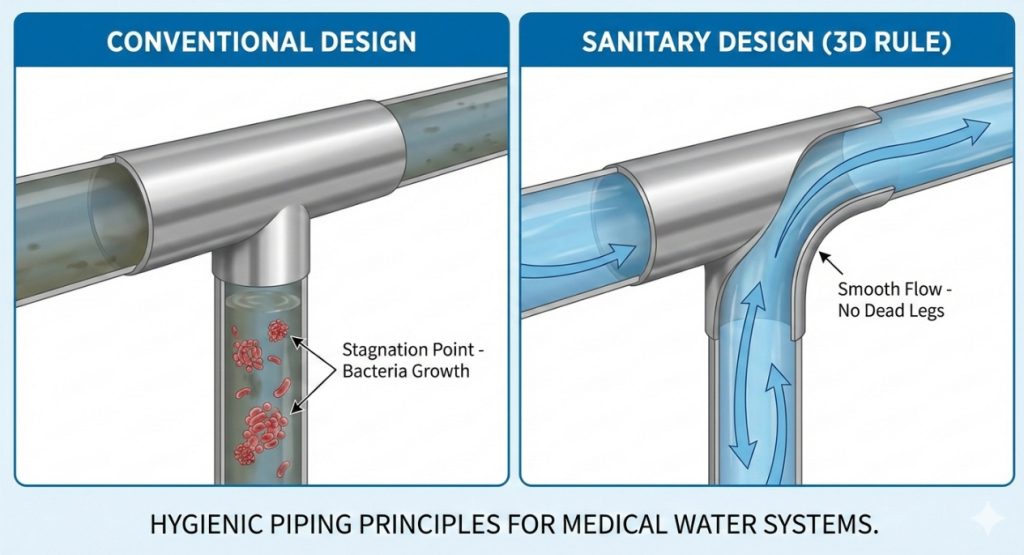
The protective matrix around the microorganisms makes them more resistant to common sanitization methods. As a result, the system may experience repeated contamination even after cleaning. Biofilm often develops when water remains stagnant for too long. Poor piping design, dead legs, low flow velocity, and inadequate sanitization all increase the risk.
How to Prevent Biofilm
Biofilm control should begin with hygienic system design. A well-designed purified water system for pharma eliminates conditions that allow biofilm to grow. Key measures include:
-
Minimize dead legs: Avoid pipe sections where water can remain stagnant. This is a critical design consideration for any water filtration system.
-
Maintain adequate flow: Proper circulation helps reduce microbial attachment and stagnation.
-
Use smooth internal surfaces: Smooth stainless-steel surfaces provide fewer places for microorganisms to attach.
-
Follow a validated sanitization program: Hot water, ozone, or chemical sanitization should be selected according to the system design.
-
Monitor microbial trends: Regular testing helps identify contamination before it becomes a major problem.
A well-designed pharmaceutical water filtration system makes microbial control easier and reduces the need for frequent emergency cleaning. USP General Chapter <1231>, Water for Pharmaceutical Purposes, discusses these same hygienic design principles, including minimizing dead legs and maintaining adequate flow to control biofilm (USP).
Failure 2: RO Membrane Scaling and Fouling
Reverse osmosis (RO) is an important stage in many pharmaceutical water filtration systems. It removes dissolved salts, particles, and other unwanted substances from feed water. However, RO membranes can lose performance when they are exposed to excessive hardness, suspended solids, or organic matter.
Scaling occurs when dissolved minerals like calcium and magnesium form deposits on the membrane surface. Fouling is usually caused by particles, colloids, or microorganisms. Both problems reduce the flow of RO pure water and increase operating pressure. Over time, this increases energy consumption and reduces the amount of purified water produced.
How to Protect RO Membranes
Effective pretreatment is the first line of defense for RO membranes. Depending on feed-water quality, a pharmaceutical system may include:
| Pretreatment Method | Main Function |
|---|---|
| Multimedia filtration | Removes suspended solids and larger particles |
| Activated carbon filtration | Reduces chlorine and organic compounds |
| Water softening | Reduces hardness that causes scaling |
| Cartridge filtration | Provides fine particle protection |
| Antiscalant dosing | Helps control mineral scaling |
RO performance should be monitored regularly. Important indicators include permeate flow, operating pressure, and salt rejection. When performance drops, membrane cleaning may be required. A proper clean-in-place (CIP) procedure should follow the manufacturer’s recommendations.
Good pretreatment significantly reduces the risk of premature membrane failure and helps pharmaceutical water filtration systems operate more efficiently. This is one of the most cost-effective investments for any purified water system for pharma.

Failure 3: EDI Performance Degradation
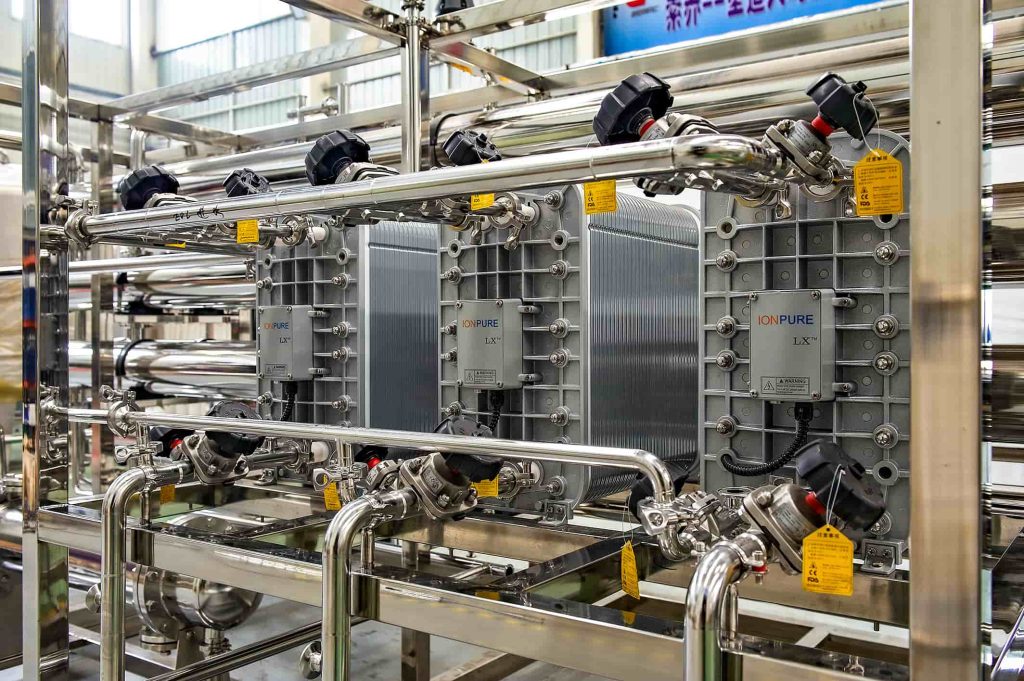
Electrodeionization (EDI) is commonly used as a polishing technology after RO in high-purity water production. It is a key component of an ultra purified water system. Unlike traditional ion-exchange systems that require chemical regeneration, EDI uses electricity to continuously remove remaining ions.
However, EDI should not be treated as an independent solution. Its performance depends heavily on the quality of the RO water entering the module. If the upstream RO system allows excessive hardness, silica, or carbon dioxide to pass through, the EDI module may gradually lose efficiency. One common warning sign is an increase in product-water conductivity.
How to Maintain EDI Performance
To keep EDI performance stable in your water filtration systems:
-
Maintain good RO permeate quality: The RO stage should provide water within the EDI manufacturer’s specified limits. This is essential for any ultra purified water system.
-
Control carbon dioxide: High CO₂ increases the ionic load on the EDI system. A degassing solution may be required.
-
Operate within design parameters: Flow, pressure, temperature, and voltage should remain within the recommended range.
-
Use correct startup procedures: Follow the manufacturer’s instructions to avoid unnecessary stress on the module.
-
Monitor conductivity and resistivity: Trend data can help identify performance changes early.
Protecting the EDI starts with protecting the RO. An integrated approach makes water filtration systems more reliable and easier to manage.
Failure 4: Corrosion and Pitting
Corrosion is another important risk in pharmaceutical water filtration systems, particularly in storage and distribution sections. Poor material selection, improper welding, and unsuitable operating conditions can all contribute to corrosion.
Pitting is especially concerning because small areas of localized corrosion can create leaks or become difficult-to-clean contamination points. Corrosion can also introduce metal ions into the water, which may affect quality. For any purified water system for pharma, material integrity is critical to long-term reliability.
How to Reduce Corrosion Risk
Material selection should be considered during the initial design stage. For pharmaceutical water applications, 316L stainless steel is widely used because of its corrosion resistance and suitability for hygienic systems.
Other important considerations include:
-
Proper surface finishing: Smooth internal surfaces reduce contamination risks.
-
Correct welding practices: Poor welds can create weak points and contamination risks.
-
Proper passivation: This improves the corrosion resistance of stainless-steel surfaces after fabrication.
-
Compatible gaskets and seals: Materials should be selected according to water quality and temperature.
-
Suitable sanitization conditions: Temperature and chemical exposure should remain within equipment limits.
A pharmaceutical water filtration system should be designed as a complete hygienic system, not simply a collection of components.

Failure 5: Poor Maintenance and Unplanned Downtime
The fifth failure is often related to management rather than equipment. Even high-quality pharmaceutical water filtration systems can experience problems when maintenance is reactive. Waiting until a component fails results in higher repair costs, longer downtime, and greater production risk.
A proactive maintenance program is much more effective. Instead of asking “When will this component fail?” operators should monitor performance and identify changes before they become serious problems. For any purified water system for pharma, preventive maintenance is essential.
Build a Proactive Maintenance Program
A practical maintenance program should include regular monitoring of pressure, flow, conductivity, microbial results, and other important parameters.
| Maintenance Activity | Recommended Approach | Main Benefit |
|---|---|---|
| Parameter monitoring | Every shift or per site procedures | Detect abnormal trends early |
| Pretreatment maintenance | Based on water usage and performance | Protect RO membranes |
| Cartridge filter replacement | Based on differential pressure | Maintain particle removal |
| RO membrane cleaning | Based on performance trends | Restore membrane performance |
| System sanitization | Based on validated procedures | Control microbial growth |
| Performance review | Regularly | Identify long-term system changes |
Maintenance intervals should be based on equipment specifications, operating conditions, and historical data. This allows maintenance to be planned during scheduled downtime instead of during an unexpected production stop.
Written by Mandy, Marketing Specialist at SKE Equipment / SKE&EAGLE with two years of experience covering the company’s pharmaceutical water and steam equipment. Technical details in this guide were reviewed by SKE&EAGLE’s engineering team before publication.
The SKE&EAGLE Advantage
At SKE&EAGLE, we understand that pharmaceutical manufacturers need more than individual components. They need a complete and reliable water treatment solution. Our pharmaceutical water filtration systems integrate key purification stages such as pretreatment, RO, EDI, storage, distribution, and intelligent monitoring.
Our system design focuses on:
-
Hygienic construction
-
Reliable water quality
-
Easy maintenance
-
Efficient integration
-
Stable long-term operation
-
Customized solutions for different requirements
By integrating all stages into one coordinated system, SKE&EAGLE helps customers manage water quality from pretreatment to final distribution. Whether you need a purified water system for pharma or a complete ultra purified water system, we can develop a solution tailored to your specific needs.
Every pharmaceutical facility has different feed-water conditions, production capacity, and quality requirements. A suitable water filtration system should be designed around the actual application, not based on a standard configuration alone.
Conclusion
Reliable water filtration systems are essential for pharmaceutical manufacturers that need stable water quality and consistent production. The five failures discussed in this article—biofilm, RO scaling, EDI degradation, corrosion, and poor maintenance—can affect performance and increase costs.
However, most of these problems can be reduced through hygienic design, effective pretreatment, proper material selection, continuous monitoring, and proactive maintenance. A well-designed purified water system for pharma provides consistent quality, reliable operation, and long-term value.
For manufacturers requiring the highest purity, an ultra purified water system with integrated RO and EDI technology offers the performance needed for critical applications. Investing in the right water filtration systems is an investment in product quality, production stability, and regulatory confidence.

Frequently Asked Questions
Q1: What are water filtration systems used for in pharmaceutical manufacturing?
Pharmaceutical water filtration systems remove particles, microorganisms, and dissolved minerals from water. A complete system may combine pretreatment, RO, EDI, storage, and distribution technologies.
Q2: How can I prevent biofilm in my water filtration system?
Biofilm can be controlled through hygienic design, adequate circulation, minimized dead legs, smooth surfaces, regular monitoring, and validated sanitization. Prevention is easier than removal.
Q3: How often should RO membranes be cleaned?
There is no fixed schedule. Clean them when performance drops—specifically, when permeate flow declines, pressure increases, or salt rejection reduces. Follow the manufacturer’s recommendations.
Q4: Why does my ultra purified water system show increasing conductivity?
Increasing conductivity usually indicates a problem with the EDI module. This could be due to poor RO feed quality, high CO₂, scaling, or incorrect operating conditions. Check the water entering the EDI first.
Q5: What materials are commonly used in pharmaceutical water systems?
316L stainless steel is widely used for storage and distribution because of its corrosion resistance. Surface finish, welding quality, passivation, and gasket compatibility are also important.
Q6: Can SKE&EAGLE customize pharmaceutical water filtration systems?
Yes. SKE&EAGLE develops solutions based on feed-water quality, required water quality, production capacity, and system configuration. We can provide a complete purified water system for pharma or ultra purified water system.
Contact SKE & Eagle for Advanced Solutions
For customized system engineering solutions or integration of high-performance water treatment technologies, please contact SKE & Eagle. Our professional team collaborates closely with industrial partners to design, implement, and maintain solutions tailored to your operational needs.
Official Website: https://www.ske-eagle.com/
Contact Email: info@ske-eagle.com
Follow us on Facebook for the latest industry insights: SKE & Eagle Facebook
Business Inquiries: Visit our official website and submit the contact form at the bottom.