

Liquid solutions are one of the most common dosage forms in medicine. Patients meet them as oral syrups, eye drops, injections, and irrigation fluids. These products look simple, but their production depends on careful control of water quality, mixing, filtration, and cleaning.
A well-designed liquid preparation system makes this possible. It helps manufacturers dissolve ingredients, mix them evenly, and transfer the finished batch safely. For companies that build pharmaceutical water equipment, this link matters. The quality of liquid solutions is decided long before filling, inside the preparation tank and inside the water system that feeds it.
What Is a Pharmaceutical Liquid Preparation System?
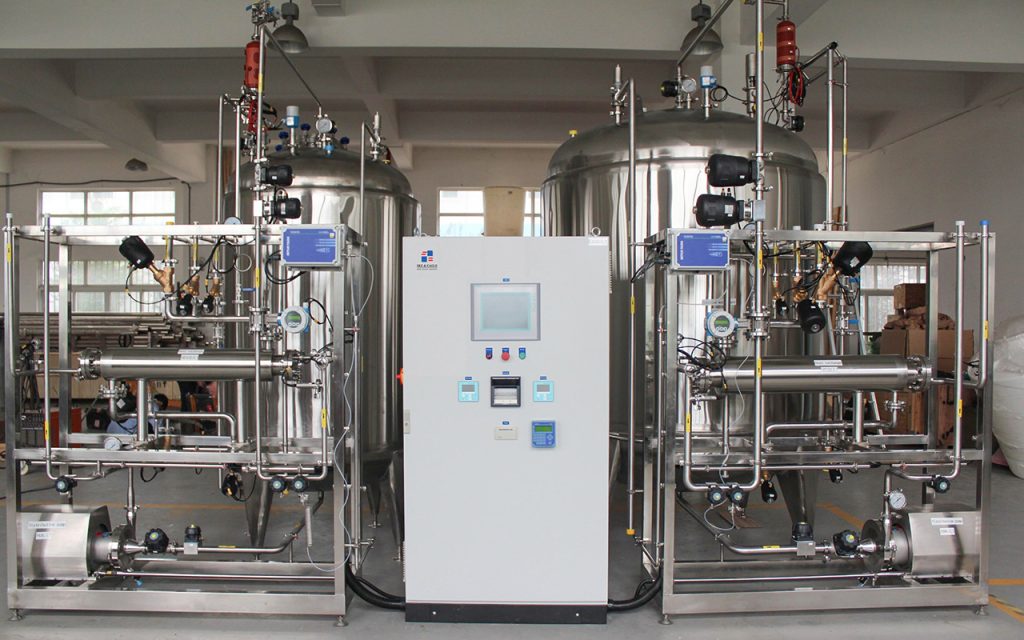
A pharmaceutical liquid preparation system is a group of equipment used to prepare, mix, and transfer liquid drug products under controlled conditions. Its goal is a uniform batch that meets its quality specification.
A typical system includes preparation tanks, agitators, heating and cooling units, transfer pumps, filtration units, instruments, and an automated control system. The exact setup depends on the product, batch size, and quality standard.
An oral solution may only need controlled mixing. A sterile injectable needs much stricter contamination control, suitable water quality, and validated sterile processing. So a system should never be chosen by tank size alone. It must match the product and the full manufacturing process. This is the first rule for producing reliable liquid solutions.

How Liquid Preparation Works Step by Step
Most liquid preparation follows a series of controlled steps.
First, operators check and weigh raw materials. Accurate weighing matters because wrong amounts change concentration and stability.
Next, pharmaceutical water enters the tank. Purified Water is common for non-parenteral products. Water for Injection (WFI) is required for applicable parenterals. Water quality must be controlled before it enters the process.
Mixing then begins. Speed, time, and temperature follow the formulation. Good mixing prevents concentration differences inside the tank.
After that, operators adjust pH, temperature, or concentration within approved limits. Finally, the liquid passes through filtration and moves to a holding tank or filling line. Every step should be documented to show the batch followed its approved procedure. Each step directly shapes the final quality of liquid solutions.
Main Equipment and Its Function
Each part of the system has a clear job. The table below shows the core equipment and what to consider.
| Equipment | Main Function | Design Consideration |
|---|---|---|
| Preparation tank | Holds and prepares the batch | Material and surface finish |
| Agitator | Mixes ingredients evenly | Speed and impeller design |
| Heating/cooling unit | Controls product temperature | Temperature accuracy |
| Transfer pump | Moves liquid between stages | Flow rate and compatibility |
| Filtration unit | Removes particles or supports sterile filtration | Filter rating and validation |
| Control system | Monitors and records the process | Data integrity and alarms |
Preparation tanks are often made of 316L stainless steel for product-contact surfaces. The inside should be smooth, corrosion-resistant, and easy to clean. Weld quality and drainage also affect suitability.
Mixing performance directly affects uniformity. The agitator must circulate the liquid without too much foam or air. Temperature control is equally important, because some ingredients dissolve better when warm, while heat-sensitive materials need lower temperatures.
Filtration controls particles and, in some processes, microorganisms. A validated sterilizing-grade filter, often 0.2 or 0.22 μm, may be used for sterile products. But pore size alone does not guarantee sterility. Manufacturers must validate microbial retention and test filter integrity after use. All of this equipment exists to produce safe liquid solutions.

Different Products, Different Requirements
Not all liquid solutions place the same demands on a system. The table below gives a simple overview.
| Product Type | Water Quality | Main Process Need |
|---|---|---|
| Oral solution | Usually Purified Water | Accurate dosing and uniform mixing |
| Ophthalmic solution | Based on product requirements | Particle control and sterile processing where required |
| Injectable solution | WFI for applicable parenterals | Endotoxin control and validated sterile processing |
| Irrigation solution | Depends on product classification | Microbial and particulate control |
It also helps to separate a solution from a suspension. A solution is homogeneous. The ingredients are dissolved and do not settle. A suspension contains solid particles that may settle over time. Suspensions often need special mixing or recirculation, while ordinary liquid solutions usually do not.
Why Water Quality Is Critical
Water is often the largest ingredient in a liquid formulation. Its quality directly affects the finished product.
Purified Water is used in non-parenteral manufacturing. It is produced by suitable processes such as reverse osmosis and electrodeionization. Its quality is monitored to control chemical and microbial contamination.
WFI is used for applicable parenteral processes. It may be produced by distillation or an approved membrane process, depending on the pharmacopoeia. Its production and distribution need strict control of microorganisms and bacterial endotoxins.
A preparation system cannot fix poor water quality after contamination enters the tank. Dissolved impurities may affect stability. Microorganisms add contamination risk. Endotoxins are a serious concern for parenterals. This is why water generation, storage, and distribution must be designed as part of the wider process.
A reliable water system should provide consistent quality at the point of use, suitable storage, effective sanitization, and regular monitoring. For manufacturers, water is not just a utility. It is part of product quality control. Without good water, there are no safe liquid solutions.
Cleaning, CIP, and SIP
Cleaning is one of the most important requirements in liquid manufacturing. After a batch, residues may remain on tank walls, agitators, valves, and pipes. If they are not removed, they can contaminate the next batch.
Clean-in-Place (CIP) cleans internal surfaces without dismantling the system. A typical cycle includes pre-rinsing, circulating cleaning solution, rinsing, and a final rinse with water of suitable quality. Spray balls or rotating nozzles help reach tank surfaces.
Sterilize-in-Place (SIP) is different. CIP removes residues. SIP uses a validated sterilization process, often clean steam, to reduce microbial contamination to the required level. Not every system needs SIP. Its use depends on whether the equipment is part of a sterile process.
Cleaning validation provides documented evidence that the procedure works consistently. Tank geometry, drainage, dead-leg control, cleaning time, and rinse quality all matter. Good equipment design makes cleaning easier from the start. Clean equipment is a basic condition for safe liquid solutions.

How Automation Helps
Modern systems use automated controls to improve consistency and reduce manual error. A PLC or distributed control system can monitor mixing speed, temperature, batch volume, pH, conductivity, and transfer flow.
Automation also supports batch records and traceability. If a parameter moves outside its limit, an alarm can notify operators. For regulated production, electronic records should meet data integrity, access control, and audit trail requirements.
Automation does not replace quality assurance. It provides better control and stronger evidence that the process followed its approved procedure. For liquid solutions, this evidence is often as important as the product itself.
How to Choose a System
Choosing the right system takes more than comparing prices or tank sizes. Manufacturers should consider batch capacity, product-contact materials, mixing performance, temperature control, and cleaning capability.
They should also review filtration needs, automation and documentation, and integration with the pharmaceutical water system. The preparation equipment must receive water of the correct quality at the right flow and pressure. Water storage, distribution, sanitization, and point-of-use design should be planned together with the preparation process.
A good choice today prevents costly problems later, especially for companies that make many kinds of liquid solutions.
How SKE&EAGLE Supports Liquid Preparation
SKE&EAGLE focuses on pharmaceutical water equipment that supports pharmaceutical production. Liquid preparation equipment and water systems do different jobs, but they are closely connected. Every preparation tank depends on a stable supply of water that meets the required standard.
SKE&EAGLE’s solutions cover key parts of this chain: Purified Water generation systems, Water for Injection systems, pharmaceutical water storage tanks, water distribution systems, and pure steam generators. By treating generation, storage, distribution, and sanitization as one integrated process, manufacturers can build a more reliable foundation for liquid solutions.
For new facilities, this coordination should start at the early engineering stage. For existing plants, reviewing water quality and distribution capacity can reveal ways to improve reliability. SKE&EAGLE works with manufacturers to design water systems around their production needs, so that every batch of liquid solutions starts from a clean and controlled source.
FAQ
1. What is a liquid preparation system?
It is a group of equipment used to dissolve, mix, and transfer liquid drug products. It usually includes tanks, agitators, pumps, filters, and controls.
2. What is the difference between a solution and a suspension?
A solution is homogeneous, and the ingredients are dissolved. A suspension contains solid particles that may settle over time.
3. Why is water quality important for liquid solutions?
Water is often the main ingredient. Poor water quality can add chemical impurities, microorganisms, or endotoxins to the product.
4. What is the difference between CIP and SIP?
CIP cleans internal surfaces without dismantling the system. SIP uses a validated sterilization process to control microbial contamination.
5. Can a liquid preparation system make sterile products?
Yes, if the equipment and process are designed for sterile production. This may require validated sterilization, suitable filtration, and controlled aseptic filling.
6. What material is common for preparation tanks?
Stainless steel 316L is common for product-contact surfaces because it resists corrosion and supports hygienic design.
7. How does a water system support liquid preparation?
It produces, stores, and distributes water of the required grade. It supplies Purified Water or WFI and helps prevent contamination before water enters the tank.
8. What should manufacturers consider when selecting a system?
Batch capacity, tank material, mixing, temperature control, filtration, CIP/SIP, automation, documentation, and integration with the water system.
Conclusion
A pharmaceutical liquid preparation system is more than a mixing tank. It connects raw materials, pharmaceutical water, mixing, filtration, cleaning, and filling. Every stage can affect the final product.
For manufacturers of liquid solutions, good equipment selection, suitable water quality, validated cleaning, and reliable monitoring are essential. When the preparation process and the water system are designed together, the result is a stronger foundation for consistent, compliant production of liquid solutions.
Contact SKE & Eagle for Advanced Solutions
For customized system engineering solutions or integration of high-performance water treatment technologies, please contact SKE & Eagle. Our professional team collaborates closely with industrial partners to design, implement, and maintain solutions tailored to your operational needs.
Contact Email: info@ske-eagle.com
Follow us on Facebook for the latest industry insights: SKE & Eagle Facebook
Business Inquiries: Visit our official website and submit the contact form at the bottom.