


Large Volume Parenteral (LVP) products are sterile liquid medicines administered directly into the bloodstream through intravenous infusion. Common examples include sodium chloride injection, glucose injection, and electrolyte solutions. Under USP terminology, large-volume intravenous solutions are single-dose injections packaged in containers labeled as containing more than 100 mL.
For manufacturers, producing safe Large Volume Parenteral products requires more than accurate formulation and sterile filling. Every batch depends on a reliable supply of pharmaceutical water. Water quality affects solution preparation, equipment cleaning, container rinsing, and final product quality.
A properly designed pharmaceutical water system is therefore essential for LVP manufacturing. In particular, the Water for Injection (WFI) system plays a critical role because WFI is used in direct product-contact applications.
This guide explains the manufacturing process, pharmaceutical water requirements, WFI generation technologies, and key equipment considerations for Large Volume Parenteral production.
What Is Large Volume Parenteral (LVP)?
Large Volume Parenteral products are sterile liquid preparations intended for intravenous administration. They are commonly supplied in glass bottles, plastic bottles, or flexible infusion bags.
Typical products include:
- Sodium chloride injection (normal saline)
- Glucose injection
- Glucose sodium chloride injection
- Electrolyte infusion solutions
Unlike oral medicines, Large Volume Parenteral products enter the bloodstream directly. They must meet strict requirements for sterility, bacterial endotoxins, visible and subvisible particles, and chemical quality.
Because each container holds a relatively large volume, contamination during preparation or filling can affect product safety. Manufacturers must therefore control water quality throughout the production process, rather than relying only on final sterilization.
A reliable pharmaceutical water supply is one of the foundations of consistent LVP manufacturing.

How Large Volume Parenteral Manufacturing Works
Large Volume Parenteral manufacturing generally involves solution preparation, container and closure preparation, filling, sealing, and sterilization. Pharmaceutical water supports several of these stages.
1. Solution Preparation
The process begins in a stainless steel preparation or mixing tank. WFI is generally used as the main solvent for injectable solutions.
The water must meet the applicable pharmacopoeial requirements. Important quality parameters include:
- Conductivity: Indicates the level of ionic impurities.
- Total Organic Carbon (TOC): Commonly limited to 0.5 mg/L.
- Bacterial endotoxins: Commonly limited to 0.25 EU/mL for WFI.
These parameters help control chemical impurities, organic contamination, and pyrogen risks. Stable WFI quality also supports consistent formulation conditions and batch-to-batch product quality.
2. Container and Closure Washing
Large Volume Parenteral products may use glass bottles, plastic containers, or flexible bags. Containers and closures must be prepared according to validated cleaning procedures before filling.
A typical washing process includes initial washing to remove visible particles, intermediate rinsing to reduce remaining residues, and final rinsing to meet the required cleanliness standards.
Purified Water (PW) may be used for suitable initial washing stages. WFI is commonly used for final rinsing of product-contact equipment and, where required by applicable regulations and validated procedures, containers and closures.
The quality of the final rinse water is important because residual microorganisms, endotoxins, or chemical impurities may introduce contamination before filling begins.
3. Filling and Sealing
After solution preparation, the liquid is transferred to the filling line. Filling equipment must operate under controlled conditions to prevent contamination.
Important considerations include filling accuracy, equipment cleanliness, container integrity, and sealing quality.
The pharmaceutical water system must also provide sufficient flow and pressure when several production areas operate simultaneously. Insufficient water supply can interrupt production and affect cleaning schedules.
4. Terminal Sterilization
Many Large Volume Parenteral products undergo terminal sterilization after filling and sealing.
The sterilization process uses a validated time and temperature cycle to achieve the required sterility assurance level. The selected cycle depends on the formulation, container material, product volume, and process characteristics.
Water supplied to autoclaves and other sterilization equipment must meet the relevant equipment and process requirements. The required water grade should be determined during engineering design rather than assumed to be identical for every installation.
Why LVP Manufacturing Requires Both Purified Water and WFI
A typical Large Volume Parenteral facility uses two main pharmaceutical water grades: Purified Water (PW) and Water for Injection (WFI). Each has different quality requirements and applications.
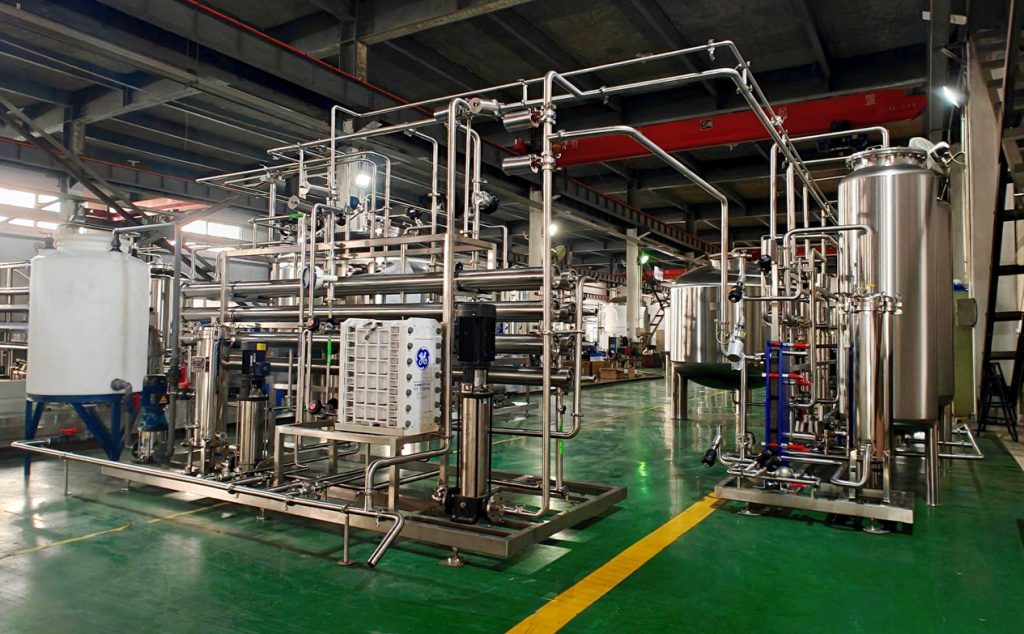
Purified Water (PW) is commonly produced through reverse osmosis (RO), often combined with electrodeionization (EDI). It provides feed water for WFI generation and supports suitable cleaning and utility applications.
Water for Injection (WFI) is a higher-quality pharmaceutical water grade used for parenteral manufacturing applications. It is commonly required for injectable solution preparation and other critical product-contact processes.
| Manufacturing Stage | Water Grade | Main Purpose |
|---|---|---|
| Initial container washing | PW | Remove particles and residues |
| Final container rinsing | As required by validated procedures | Control contamination before filling |
| Solution preparation | WFI | Main formulation solvent |
| Equipment pre-rinsing | PW | Remove product residues |
| WFI generation feed | PW | Provide suitable feed water |
| Autoclave water supply | Process-dependent | Support sterilization equipment |
The two systems must work together. If the PW system cannot provide stable feed water, WFI production may become unstable. If the WFI distribution loop cannot meet peak demand, production equipment may experience insufficient water supply.
For this reason, pharmaceutical water system design should consider the complete production process rather than treating each machine as an independent unit.
How a Pharmaceutical Water System Supports WFI Production
A reliable WFI system starts with suitable feed water. In many pharmaceutical facilities, purified water is produced before entering the WFI generation stage.
A typical pharmaceutical water treatment process includes several stages:
Pretreatment: Multimedia filters reduce suspended solids, activated carbon removes residual chlorine and certain organic impurities, and softeners reduce water hardness.
Reverse Osmosis (RO): RO membranes reduce dissolved salts, organic substances, and other impurities.
Electrodeionization (EDI): EDI further reduces dissolved ions and helps produce consistent purified water without regular chemical regeneration.
PW Storage and Distribution: Treated water enters a sanitary storage tank and is distributed through a hygienic piping system. Proper circulation, drainability, and online monitoring help maintain water quality.
The resulting PW is supplied to the WFI generation system. The design must consider feed water quality, production capacity, operating conditions, and applicable pharmacopoeial requirements.

WFI System Selection: Distillation or Membrane Technology?
Two major approaches are used in modern pharmaceutical WFI production: multi-effect distillation and membrane-based purification.
The correct choice depends on regional regulations, feed water quality, energy costs, production capacity, and the manufacturer’s technical capabilities.
Multi-Effect Distillation
Multi-effect distillation uses several evaporation and condensation stages. Heat from one effect supports the next, improving thermal efficiency.
During evaporation, non-volatile impurities and endotoxins remain in the liquid phase rather than entering the purified vapor, provided the equipment is properly designed and operated.
Key advantages include:
- Established technology with extensive pharmaceutical applications.
- Effective separation of non-volatile impurities.
- Thermal processing as an additional microbial control barrier.
- Suitable for facilities with reliable steam and cooling utilities.
However, multi-effect distillation requires suitable heating utilities, cooling capacity, and regular maintenance.
Membrane-Based WFI Production
Membrane-based WFI production uses an appropriately designed purification process. Depending on the system configuration, it may combine reverse osmosis, electrodeionization, ultrafiltration, and other suitable treatment technologies.
The European Pharmacopoeia has permitted qualified non-distillation WFI production methods since 2017. Other markets have their own requirements, so manufacturers must confirm whether membrane-based WFI production is accepted by the applicable regulatory framework.
Potential advantages include lower thermal energy demand, continuous operation, and integration with existing purified water systems.
However, membrane-based systems require effective control of microorganisms and bacterial endotoxins. A validated contamination-control strategy may include continuous circulation, suitable sanitization, UV treatment where appropriate, and routine water quality monitoring.
| Comparison | Multi-Effect Distillation | Membrane-Based WFI |
|---|---|---|
| Main principle | Evaporation and condensation | Membrane separation and purification |
| Energy demand | Higher thermal demand | Generally lower thermal demand |
| Microbial control | Thermal process provides an additional barrier | Requires validated contamination control |
| Main equipment | Evaporators, condensers, heat exchangers | RO, EDI, UF and supporting equipment |
| Key consideration | Steam and cooling utilities | Feed water and microbial control |
Neither technology is automatically the best choice for every facility. Manufacturers should first confirm regulatory acceptance in their target market and then compare technical requirements, operating costs, and long-term maintenance needs.
WFI Storage and Distribution: Protecting Water Quality
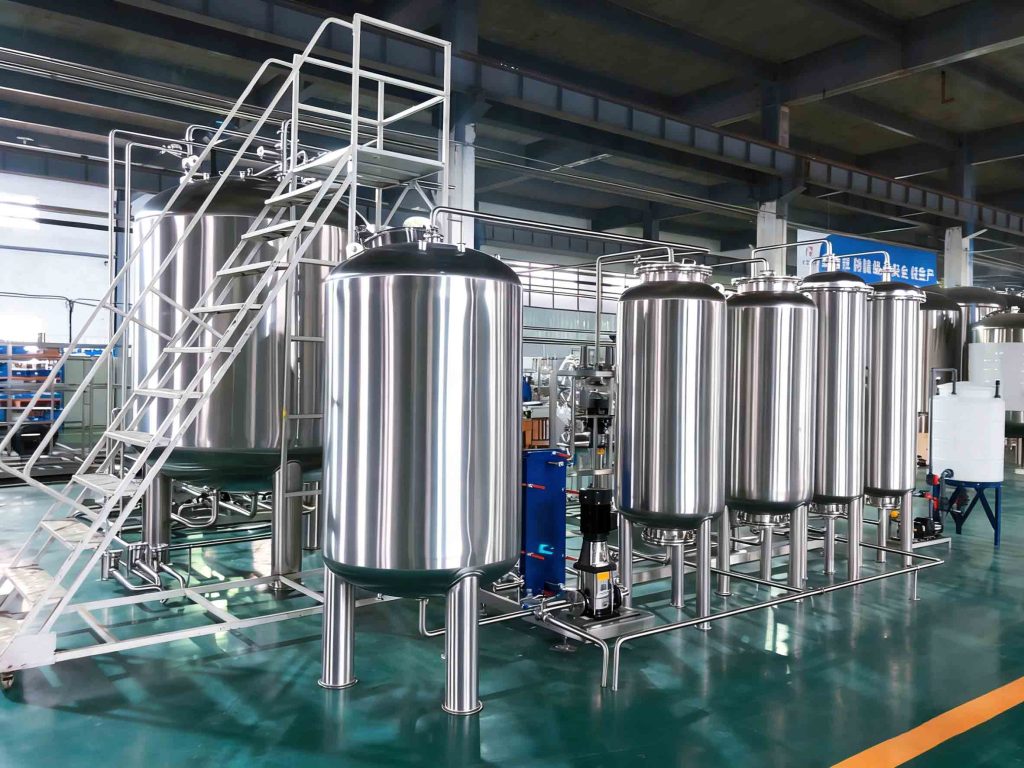
Producing qualified WFI is only the first step. Water must remain within specification during storage and distribution.
Poorly designed distribution systems may allow microbial growth, biofilm formation, and endotoxin accumulation, even when the WFI generator operates correctly.
Important engineering considerations include:
- Hygienic materials: Product-contact surfaces commonly use 316L stainless steel.
- Dead-leg control: Pipe connections should be designed to minimize stagnant sections.
- Continuous circulation: Suitable circulation helps maintain consistent water quality.
- Drainability: Proper pipe slopes and hygienic connections support effective drainage.
- Online monitoring: Conductivity, TOC, temperature, pressure, and flow can be monitored according to system requirements.
- Sanitization: Thermal or other validated sanitization strategies help control microbial risks.
A well-designed WFI storage and distribution loop helps maintain water quality from generation to the point of use.
SKE&EAGLE Pharmaceutical Water System Solutions for LVP Manufacturing
For pharmaceutical manufacturers, stable water quality requires more than an individual WFI generator. It requires an integrated system connecting pretreatment, purified water production, WFI generation, storage, and distribution.
SKE&EAGLE specializes in pharmaceutical water treatment equipment and integrated water system solutions. Our equipment solutions can include:
- Pharmaceutical Purified Water Systems: RO and EDI treatment systems designed to produce stable purified water.
- WFI Generation Systems: Multi-effect distillation equipment and membrane-based solutions where permitted by applicable regulations.
- WFI Storage Tanks: Hygienic stainless steel tanks designed for pharmaceutical water storage.
- Water Distribution Systems: Sanitary piping and circulation systems designed around plant capacity and points of use.
- System Integration: Equipment selection and capacity matching across different water treatment stages.
For Large Volume Parenteral projects, system integration is particularly important. The purified water system must provide suitable feed water for WFI generation. The WFI generator must meet production demand, while storage and distribution systems must maintain water quality until the water reaches each point of use.
FAQ
Q1: What type of water is used in Large Volume Parenteral manufacturing?
WFI is generally used for injectable solution preparation and critical product-contact applications. Purified water supports initial washing, WFI generation feed, and other approved manufacturing processes.
Q2: What is the difference between purified water and WFI?
Purified water is commonly produced through RO and EDI and is used for various pharmaceutical manufacturing applications. WFI must meet additional requirements for injectable product manufacturing, particularly bacterial endotoxin control.
Q3: Can membrane technology produce WFI for Large Volume Parenteral products?
Yes, in markets where the applicable pharmacopoeia and regulatory framework permit qualified non-distillation methods. The process must be designed, qualified, and monitored to consistently meet WFI quality requirements.
Q4: What is the bacterial endotoxin limit for WFI?
A commonly applied pharmacopoeial limit is not more than 0.25 EU/mL. Manufacturers should verify the current requirements of the pharmacopoeia applicable to their market.
Q5: Why is WFI distribution system design important?
Poor pipe layouts, dead legs, stagnant water, and inadequate sanitization may increase microbial and endotoxin risks. A hygienic distribution loop with suitable circulation, monitoring, and validated sanitization helps maintain water quality.
Conclusion
Water quality is one of the foundations of safe and reliable Large Volume Parenteral manufacturing. From solution preparation to container rinsing and equipment cleaning, pharmaceutical water systems affect multiple production stages.
A properly designed purified water system provides stable feed water, while a qualified WFI system supplies water for critical parenteral applications. Both systems must work together with suitable storage, distribution, monitoring, and sanitization strategies.
For manufacturers planning a new production facility or upgrading an existing line, selecting an experienced pharmaceutical water equipment supplier is an important step toward stable production and consistent product quality.
SKE&EAGLE provides pharmaceutical water treatment equipment and integrated WFI system solutions to support pharmaceutical manufacturers in building reliable water supply systems for Large Volume Parenteral production. Contact our engineering team to discuss your project requirements and system configuration.
Contact Email: info@ske-eagle.com
Follow us on Facebook for the latest industry insights: SKE & Eagle Facebook
Business Inquiries: Visit our official website and submit the contact form at the bottom.