

Water is the highest-volume raw material in most pharmaceutical plants. It is also the one most likely to trigger an FDA observation. In fiscal year 2025, the FDA’s Office of Compliance issued more than 120 warning letters to drug manufacturing facilities citing CGMP deviations (FDA, FY2025). Water system failures, dead legs, inadequate sanitization, unvalidated monitoring, are a recurring theme in those findings. Choosing a commercial water purifier system is a compliance decision as much as an engineering one.
This guide explains what separates a pharmaceutical-grade purification system from an industrial one. It covers the compendial standards a system must meet, the technologies used to get there, and the validation documentation a supplier should hand over before the system touches production.
Key Takeaways
- Purified Water (PW) and Water for Injection (WFI) must meet USP, EP, and JP conductivity and TOC limits, verified through staged online testing under USP <645>.
- Since April 2017, EP monograph 0169 has allowed WFI to be produced by reverse osmosis combined with electrodeionization, ultrafiltration, or nanofiltration, not distillation alone (EMA, 2017).
- A complete validation package includes DQ, IQ, OQ, and PQ documentation, plus material certifications and calibration records (FDA inspection guide).
- Well-designed reverse osmosis membranes typically reject 95 to 99% of dissolved solids under normal operating conditions; rejection varies by compound and membrane condition (NIH study).
For related equipment, see SKE & EAGLE’s pure water system solutions or reverse osmosis generators.
Why Purified Water and WFI Require Different Standards
Purified Water (PW) is water used as an ingredient in non-parenteral drug formulations, for equipment cleaning, and for quality control testing. Water for Injection (WFI) is water that meets the strictest pharmacopoeial purity standard because it becomes part of, or contacts, a sterile injectable product. Both must be produced from a validated system, but WFI carries tighter microbial and endotoxin control.
Feed water quality varies by source and season, so few pharmaceutical operations can use municipal water untreated. USP, EP, and JP each define conductivity and TOC limits for PW and WFI, verified through the staged testing described in USP <645>. Both water grades share a TOC target limit response of 500 µg carbon per liter. The exact pass or fail number depends on the reference standard and instrument used (USP FAQ).
A commercial water purifier system built to hit these limits consistently is typically organized into three sections: pretreatment, primary purification, and distribution. Each section removes a different category of contaminant.

Multi-Stage Filtration: The Foundation of Reliable Purification
No single treatment step removes every contaminant category, so pharmaceutical water systems use multi-stage filtration: a sequence of barriers, each targeting a specific class of impurity. A sediment filter removes particles like sand and rust, but not dissolved salts. A reverse osmosis membrane reduces total dissolved solids effectively, but it may not fully remove every microbe or organic compound. A typical pharmaceutical pure water train includes:
- Pre-filtration to remove suspended particles
- Activated carbon to reduce chlorine and organic compounds
- Reverse osmosis to remove dissolved salts and heavy metals
- Continuous electrodeionization for further ion polishing
- Ultraviolet disinfection for microbial control
This layered design extends the service life of downstream components. The FDA’s own inspection guidance calls out under-designed pretreatment as a common root cause of membrane fouling and unplanned outages (FDA guide).
Advanced Technologies in Modern Systems
Reverse Osmosis
Reverse osmosis (RO) is a pressure-driven membrane process that pushes feed water through a semi-permeable barrier, retaining dissolved ions and organics while passing purified water through. A peer-reviewed evaluation of RO membrane performance found rejection rates ranging from roughly 74% to over 99%, depending on the target compound and membrane condition (NIH study). Well-maintained systems consistently land at the high end of that range. That variability is exactly why RO is paired with downstream polishing steps rather than used alone.
For example, a facility relying on RO as its sole barrier against ionic contaminants needs to track rejection performance closely. A membrane nearing the end of its service life can drift toward the lower end of that range well before it fails outright. Automatic pressure control and a documented membrane replacement schedule reduce that risk. See SKE & EAGLE’s reverse osmosis generator systems for one implementation approach.
Continuous Electrodeionization
Continuous electrodeionization (CEDI) is a polishing technology that combines ion-exchange resin with an applied electrical current to remove residual ionic impurities. Unlike traditional ion-exchange systems, it needs no acid or caustic regeneration chemicals. Pairing RO with CEDI is now standard practice for high-purity water production. Well-operated CEDI trains can approach the conductivity of theoretically pure water, roughly 0.055 µS/cm at 25°C. That is well under the USP <645> Stage 1 online limit of 1.3 µS/cm at 25°C for both PW and WFI (Veolia: USP <645>).
Until April 2017, this RO-plus-CEDI approach could not legally be used to produce WFI in the European Union. European Pharmacopoeia monograph 0169 restricted WFI production to distillation only. The monograph was then revised to permit reverse osmosis combined with electrodeionization, ultrafiltration, or nanofiltration as an equivalent process (EMA, 2017). System specifications written before that date, or validation packages inherited from an older facility, may still assume distillation is the only compliant WFI method. It’s worth confirming which pharmacopoeia and monograph revision a given spec was written against before ruling out membrane-based WFI on regulatory grounds.
Ozone Sanitization
For distribution loops that run at ambient temperature, ozone is often used to control bacterial growth between production cycles. Ozone is generated from a small side-stream of purified water, then destroyed by UV light before the water re-enters the distribution loop, giving microbial control without leaving a chemical residue.

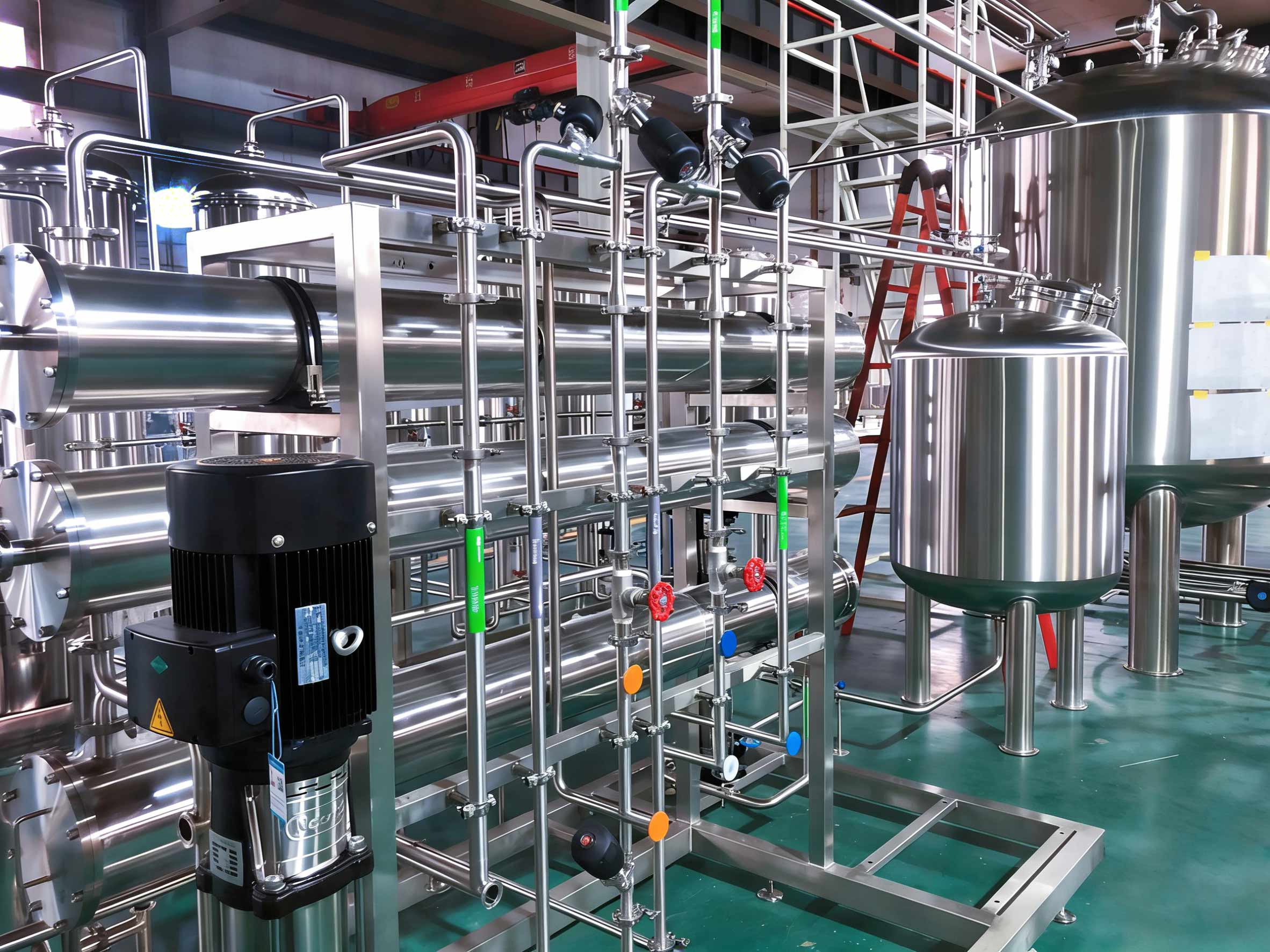
Purified water system with reverse osmosis and CEDI polishing stages
Validation: A Non-Negotiable Requirement
Validation proves a water system performs consistently and meets its stated objectives throughout its operating life. It is required for USP, EP, and JP-compliant PW and WFI systems, not optional documentation added after commissioning.
A complete validation package from a qualified supplier typically includes:
- Design Qualification (DQ), documented evidence that the system design meets user requirements before construction begins
- Installation Qualification (IQ), verification that equipment is installed as specified
- Operational Qualification (OQ), testing that confirms the system operates within defined parameters
- Performance Qualification (PQ), extended testing that confirms consistent performance under real operating conditions
- Functional and software design specifications
- QA test records and instrument calibration certificates
FDA’s FY2025 compliance data shows warning letters concentrated on CGMP deviations and inadequate investigation of out-of-specification results, not necessarily on equipment design itself (FDA, FY2025). That pattern suggests the documentation and deviation-handling process, not just the hardware specification, is where audits most often find gaps. Documentation should follow GAMP 5 principles and satisfy FDA expectations for data integrity under 21 CFR Part 11.
Material Selection and Hygienic Design
Pharmaceutical water systems require careful attention to materials and hygienic design, including:
- Sanitary connections and fittings
- Sloped piping with low-point drains
- Minimal dead legs, unused sections of piping where stagnant water can support biofilm growth
- Certified materials that meet pharmacopoeial requirements
ASME BPE refers to the American Society of Mechanical Engineers’ Bioprocessing Equipment standard, which governs weld quality, surface finish, and material traceability for pharmaceutical piping and vessels. Systems built to this standard use qualified welders, with every weld inspected and documented for traceability back to the original material certification.
System Configuration Options
Skid-Mounted Systems
Skid-mounted systems are pre-assembled and pre-tested off-site, which shortens installation time for facilities that need continuous, high-capacity purification with minimal site disruption. Typical features include microprocessor-based controls, integrated pretreatment, safety sensors, Clean-in-Place (CIP) capability, and optional IoT monitoring. For processes that also require sterilization rather than cleaning alone, see how CIP compares to Steam-in-Place (SIP) and SKE & EAGLE’s CIP and SIP equipment solutions.
Custom-Engineered Solutions
Site constraints or unusual capacity requirements sometimes call for a custom-engineered approach rather than a standard skid. A well-executed custom design maintains full regulatory compliance while accommodating the specific footprint, feed water chemistry, and throughput a facility actually has. Timelines are often comparable to a standard skid once engineering requirements are locked.
Distribution Systems: Protecting Quality to the Point of Use
The distribution system must maintain water quality from production to every point of use while preventing microbial growth along the way. Recirculation loops continuously circulate water to avoid stagnation, which reduces the risk of biofilm formation at low-flow points.
Key components include hygienic pumps, diaphragm valves sized for the loop’s flow profile, heat exchangers for temperature control, and point-of-use coolers. Heat sanitization is widely used in distribution loops because it controls biofilm without introducing a chemical residue that would need to be rinsed or monitored separately.

Monitoring and Control
Modern systems monitor Total Organic Carbon, conductivity, and microbial counts continuously rather than relying solely on periodic grab samples. Total Organic Carbon (TOC) is a measurement of organic contamination in water. Pharmacopoeias set a target limit response of 500 µg carbon per liter for both PW and WFI (USP FAQ). Online TOC analyzers built to USP <643> methodology can detect carbon levels well below that limit, giving operators an early warning before a batch-release excursion occurs.
Control systems built for 21 CFR Part 11 data integrity include alarm management, audit trails, and change logging so that conductivity, TOC, and microbial trend data can be reconstructed during an inspection.
Bar chart comparing typical CEDI conductivity and TOC design output against USP Stage 1 conductivity and TOC compendial limits, showing a wide compliance margin.
Typical CEDI Output vs. USP Compendial Limits
Conductivity (µS/cm @25°C)
CEDI ~0.055
USP limit 1.3
TOC (µg C/L)
Design <10
USP limit 500
Bars not to a shared linear scale; illustrative margin only. Source: USP <645>, USP FAQ, 2026.
Comparison of System Configurations
| Application | Recommended Setup | Design Priority |
|---|---|---|
| Purified Water for oral solids | RO + CEDI + UV | Compact footprint, lower utility cost |
| Water for Injection (WFI) | RO + CEDI + Ozone + Heat Sanitization | No chemical residue, full microbial control |
| Pretreatment for distillation | Softener + Carbon + Dual-Pass RO | Automatic CIP, high TDS reduction ahead of the still |
Illustrative Case Study: Closing a TOC Monitoring Gap in a Sterile Manufacturing Facility
This is a composite, illustrative scenario built from patterns common to sterile injectable manufacturers, not a specific verified customer.
Snapshot
- Industry: Sterile injectable manufacturing
- Scale: Mid-sized manufacturer, single WFI loop feeding three filling lines
- Equipment: RO + CEDI + ozone sanitization skid with online TOC and conductivity monitoring
- Headline result: batch-release TOC excursions eliminated after moving from weekly grab sampling to continuous online monitoring
The Challenge
A mid-sized sterile injectable manufacturer had been releasing WFI batches using weekly offline TOC grab samples, a testing cadence that met the letter of USP <643> but left several days of blind spots between samples. An audit finding noted that a TOC excursion could occur and resolve itself between sampling points without ever appearing in the batch record. That is exactly the kind of gap FDA’s FY2025 enforcement data associates with CGMP deviation citations.
The Solution
The facility upgraded to continuous online TOC and conductivity monitoring integrated with its existing CEDI polishing stage. Alarm thresholds were set well inside the USP <645> Stage 1 limit rather than at the compendial edge. Because the monitoring data logged automatically with timestamps, the validation package could demonstrate continuous compliance rather than a series of discrete passing samples.
Results
- TOC monitoring coverage moved from roughly weekly grab samples to continuous online measurement
- No batch-release TOC excursions were recorded in the twelve months following the upgrade
- The following inspection cycle closed with no repeat findings related to water system monitoring
“Continuous monitoring didn’t just catch problems faster. It gave us a documented record that shows the system was in control the whole time, not just at the moment someone pulled a sample.”
Quality Manager, composite scenario
Frequently Asked Questions
What makes pharmaceutical water systems different from commercial purifiers for other industries?
Pharmaceutical systems must meet USP, EP, and JP pharmacopoeial standards, with full validation and contaminants measured in parts per billion. The system has to maintain that purity throughout the entire distribution loop, not just at the point of production, which is a much higher bar than most industrial or residential purification applications.
What validation documentation should a supplier provide?
A complete package includes DQ, IQ, OQ, PQ, functional specifications, material certifications, calibration certificates, weld maps, and passivation records, all built around GAMP 5 principles. If a supplier can’t produce this documentation before installation, that’s a sign the system wasn’t engineered with validation in mind from the start.
Why is TOC monitoring important?
TOC measures organic contamination that could interfere with drug stability or introduce impurities. Pharmacopoeias set a target limit response of 500 µg carbon per liter for PW and WFI, and online analyzers can detect levels well below that, giving real-time visibility instead of waiting on periodic lab results.
What are the advantages of skid-mounted systems?
They arrive pre-assembled and pre-tested, which means faster installation with less site disruption than a fully custom build. Integrated controls, CIP capability, and optional remote monitoring reduce the operational burden once the system is running.
How do I choose the right system for my production scale?
The choice depends on feed water quality, daily consumption, and which pharmacopoeia governs the facility. For example, a facility supplying only the EU market can now specify RO-based WFI production under the post-2017 EP monograph. One supplying markets that still require distillation-equivalent processes needs to confirm that requirement before finalizing a design.
Conclusion
A pharmaceutical commercial water purifier system is a compliance system first and a piece of equipment second. The validation package, monitoring strategy, and documented deviation process matter as much as the RO membranes and CEDI stack, since FDA’s own enforcement data points to documentation gaps as often as hardware failures.
This guide is reviewed by SKE & EAGLE’s engineering team before publication. See About SKE & EAGLE for background on the team that designs and validates these systems. To talk through feed water conditions and validation requirements for a specific facility, contact the engineering team.