

In pharmaceutical manufacturing, water quality can change after it leaves the RO/EDI unit. Poor storage conditions, stagnant pipes, and weak circulation can allow microorganisms to grow. This can lead to biofilm formation and unstable water quality in any Purified Water Systems.
One of the most common design risks is the dead leg.
A dead leg is a section of pipe where water does not move properly. Even a small branch can become a place where microorganisms grow and spread into the main distribution loop.
At SKE&EAGLE, we design Purified Water Systems with a focus on the complete process, from generation to storage and distribution. A reliable generation unit is important, but the whole system must work together to protect water quality.
This article explains how storage and distribution work, why dead legs create microbial risks, and what engineers should consider when designing a hygienic Purified Water Systems.

What Does a Purified Water Storage and Distribution System Do?
A standard system usually includes two main sections: generation and storage and distribution.
The generation system produces purified water through reverse osmosis (RO), electrodeionization (EDI), and other processes. Its performance is evaluated through conductivity, total organic carbon (TOC), and microbial quality, according to pharmacopoeial requirements.
The storage and distribution system has a different responsibility. It must maintain water quality after generation and deliver water reliably to different production areas.
This part of the Purified Water Systems normally includes:
-
Storage tank: Holds purified water and balances changes in demand.
-
Circulation pump: Moves water through the distribution loop.
-
Distribution piping: Delivers water to points of use.
-
Sanitary valves and fittings: Control flow while reducing contamination risks.
-
Monitoring instruments: Measure conductivity, temperature, and TOC.
-
Sanitization equipment: Supports microbial control through validated procedures.
Storage and distribution are not simply plumbing. They are important parts of Purified Water Systems quality control.
Many facilities use continuously recirculating loops to reduce stagnation. However, circulation alone cannot guarantee water quality. Tank design, pipe geometry, temperature, sanitization, and routine monitoring must also be controlled.
Table 1: Key Design Considerations for Purified Water Storage and Distribution
| Parameter | Design Consideration | Main Purpose |
|---|---|---|
| Water circulation | Continuous recirculation where appropriate | Reduces stagnation |
| Flow conditions | Suitable and validated flow throughout the loop | Supports microbial control |
| Tank vent | Hydrophobic, bacteria-retentive filter | Reduces airborne contamination |
| Sanitization | Validated thermal or chemical method | Controls microbial growth |
| Pipe connections | Hygienic design with minimal dead legs | Reduces stagnant areas |
| Drainage | Proper pipe slope and drainable design | Prevents retained water |
Dead Legs: A Hidden Risk in Purified Water Systems
A dead leg is a section of piping where water remains stagnant or has very limited movement during normal operation.
Common examples include unused pipe branches, poorly designed instrument connections, long valve connections, bypass lines, and unused sampling points.
In a Purified Water Systems, these areas can create conditions for microbial growth.
Why Are Dead Legs Dangerous?
Water in a stagnant branch does not receive the same circulation as water in the main loop. It may also receive insufficient exposure to sanitization.
When water remains in one place, microorganisms can attach to the internal pipe surface. Over time, they may form a biofilm. This is a layer of microorganisms protected by a surrounding matrix, and normal circulation may not remove it.
The problem does not always appear immediately. A dead leg may stay unnoticed until microbial monitoring detects an unexpected increase in bacteria. Once contamination occurs, microorganisms can enter the main loop and reach multiple points of use.
This creates several operational risks: unstable microbial results, repeated sanitization and investigation, extra maintenance and downtime, and possible impact on manufacturing.
For this reason, dead leg prevention should be considered during the initial design of a Purified Water Systems, not treated as a maintenance issue.
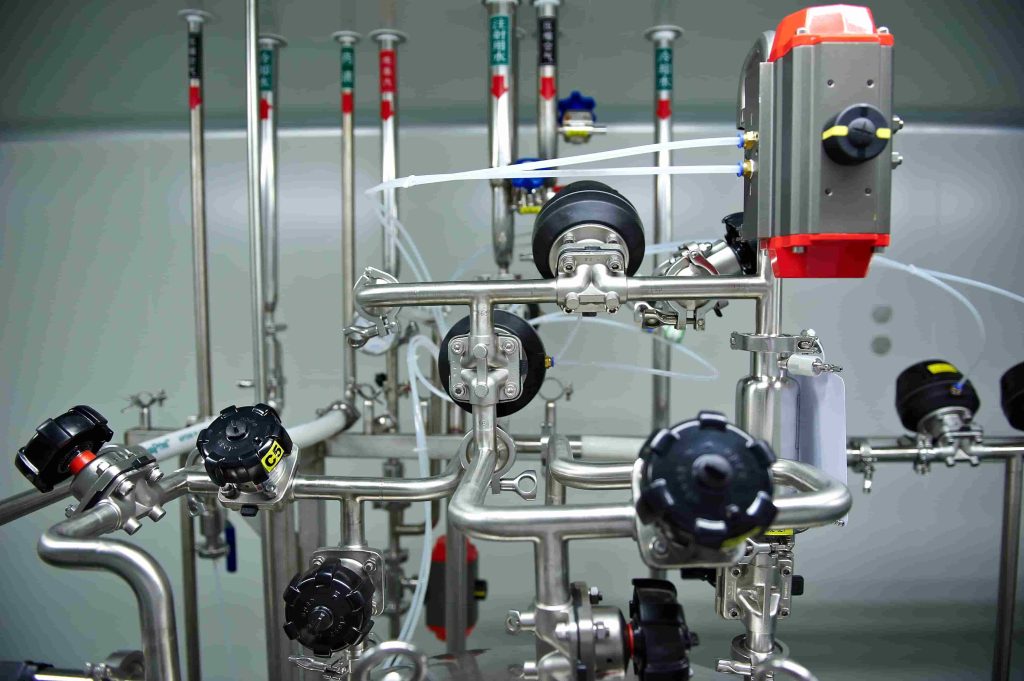
Understanding the 3D and 6D Dead Leg Concepts
The 3D and 6D concepts are commonly discussed in system engineering.
The term D refers to the pipe diameter used for measuring a branch length. However, the measurement method and design context must be clearly defined.
The FDA’s 1993 High Purity Water System guide discusses a six-diameter concept for certain high-purity piping arrangements. It should not be read as a universal legal limit.
Similarly, 3D is widely used as a more conservative hygienic design reference. It should not automatically be described as a universal WHO or ISPE requirement.
Table 2: Understanding Dead Leg Design References
| Design Reference | General Meaning | Engineering Consideration |
|---|---|---|
| 6D concept | Branch length up to six pipe diameters | Requires careful evaluation of stagnant volume and sanitization |
| 3D concept | Shorter branch length, common conservative reference | Helps reduce stagnant areas |
| Zero dead leg design | Suitable hygienic valves and connections | Minimizes stagnant volumes when correctly installed |
A shorter branch generally reduces stagnant water and makes flushing easier. However, a ratio alone cannot prove that a connection is hygienic. Performance also depends on pipe orientation, geometry, drainage, and sanitization effectiveness.
For new projects, engineers should minimize unnecessary branches and use zero dead leg valves where appropriate.
Storage Tank Design: Protecting Water Quality Before Distribution
The storage tank is another important part of the system.
Its main function is to balance water production with changing demand. However, poor tank design can create contamination risks even when the generation system performs well.
A pharmaceutical storage tank should be designed to reduce microbial growth and support effective cleaning and sanitization.
1. Hygienic Internal Design
The tank interior should have a smooth, cleanable surface with suitable sanitary welds. Internal structures should avoid gaps where water can remain.
2. Spray Devices and Surface Wetting
Suitable spray devices help distribute water across internal tank surfaces during cleaning and sanitization. Their coverage should be evaluated as part of the system design.
3. Complete Drainage
The tank bottom should support effective drainage. Poor drainage can leave residual water and create conditions for microbial growth.
4. Tank Vent Protection
As water enters and leaves the tank, air exchange may occur. A hydrophobic, bacteria-retentive vent filter helps reduce airborne contamination. Filter integrity and replacement should be part of the maintenance plan.
5. Temperature and Sanitization Control
Storage temperature affects microbial growth. Depending on design, facilities may use hot water circulation, ozone, or other validated methods. The method should match materials, operating conditions, and water quality requirements.
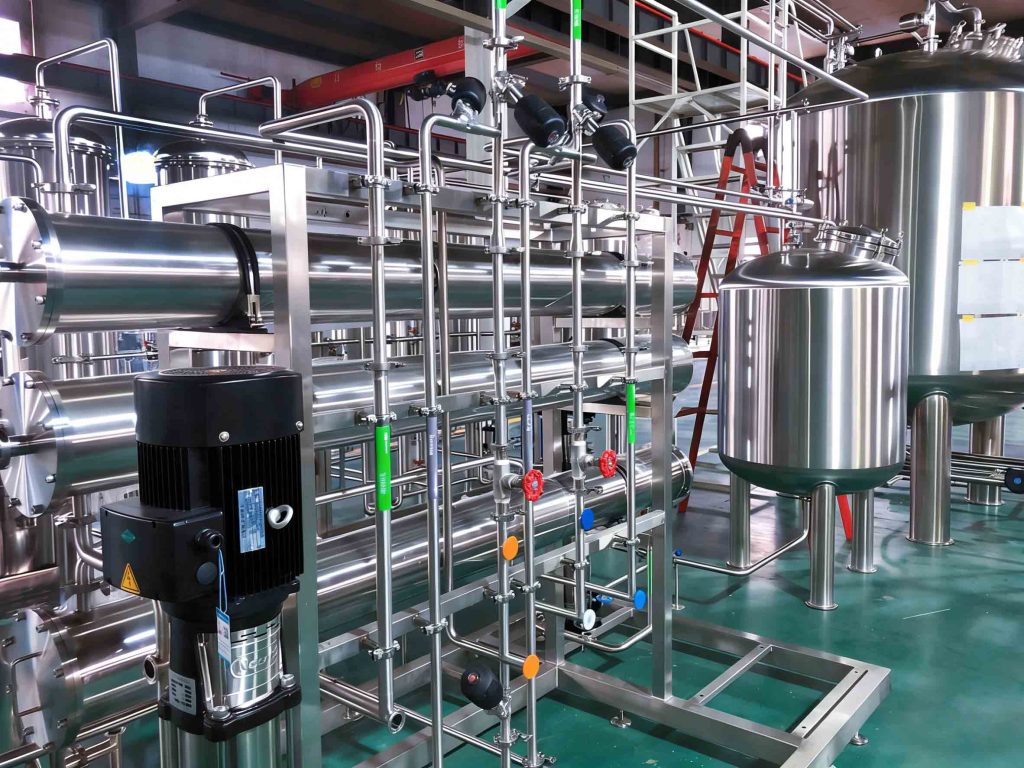
How to Design a Reliable Pharmaceutical Water Distribution Loop
A well-designed distribution loop helps maintain stable water quality from the tank to every point of use. Engineers must consider how water behaves during low demand, peak demand, and sanitization.
1. Maintain Suitable Water Circulation
Circulation pumps should be selected according to system demand, pipe dimensions, pressure losses, and operating conditions. The system should maintain suitable flow throughout the loop, including when consumption changes.
Variable frequency drives (VFDs) can adjust pump operation according to demand. However, pressure control should not cause unacceptable reductions in circulation or compromise validated conditions.
2. Minimize Dead Legs and Unnecessary Connections
Every branch should have a clear purpose. Instrument connections, sampling points, bypass lines, and equipment connections should be reviewed during design.
Suitable sanitary valves and hygienic connections can reduce stagnant volumes and improve cleaning access.
3. Use Hygienic Piping and Welding
Piping material and internal surface quality affect cleaning and microbial control. Pharmaceutical Purified Water Systems commonly use suitable grades of stainless steel, such as 316L, depending on requirements.
Automatic orbital welding can improve weld consistency. Weld inspection, surface finishing, and electropolishing may also support a smooth, cleanable surface.
4. Ensure Effective Drainage
Pipes should be designed with suitable slopes to reduce water retention. Low points, equipment connections, and sampling locations need particular attention. A system that cannot drain properly may retain water even if its main loop operates correctly.
5. Establish a Validated Sanitization Strategy
Different facilities may use different sanitization methods:
-
Hot water sanitization: Uses controlled temperature and exposure time.
-
Ozone sanitization: Uses ozone as an oxidizing agent.
-
Chemical sanitization: Uses suitable chemical agents under controlled conditions.
The choice depends on materials, water quality, equipment design, and operating requirements. Procedures should be validated to show effective microbial control throughout the system.
How SKE&EAGLE Designs Complete Purified Water Systems
At SKE&EAGLE, our engineering approach focuses on protecting water quality throughout the complete purification process. We understand that a high-performance RO/EDI unit is only one part of the solution. Storage tanks, piping, pumps, valves, and control systems must work together.
Our solutions can cover the following areas.
1. Integrated Generation and Distribution
We provide complete configurations covering generation, storage, and distribution. Depending on requirements, the design can include RO, EDI, storage tanks, circulation pumps, and sanitary piping.
2. Hygienic Piping Design
Our team considers pipe routing, branch connections, circulation, and drainage during design. We use automatic argon-protected orbital welding where appropriate, with suitable surface finishing and electropolishing.
3. Customized Storage Tank Solutions
Tanks are designed according to production demand, installation space, and system requirements. Key points include capacity, internal surface quality, drainage, and sanitary connections.
4. Automated Monitoring and Control
Control systems can monitor operating conditions and important water quality parameters. Depending on configuration, they can support alarm management, data recording, audit trails, and electronic signatures. Where applicable, systems can be designed to support 21 CFR Part 11 requirements.
5. Documentation and Validation Support
Our project documentation can include material certificates, welding records and weld maps, internal pipe inspection and endoscopy records, pressure test reports, equipment drawings, and IQ/OQ documentation support. The final scope depends on project specifications and agreed validation responsibilities.
By treating generation, storage, distribution, and control as one integrated system, SKE&EAGLE helps manufacturers build setups that support reliable daily operation and consistent water quality.

FAQ:Purified Water Systems
Q1: What is the difference between a dead leg and a low-flow zone?
A dead leg is a pipe branch where water has little or no movement during normal operation. A low-flow zone is an area where water moves more slowly than intended. Both can create microbial risks. However, a dead leg may be more difficult to flush and sanitize because water exchange is limited.
Q2: Is the 3D or 6D rule better?
The 3D concept is generally a more conservative design reference because it reduces branch length and stagnant volume. The 6D concept is discussed in historical FDA guidance, but it should not be treated as a universal requirement. The final design should consider applicable guidance, piping geometry, operating conditions, and sanitization validation.
Q3: How often should a purified water distribution loop be sanitized?
There is no universal frequency for every facility. The interval should be established through qualification, microbial monitoring, operating conditions, and risk assessment. Facilities should use monitoring trends and validated procedures to confirm the selected frequency provides consistent control.
Q4: Can a system operate without a storage tank?
Some setups can be designed for direct supply, depending on production demand and process requirements. However, many facilities use storage tanks to balance production and consumption. The right configuration depends on demand, capacity, distribution design, and operational requirements.
Q5: Does SKE&EAGLE supply storage tanks and distribution loops or only RO/EDI equipment?
SKE&EAGLE provides Purified Water Systems solutions that can include generation, storage tanks, distribution loops, pumps, sanitary piping, and control systems. The project scope can be customized according to facility requirements, production capacity, and applicable standards.
Conclusion
A reliable Purified Water Systems requires more than effective generation. Storage and distribution play an equally important role in maintaining water quality throughout pharmaceutical manufacturing.
Dead legs, poor drainage, unsuitable tank design, and weak circulation can create conditions for microbial growth. These problems may stay hidden until monitoring detects an issue.
The best approach is to prevent these risks during design. Hygienic piping, suitable circulation, effective drainage, properly designed tanks, and validated sanitization all contribute to stable water quality in any Purified Water Systems.
For manufacturers planning a new Purified Water Systems or upgrading an existing installation, SKE&EAGLE provides integrated engineering solutions covering generation, storage, and distribution.
Contact Email: info@ske-eagle.com
Follow us on Facebook for the latest industry insights: SKE & Eagle Facebook
Business Inquiries: Visit our official website and submit the contact form at the bottom.