


Water filter systems in pharmaceutical manufacturing do not perform the main purification work. That role belongs to reverse osmosis, electrodeionization, or distillation. What water filter systems do is protect downstream equipment, remove specific impurities at defined stages, and support the overall water quality strategy.
This distinction matters because pharmaceutical water quality is not judged by a single sample. It depends on the performance of the complete treatment process—pretreatment, purification, storage, and distribution—operating consistently over time.
For engineers and quality teams, the practical question is not “which filter is best.” It is “how do water filter systems fit into a sanitary, monitorable, and compliant water treatment process.”
This article explains the role of water filter systems in pharmaceutical water production, including pretreatment stages, sanitary design principles, and daily monitoring requirements. It also covers common operational problems and how SKE&EAGLE approaches system design for pharmaceutical applications.
What Water Filter Systems Do in Pharmaceutical Water
A common misunderstanding is that filters perform all purification. In reality, pharmaceutical water treatment combines several technologies, each with a specific function.
The main purification steps are typically reverse osmosis (RO), electrodeionization (EDI), or distillation. Water filter systems support these processes by removing impurities that would damage downstream equipment or degrade final water quality.
Understanding this division of labor helps manufacturers specify correct equipment and avoid unnecessary system complexity.
Pretreatment Filtration
Pretreatment is the first stage in most pharmaceutical water filter systems. Its purpose is to improve feed water quality and protect downstream purification equipment.
Common pretreatment equipment includes multimedia filters for suspended solids and turbidity reduction, activated carbon filters for chlorine and chloramine removal, water softeners for hardness reduction, and cartridge filters for fine particle removal before sensitive equipment.
Activated carbon filtration requires particular attention. Chlorine damages RO membranes, so effective dechlorination is essential. However, carbon beds can also support microbial growth if poorly maintained. Regular monitoring, appropriate sanitization, and timely maintenance are therefore necessary to keep water filter systems under control.
Reverse Osmosis (RO)
Reverse osmosis is the central purification technology in many pharmaceutical water systems. An RO membrane uses pressure to separate water from dissolved salts, organic compounds, particles, and microorganisms.
In water filter systems, RO is the main impurity removal step. Its performance determines the quality of water entering downstream polishing stages.
Key operating parameters include feed pressure, permeate conductivity, recovery rate, differential pressure, and membrane performance trends. Monitoring these parameters helps operators identify fouling, scaling, and performance changes before they affect water quality.

Electrodeionization (EDI)
EDI is often installed after RO to remove residual dissolved ions. It combines ion-exchange materials, selective membranes, and an electrical field to produce high-purity water without chemical regeneration.
In pharmaceutical water filter systems, RO and EDI are commonly paired to achieve purified water quality. EDI performance depends on RO permeate quality and correct operating conditions. It does not replace the entire purification process.
Ultrafiltration (UF)
Ultrafiltration uses membranes with smaller pores than conventional filters to retain suspended particles, macromolecules, and—depending on membrane selection—endotoxins.
In pharmaceutical water applications, UF serves as a specific barrier where endotoxin control is required. It should be treated as a targeted purification step, not a universal solution for all contamination risks.
Sanitary Design for Water Filter Systems
Pharmaceutical water filter systems must do more than produce clean water at installation. They must remain cleanable, sanitizable, and controllable throughout their service life.
Poor design creates stagnant areas, difficult-to-clean surfaces, and conditions that support biofilm formation. Once established, biofilms become a persistent source of microbial contamination.
Three design principles reduce this risk.
Minimize Dead Legs and Stagnant Areas
Dead legs are piping sections where water does not circulate effectively. Stagnant water increases microbial growth risk and makes sanitization more difficult.
Pharmaceutical water distribution systems should minimize dead legs and avoid unnecessary branches and unused connections. This applies to water filter systems as well as storage and distribution loops. Design should account for actual flow rate, temperature, pipe dimensions, and water use patterns.
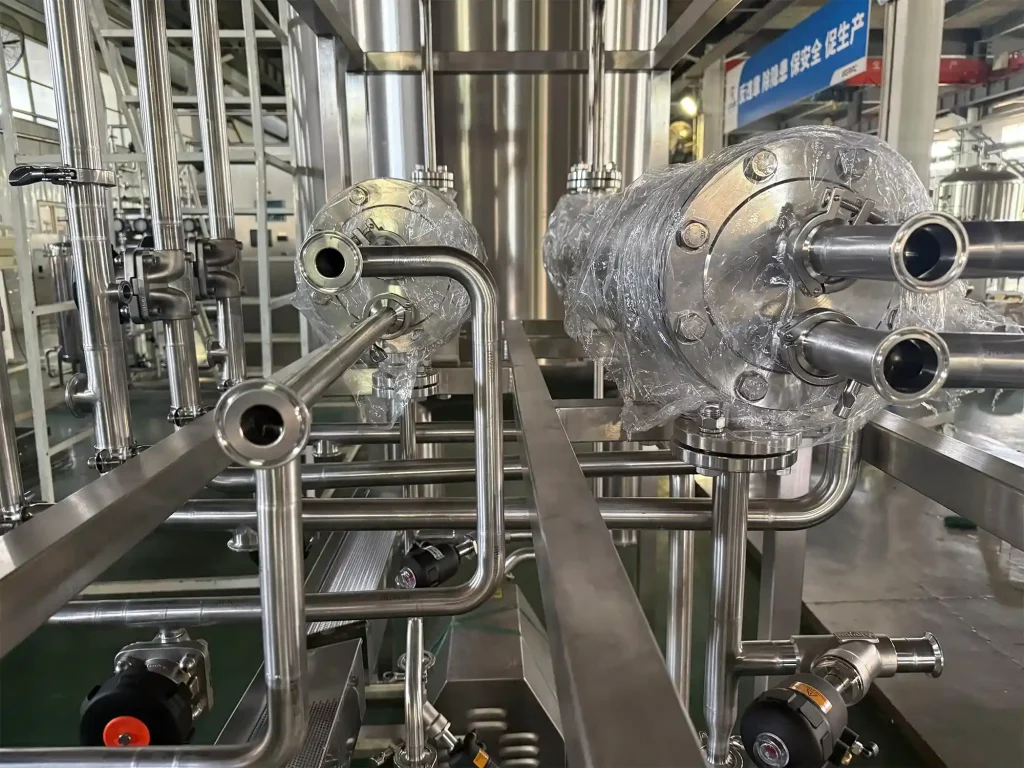
Select Materials Compatible with Sanitization
316L stainless steel is commonly used in pharmaceutical water storage tanks, distribution piping, and filter housings because of its corrosion resistance and suitability for sanitary fabrication.
Material selection alone is not sufficient. Surface finish, welding quality, drainage, and connection design also affect system cleanliness. Poorly finished welds and difficult-to-clean connections create locations where contamination may develop.
Design Filter Housings for Cleaning and Sanitization
For water filter systems, sanitary design means drainable housings, suitable sealing materials, minimal internal crevices, compatibility with cleaning agents, temperature resistance during hot water sanitization, and easy access for inspection.
If a system uses hot water sanitization at 80°C, the filter housing, seals, and connected components must withstand that temperature. If chemical sanitization is used, all wetted materials must be compatible with the selected chemicals.
Monitoring Water Filter Systems
A pharmaceutical water system cannot be evaluated through a single sample. Water quality depends on the complete process operating within defined limits.
WHO guidance and GMP principles emphasize regular monitoring, documented results, trend analysis, and corrective actions. For water filter systems, monitoring should be part of daily operation.
Online Monitoring Parameters
Online instruments help operators understand how water filter systems perform under normal conditions.
Conductivity indicates changes in dissolved ionic content. Total Organic Carbon (TOC) monitors organic contamination. Flow rate identifies changes in circulation and equipment performance. Pressure supports evaluation of pumps, membranes, and filters. Temperature confirms operating and sanitization conditions.
Conductivity and TOC are particularly important quality indicators in most pharmaceutical water systems. Monitoring requirements should be defined according to applicable pharmacopoeial standards and the approved control strategy.
Representative Sampling
Online instruments cannot replace laboratory testing and microbiological monitoring. Sampling locations and procedures should reflect actual system design and intended water use.
A sampling plan may include points after purification equipment, in storage and distribution loops, and at selected points of use. Where point-of-use filters are installed, sampling before and after the filter helps evaluate both incoming water quality and filter performance.
Sampling procedures must control external contamination. Sampling ports, hoses, flushing procedures, and containers must suit the test being performed.
Preventive Maintenance and Trend Review
Waiting until a filter blinds or a membrane loses performance causes unplanned downtime. Preventive maintenance uses operating data to identify deterioration before it becomes a serious problem.
An increase in cartridge filter differential pressure may indicate particle accumulation. A gradual change in RO permeate conductivity may indicate membrane degradation. Maintenance teams should review these trends and act according to established procedures.
Key Water Filter System Components
| Equipment | Typical Position | Main Function | Key Monitoring Parameter |
|---|---|---|---|
| Multimedia filter | Pretreatment | Remove suspended solids, reduce turbidity | Differential pressure |
| Activated carbon filter | Pretreatment | Reduce chlorine and chloramines | Chlorine after filtration |
| Water softener | Pretreatment | Reduce calcium and magnesium hardness | Outlet hardness |
| Cartridge filter (1–5 μm) | Before RO | Remove remaining particles | Differential pressure |
| Reverse osmosis (RO) | Main purification | Reduce dissolved ions and impurities | Conductivity, pressure, recovery |
| Electrodeionization (EDI) | After RO | Further reduce residual ions | Conductivity or resistivity |
| Ultrafiltration (UF) | Selected polishing stage | Retain endotoxins and larger molecules | Pressure and flow |
Not every pharmaceutical water system requires all listed technologies. The treatment process should be selected according to raw water quality, required water grade, and validated system design.

FAQ
Q1: How often should filter cartridges be replaced in pharmaceutical water filter systems?
There is no universal replacement interval. Replacement frequency should be established through equipment specifications, system qualification, routine monitoring, and operating experience. Differential pressure, feed water quality, microbial results, and filter performance all inform the schedule. The replacement schedule should be documented in an SOP and reviewed when conditions change.
Q2: Can a point-of-use 0.2-micron filter make pharmaceutical water safe?
No. A 0.2-micron filter reduces microorganisms under validated conditions, but it cannot replace properly designed water filter systems and a controlled pharmaceutical water system. It does not reliably remove dissolved substances or endotoxins. If point-of-use filtration is used, its purpose, installation, integrity, sanitization compatibility, and replacement frequency must be clearly defined.
Q3: What are common operational problems in water filter systems?
Common problems include inadequate routine monitoring, poor sampling practices, delayed filter replacement, RO membrane fouling or scaling, biofilm formation in storage and distribution loops, and incomplete maintenance documentation. These can affect water quality even when the original design is suitable.
Q4: How do pharmaceutical water filter systems differ from commercial water filters?
Commercial filters improve water quality for ordinary applications. Pharmaceutical water filter systems must be designed around required water grade, pharmacopoeial standards, sanitary construction, monitoring, and validation. They are integrated treatment processes with defined quality controls, not simply larger commercial units.
Q5: How does SKE&EAGLE approach water filter system design for pharmaceutical applications?
SKE&EAGLE designs pharmaceutical water treatment equipment and integrated water filter systems. The engineering approach considers raw water conditions, required water quality, treatment technology, sanitary construction, material selection, and operating requirements.
Depending on project needs, water filter systems can incorporate pretreatment, RO, EDI, storage, distribution, and other purification technologies. The objective is equipment that supports reliable operation, effective maintenance, and the customer’s qualification and validation activities.
Conclusion
Water filter systems play a specific and important role in pharmaceutical water production. They protect downstream purification equipment, polish water at selected stages, and form part of the barrier between raw feed water and a finished product that must meet pharmacopoeial standards.
But filtration alone does not make pharmaceutical water. Reliable performance depends on appropriate pretreatment, effective purification technology, sanitary equipment design, and continuous monitoring.
SKE&EAGLE is a manufacturer of pharmaceutical water treatment equipment, providing water purification and water filter systems for pharmaceutical production. From pretreatment and RO/EDI purification to integrated system engineering, SKE&EAGLE supports manufacturers in developing water treatment systems based on their production requirements and water quality specifications.
For a new pharmaceutical water project or an existing system upgrade, contact the SKE&EAGLE technical team to discuss a suitable water filter systems solution.
Contact Email: info@ske-eagle.com
Follow us on Facebook for the latest industry insights: SKE & Eagle Facebook
Business Inquiries: Visit our official website and submit the contact form at the bottom.