

Water is one of the most widely used raw materials in pharmaceutical manufacturing. However, not all water is suitable for pharmaceutical use. When manufacturers refer to PW purified water, they mean water that meets the quality requirements of the applicable pharmacopoeia.
For pharmaceutical companies, producing purified water is only part of the challenge. The system must also maintain water quality during storage and distribution. This requires suitable treatment equipment, sanitary design, reliable monitoring, and effective microbial control.
This guide explains USP purified water requirements, common treatment technologies, key quality parameters, and the main factors to consider when selecting a pharmaceutical water system.
What Is PW Purified Water?
PW stands for Purified Water. In pharmaceutical manufacturing, PW purified water is produced from a suitable drinking water source through an appropriate purification process.
Under the United States Pharmacopeia (USP), Purified Water must meet the applicable quality requirements, including those for conductivity and total organic carbon (TOC). It is commonly used as an ingredient in non-parenteral pharmaceutical products, for equipment cleaning, and for other applications where this grade of water is suitable.
PW is not the same as sterile water or Water for Injection (WFI). Purified Water is not required to be sterile, and it should not be used for applications that require WFI unless the applicable requirements specifically permit the intended use.
The required water grade depends on the product, manufacturing process, cleaning application, and applicable regulations. Manufacturers should define the required water quality before selecting a treatment system.
A pharmaceutical PW purified water system must do more than produce water that meets specifications at one point in time. It must consistently maintain the required quality under normal operating conditions.

USP Purified Water Requirements
USP provides quality standards for USP purified water but does not require every manufacturer to use the same treatment technology. Suitable systems may use reverse osmosis (RO), distillation, deionization, or combinations of purification technologies.
Two important chemical quality tests are conductivity and total organic carbon. Conductivity helps identify ionic impurities, while TOC measures organic carbon as an indicator of organic contamination.
Microbial control is also essential. USP does not establish a universal microbial acceptance limit in the Purified Water monograph itself. Its general information chapter on pharmaceutical water provides guidance for developing appropriate monitoring and control strategies. Manufacturers should establish suitable alert and action levels based on the intended use, system performance, and risk assessment.
For equipment manufacturers and pharmaceutical operators, this means that system design must support both chemical quality and microbiological control.
Key PW Quality Parameters
The following table summarizes important quality attributes and their role in pharmaceutical water system control.
| Parameter | Purpose | System Control Considerations |
|---|---|---|
| Conductivity | Indicates ionic impurities | Use the applicable USP test procedure and acceptance criteria |
| Total organic carbon (TOC) | Indicates organic contamination | Monitor according to USP requirements and the site’s control strategy |
| Microbial count | Evaluates microbial contamination | Establish justified alert and action levels and review trends |
| Endotoxins | Detects bacterial endotoxins | Assess whether testing is required for the intended application; TOC cannot replace endotoxin testing |
Conductivity and TOC are key chemical quality attributes, but neither provides a complete picture of microbial quality. A reliable system therefore needs a control strategy that considers all relevant quality risks.
The exact acceptance criteria should be confirmed against the current applicable pharmacopoeia and approved site specifications before equipment design or qualification is finalized.
How Is Pharma Grade Purified Water Produced?
A pharma grade purified water system typically combines several treatment stages. Each stage has a specific purpose, and the final configuration depends on source water quality, required output, operating conditions, and the target water grade.
1. Pretreatment
Pretreatment protects the main purification equipment from excessive particles, hardness, chlorine, and other substances in the feed water.
Common equipment includes multimedia filters, water softeners, activated carbon filters, and cartridge filters. Not every system needs every component. The pretreatment design should be based on feed water analysis and the requirements of downstream equipment.
For example, free chlorine can damage many RO membranes. A suitable chlorine removal method and monitoring plan can help protect membrane performance.
2. Reverse Osmosis (RO)
Reverse osmosis is widely used in pharmaceutical water treatment. It uses a semi-permeable membrane and applied pressure to separate much of the dissolved salt content and other contaminants from the water.
RO performance depends on feed water quality, membrane condition, operating pressure, temperature, and recovery rate. Monitoring parameters such as conductivity, differential pressure, and flow helps operators identify performance changes before they affect the overall system.
Single-pass or double-pass RO may be selected according to the required water quality and the performance of the complete treatment train.
3. Electrodeionization (EDI)
Electrodeionization uses ion-exchange media, selective membranes, and an electric field to remove remaining ions from water. It is commonly installed downstream of RO to improve ionic purity.
An RO and EDI combination can provide continuous deionization without the routine chemical regeneration associated with conventional mixed-bed ion-exchange systems.
However, EDI does not replace the need for suitable pretreatment, microbial control, or final water quality monitoring. Its performance depends on feed water quality and correct operating conditions.
4. Additional Treatment and Monitoring
Depending on the application, a PW purified water system may include ultraviolet (UV) treatment, ultrafiltration, or other suitable technologies.
UV treatment can support microbial control or organic reduction when the correct wavelength and operating conditions are selected. Ultrafiltration can help remove particles and certain larger contaminants, including endotoxins when the system is appropriately designed and validated.
These technologies serve different purposes. They should be selected according to the required water quality rather than added without a clear technical reason.
Why Storage and Distribution System Design Matters
A purified water generation unit cannot guarantee consistent quality at every point of use. Water can become contaminated after treatment if storage and distribution are poorly designed or operated.
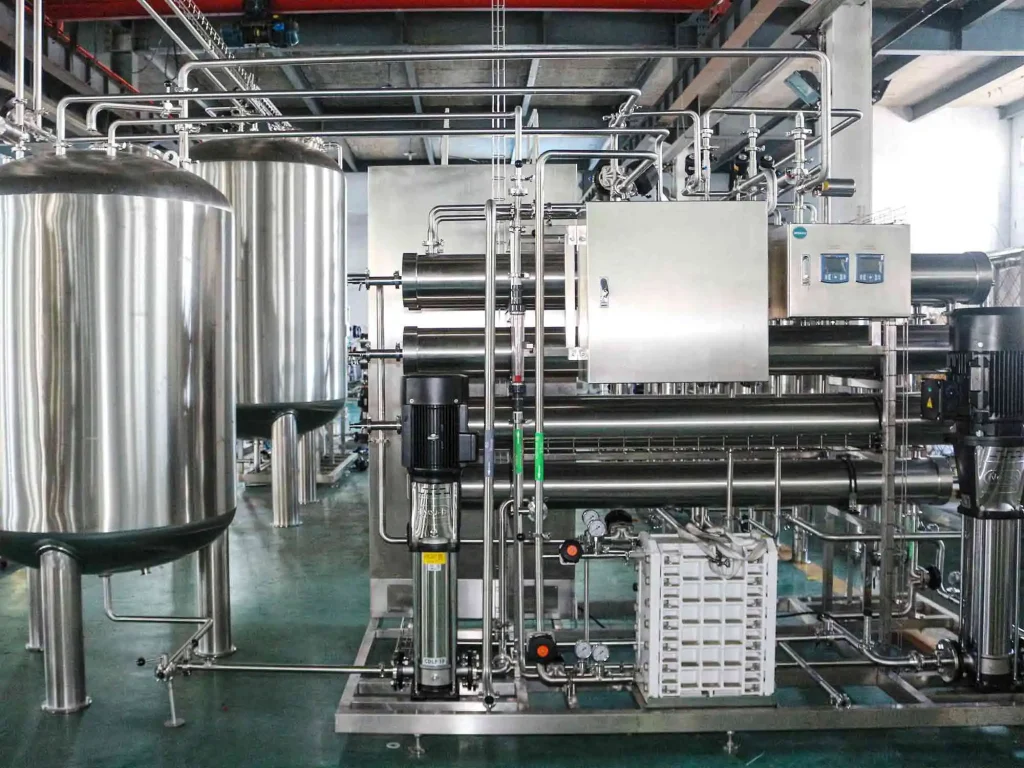
A pharmaceutical PW purified water system therefore includes the generation unit, storage tank, circulation loop, monitoring instruments, and points of use.
Important design considerations include:
-
Sanitary materials: Product-contact surfaces should be suitable for pharmaceutical water service and compatible with the selected sanitization method.
-
Hygienic piping: Pipe routing, drainage, connections, and equipment layout should reduce stagnant areas and support effective cleaning and sanitization.
-
Controlled circulation: Appropriate flow and temperature conditions help manage microbial growth and biofilm risk.
-
Suitable storage: Tanks should be designed to reduce contamination risks and support the required operating and sanitization conditions.
-
Representative monitoring: Sampling points should provide useful information about generation, storage, distribution, and water quality at critical use points.
Hot-water sanitization and ozone-based approaches may be suitable for certain system designs. The choice depends on materials, operating temperatures, process requirements, and the validated control strategy.
Sanitization frequency should not be based only on habit. Manufacturers should use microbial monitoring results, system performance trends, and documented risk assessments to establish and review the schedule.
How to Select the Right PW Purified Water System
The best system is not necessarily the one with the most treatment stages. It is the one that consistently meets the required water quality while supporting safe, efficient, and maintainable operation.
Before selecting a system, manufacturers should evaluate five main factors:
-
Water quality requirements: Confirm the applicable USP or other pharmacopoeial requirements and define the intended use of the water.
-
Feed water conditions: Analyze the source water to determine pretreatment needs and the appropriate purification process.
-
Production capacity: Calculate peak demand, daily consumption, storage requirements, and future expansion needs.
-
Monitoring and documentation: Define instrumentation, sampling locations, qualification requirements, and documentation needs.
-
Lifecycle costs: Consider energy, water recovery, consumables, maintenance, sanitization, and downtime rather than focusing only on the initial purchase price.
An experienced PW purified water equipment manufacturer can help translate these requirements into a suitable system configuration. Early coordination between the manufacturer, engineering team, quality department, and end users can also reduce design changes during installation and qualification.
FAQ: PW Purified Water
1.Is PW purified water the same as sterile water?
No. Purified Water is not required to be sterile. Sterile Purified Water is Purified Water that has been sterilized and suitably packaged. Neither should automatically be treated as a substitute for WFI in applications requiring WFI.
2.What is the difference between PW and WFI?
PW and WFI serve different pharmaceutical applications and have different quality requirements. WFI has specific endotoxin requirements and is used where water of injectable quality is required. The permitted production methods depend on the applicable pharmacopoeia and regulatory framework.
3.Can an RO and EDI system produce USP Purified Water?
Yes. An appropriately designed and controlled RO/EDI system can be suitable for producing PW purified water. However, compliance depends on the complete system, feed water quality, operating conditions, storage and distribution design, and evidence that the required water quality is consistently achieved.
4.How often should purified water quality be tested?
The testing frequency depends on the applicable requirements, system design, intended use, and risk assessment. Conductivity and TOC may be monitored online or through suitable offline testing. Microbial monitoring requires an appropriate sampling plan and trend review.
5.Why can a purified water system fail after successful qualification?
Changes in feed water quality, membrane performance, instrument calibration, sanitization effectiveness, or distribution loop conditions can affect performance. Routine monitoring, preventive maintenance, and investigation of adverse trends help maintain consistent water quality.
Conclusion
PW purified water is a critical utility in pharmaceutical manufacturing. Meeting USP requirements involves more than selecting an RO or EDI unit. The complete system must support chemical purity, microbial control, reliable storage and distribution, and consistent performance throughout its operating life.
By defining water quality requirements early and considering pretreatment, purification, monitoring, sanitization, and distribution together, manufacturers can select a system that supports both production needs and quality requirements.
For companies planning a new installation or upgrading an existing pharmaceutical water treatment system, working with an experienced equipment manufacturer can help align system configuration with feed water conditions, required capacity, and applicable standards.
Regulatory note: This article provides general technical information. Manufacturers should verify current pharmacopoeial requirements and applicable regulations before making equipment, qualification, or compliance decisions.
Contact SKE & Eagle for Advanced Solutions
For customized system engineering solutions or integration of high-performance water treatment technologies, please contact SKE & Eagle. Our professional team collaborates closely with industrial partners to design, implement, and maintain solutions tailored to your operational needs.
Contact Email: info@ske-eagle.com
Follow us on Facebook for the latest industry insights: SKE & Eagle Facebook
Business Inquiries: Visit our official website and submit the contact form at the bottom.