


Water is one of the most important materials in pharmaceutical manufacturing. It can be used as a raw material, solvent, cleaning agent, or process utility. Because water can affect product quality, pharmaceutical manufacturers must control its chemical and microbiological quality.
A pharmaceutical water purification system removes unwanted substances from source water and produces water for a defined pharmaceutical use. Unlike ordinary commercial water treatment, a pharmaceutical purification system must also control microorganisms, biofilm, storage, distribution, and sanitization.
Among the different treatment methods, RO treatment is one of the most important steps. Reverse osmosis can reduce dissolved salts, organic matter, microorganisms, and other contaminants. However, RO is only one part of a complete pharmaceutical water purification system.
This article explains how a pharmaceutical water purification system works, the role of RO treatment, and how storage, distribution, and monitoring help maintain water quality.
What Is a Pharmaceutical Water Purification System?
A pharmaceutical water purification system is a group of treatment and control equipment used to produce water that meets the required pharmaceutical quality.
The process usually starts with pretreatment. Pretreatment protects the main purification equipment and reduces substances that can damage or foul RO membranes.
Common pretreatment equipment includes multimedia filters, water softeners, activated carbon filters, and cartridge filters. Each step has a different purpose.
After pretreatment, the water enters the main purification section. A typical purification system may use RO treatment followed by EDI, UV, ultrafiltration, or other polishing equipment. The exact process depends on the source water, required water quality, production capacity, and applicable regulations.
After purification, the water is sent to a storage tank and distribution loop. These parts are important because water quality must be maintained after purification.
A complete pharmaceutical water purification system therefore includes more than filters and membranes. It also includes storage, distribution, monitoring, and sanitization.

How RO Treatment Works
RO treatment, or reverse osmosis treatment, uses pressure to push water through a semipermeable membrane.
The membrane allows water to pass while rejecting many dissolved salts, organic substances, microorganisms, and other contaminants. As a result, RO can greatly reduce conductivity and total dissolved solids.
RO is widely used in pharmaceutical water systems because it can provide a strong purification barrier. However, RO performance depends on good pretreatment and correct operation.
For example, suspended solids can cause fouling. Hardness can cause scaling. Free chlorine can damage many RO membranes. Therefore, pretreatment is important before the water reaches the RO membrane.
Some pharmaceutical purification systems use two-pass RO. In this design, water passes through a second RO stage to improve the removal of dissolved contaminants before further polishing.
RO can also provide a strong barrier against microorganisms and endotoxin-related contamination. However, it should not be considered the only control method. Membrane condition, system design, sanitization, storage, and distribution all affect the final water quality.
Common Treatment Stages
| Treatment Stage | Main Function |
|---|---|
| Multimedia Filtration | Removes suspended particles |
| Softening | Reduces calcium and magnesium |
| Activated Carbon | Reduces chlorine and some organic matter |
| Cartridge Filtration | Removes fine particles |
| RO Treatment | Reduces salts, organics, and microorganisms |
| EDI | Removes remaining dissolved ions |
| UV | Supports microbial or organic control |
| Ultrafiltration | Provides an additional barrier for microorganisms and larger contaminants |
Not every purification system needs all these technologies. The process should be designed according to the actual water quality and pharmaceutical application.
The Role of EDI and Ultrafiltration
EDI and ultrafiltration have different functions in a pharmaceutical water purification system.
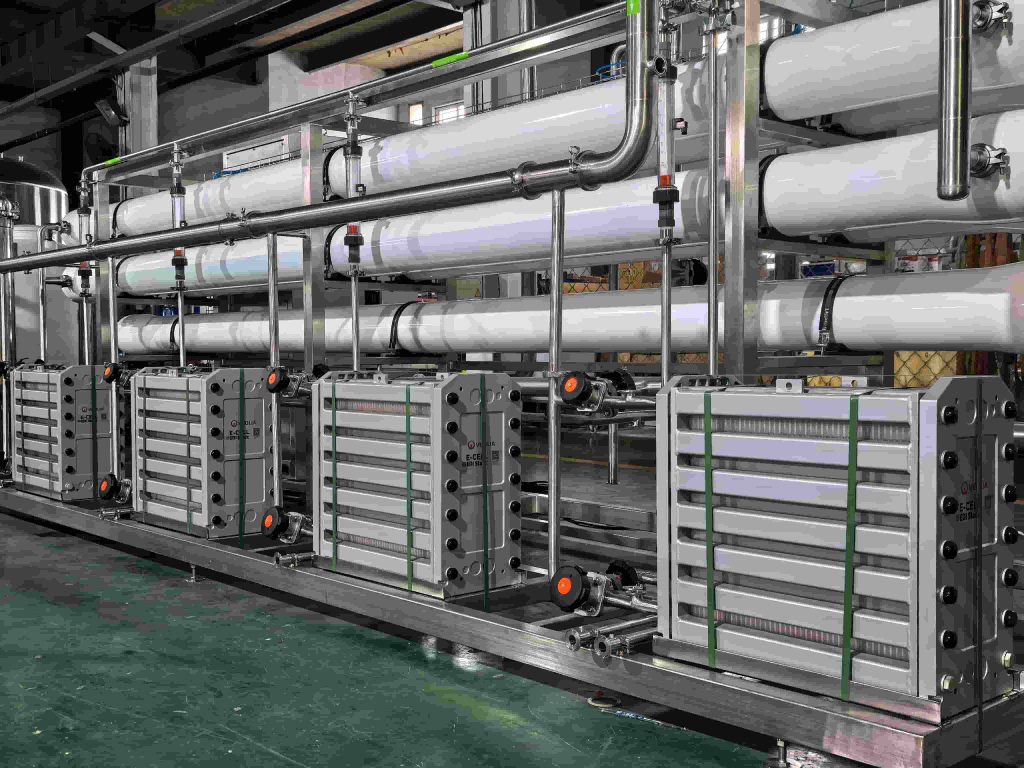
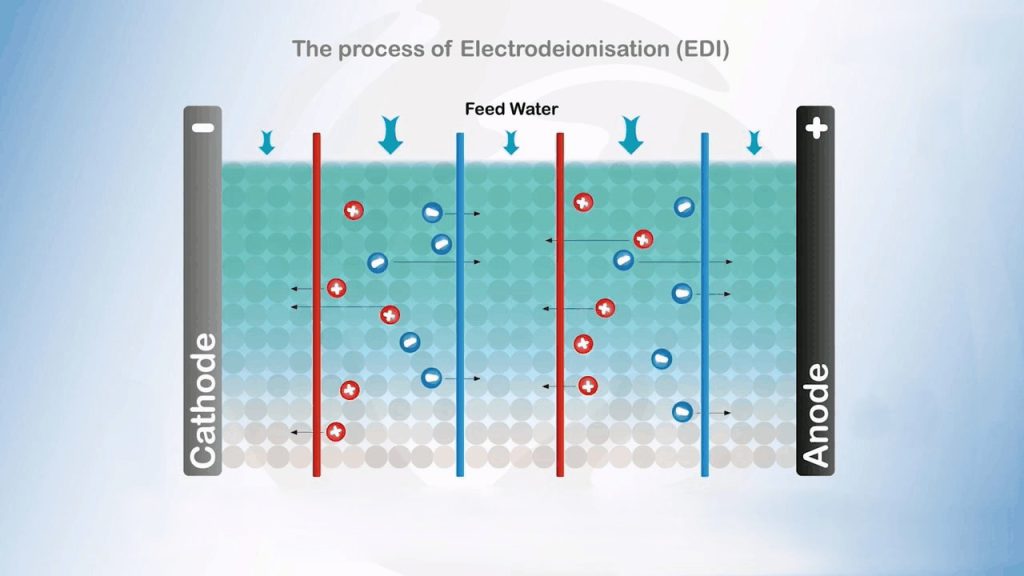
EDI, or electrodeionization, is mainly used to remove remaining dissolved ions after RO. It uses electricity, ion-exchange materials, and membranes. EDI can provide continuous water polishing without the regular chemical regeneration used by traditional ion-exchange systems.
Ultrafiltration, or UF, uses a membrane with smaller pores than many traditional filtration systems. Depending on the membrane and system design, UF can reduce microorganisms, colloids, and endotoxin-related contaminants.
UV may also be used for microbial control. Some UV systems are designed to help reduce certain organic substances.
These technologies should not be treated as the same. RO mainly provides broad contaminant removal, EDI focuses on ionic polishing, and UF provides an additional physical barrier.
Building a Reliable Purified Water System
A Purified Water System is more than a water treatment machine. It includes purification equipment, storage, distribution, monitoring, and sanitization.
Materials must be suitable for pharmaceutical water service and compatible with cleaning and sanitization methods. 316L stainless steel is widely used in pharmaceutical water systems. Suitable pharmaceutical-grade plastics may also be used for some parts.
Good hygienic design is also important. Pipes should be designed to reduce stagnant areas. Dead legs should be minimized, and the system should support effective drainage and sanitization.
Important Design Elements
| Design Element | Purpose |
|---|---|
| Storage Tank | Stores purified water under controlled conditions |
| Distribution Loop | Keeps water moving and reduces stagnation |
| 316L Stainless Steel | Provides hygienic and corrosion-resistant construction |
| Sanitization System | Helps control microbial growth |
| Monitoring Instruments | Tracks important water quality parameters |
| Sampling Points | Allows regular water quality testing |
| PLC Control System | Controls operation and alarms |
The storage and distribution system is especially important. Water that meets the required quality after RO can still develop problems if it is stored incorrectly or remains stagnant for too long.
Microbial Control and Sanitization
Microbial control is one of the main challenges in pharmaceutical water systems.
Microorganisms can enter a purification system through feed water, air, equipment surfaces, or maintenance activities. If water remains stagnant, microorganisms may grow and form biofilms.
A well-designed distribution loop keeps water moving and reduces stagnant areas. Regular monitoring can also help identify changes before they become serious problems.
Thermal sanitization is widely used in pharmaceutical water systems. Chemical sanitization may also be used when it is suitable for the equipment and system materials.
There is no single sanitization schedule for every purification system. The temperature, time, frequency, and method should be based on system design, risk assessment, validation, and microbial monitoring.
The goal is to maintain a controlled and validated system, not simply to follow a fixed sanitization schedule.
Common Problems in Pharmaceutical Water Systems
Microbial Contamination
Microbial contamination can result from stagnant water, poor hygienic design, insufficient sanitization, or maintenance problems.
If microbial results increase, the manufacturer should check the whole system. The investigation may include the storage tank, distribution loop, valves, sampling points, and sanitization process.
Conductivity Increase
A rise in conductivity can indicate changes in RO membrane performance, EDI operation, feed-water quality, or other system conditions.
For RO, operators can monitor permeate conductivity and salt rejection. Trend monitoring is useful because a gradual change may show membrane fouling or performance loss.
TOC Increase
Total Organic Carbon (TOC) is another important water quality parameter. A rising TOC value may be related to feed-water changes, organic contamination, or microbial activity.
TOC should be reviewed together with other data such as conductivity, temperature, flow, and microbial results.
RO Treatment and WFI
RO treatment is widely used for Purified Water production. However, WFI has higher quality requirements.
Distillation remains an important method for WFI production. In some regulatory environments, properly designed and validated membrane-based systems may also be used for WFI.
The correct choice depends on the applicable pharmacopoeia, local regulations, water quality requirements, system design, and validation strategy.
Manufacturers should therefore select WFI technology based on the complete project requirements rather than choosing a process only by equipment cost or purification capacity.
Frequently Asked Questions
1.What is a pharmaceutical water purification system?
It is an integrated purification system that treats source water and produces water for pharmaceutical use. It may include pretreatment, RO, EDI, UV, UF, storage, distribution, monitoring, and sanitization.
2.What is the role of RO treatment?
RO treatment removes many dissolved salts, organic substances, microorganisms, and other contaminants. It is often a major purification step in pharmaceutical water systems.
3.Is RO enough for pharmaceutical water?
Not always. The required treatment process depends on source water quality, production capacity, target water grade, and regulatory requirements. Additional technologies may be needed.
4.What is the difference between RO and EDI?
RO uses a semipermeable membrane to remove many contaminants. EDI mainly removes remaining dissolved ions after RO.
5.Can RO be used for WFI?
In some regulatory environments, validated membrane-based systems can be used for WFI. The applicable pharmacopoeia and local requirements must be checked before selecting the process.
6.How often should a Purified Water System be sanitized?
There is no universal schedule. Sanitization frequency should be based on system design, risk assessment, validation data, and microbial monitoring.
Conclusion
A reliable pharmaceutical water purification system is a complete solution, not just an RO machine. Pretreatment protects the system, RO treatment provides a major purification step, and EDI, UV, or UF can provide additional treatment when required.
Storage, distribution, monitoring, sanitization, and hygienic design are also important for maintaining water quality after purification.
For pharmaceutical manufacturers, the right purification system should match the required water grade, source-water quality, production capacity, applicable regulations, and long-term operating needs.
SKE&EAGLE provides pharmaceutical water purification solutions, including RO-based systems, EDI systems, storage and distribution systems, and integrated water treatment equipment for pharmaceutical manufacturing.
Official Website: https://www.ske-eagle.com/
Contact Email: info@ske-eagle.com
Follow us on Facebook for the latest industry insights: SKE & Eagle Facebook
Business Inquiries: Visit our official website and submit the contact form at the bottom.