

Liquid pharmaceutical manufacturing requires more than active ingredients and a carefully prepared formula. Manufacturers also need hygienic equipment, controlled processing conditions, high-quality pharmaceutical water, and validated cleaning processes.
A pharmaceutical blending tank is an important part of this production process. It is used to mix active ingredients, excipients, solvents, and other components into a uniform liquid product. Depending on the product, the tank may also provide controlled heating, cooling, and other process functions.
However, a blending tank does not work alone. It is connected to other systems, including pharmaceutical water purification, storage, distribution, filtration, CIP, and, for suitable applications, SIP systems.
This article explains how pharmaceutical blending tanks work, how they differ from plant extraction tanks, why water quality matters, and what manufacturers should consider when selecting a complete system.
Key Takeaways
- A pharmaceutical blending tank mixes prepared ingredients into a uniform formulation; a plant extraction tank pulls compounds out of raw plant material — they serve different stages and are not interchangeable.
- Mixing uniformity depends on agitator type (paddle, turbine, anchor, or high-shear) and tank geometry, not just tank size.
- Purified Water and WFI are not interchangeable inputs — the required grade depends on the application, with WFI needed for parenteral and other high-control processes.
- CIP handles cleaning and SIP handles sterilization; not every blending tank needs SIP, but every one needs a validated cleaning strategy.
What Is a Pharmaceutical Blending Tank?
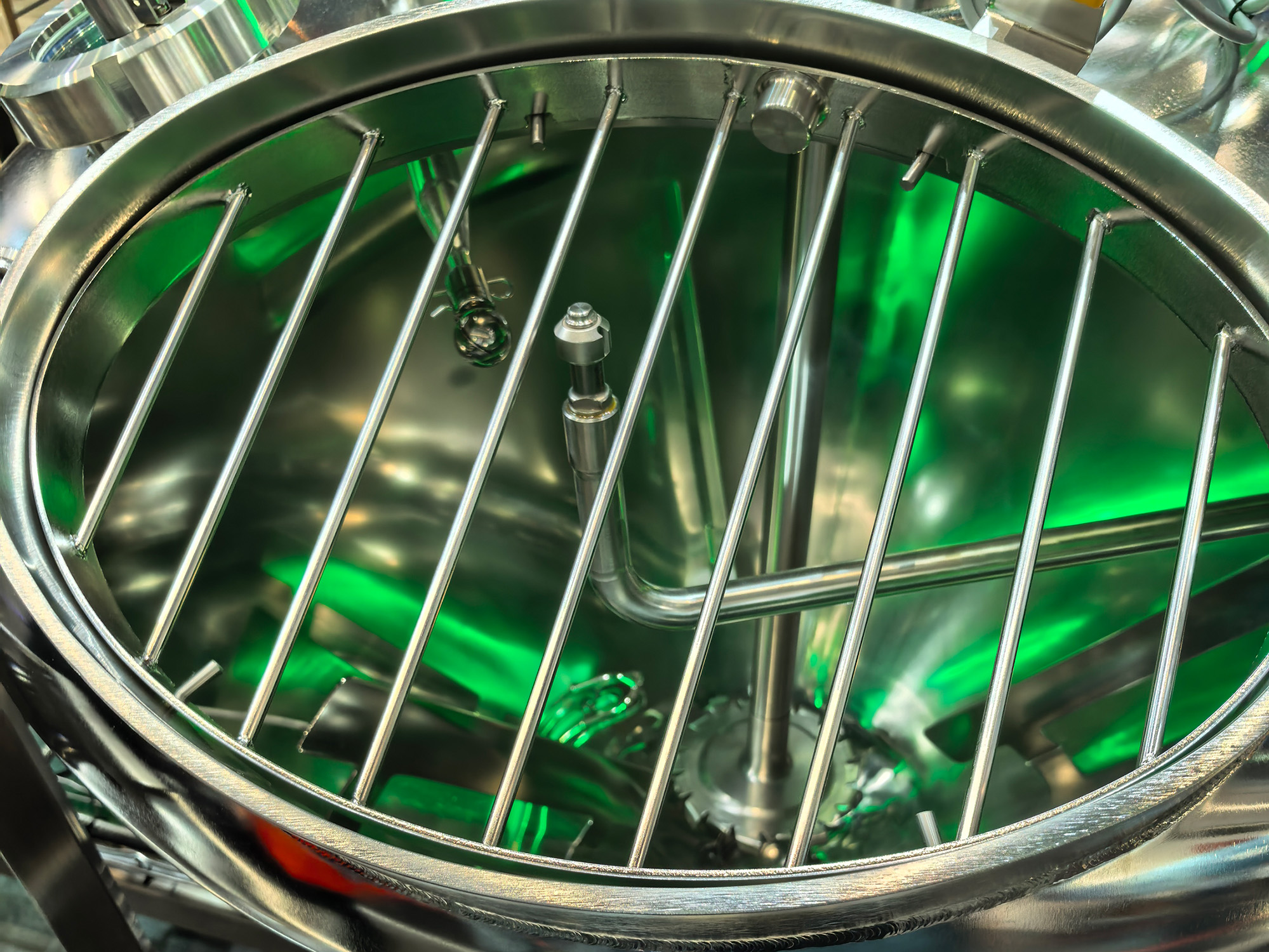
A pharmaceutical blending tank is a sanitary stainless steel vessel designed to mix pharmaceutical ingredients under controlled conditions. It may also be called a pharmaceutical mixing tank, compounding tank, or preparation vessel.
The main purpose is to produce a homogeneous mixture. Every part of the batch should have the required concentration of active ingredients and excipients.
A typical pharmaceutical blending tank may include:
- 316L stainless steel product-contact surfaces
- Mechanical or magnetic agitation
- Heating and cooling jackets
- Temperature sensors
- Sanitary valves and fittings
- Bottom product outlets
- Spray devices for CIP
- Load cells for accurate weighing
- Pressure or vacuum connections when required
- Hygienic transfer connections
The exact design depends on the product and manufacturing process.

How Does a Pharmaceutical Blending Tank Work?
The blending process normally follows a defined production procedure.
First, the required ingredients are prepared and weighed. Pharmaceutical water or another approved solvent is then added to the tank. The agitator starts mixing the liquid at a controlled speed.
Other ingredients are added according to the approved formulation and manufacturing process.
The mixing speed and addition order are important. Some materials dissolve quickly, while others require more time or stronger agitation. Excessive agitation may also create unwanted foam or introduce air into the product.
A jacket can heat or cool the tank when temperature control is required.
Pharmaceutical Blending and Liquid Formulation
Liquid pharmaceutical formulation involves more than simply putting ingredients into a tank.
A formulation defines the ingredients, their quantities, concentration, addition order, and processing conditions. The final product must meet requirements for identity, strength, quality, and stability.
Depending on the product, a liquid formulation may contain:
- Active pharmaceutical ingredients (APIs)
- Purified Water or another approved solvent
- Preservatives
- Stabilizers
- Sweeteners
- Flavoring agents
- Buffers
- Other excipients
Each ingredient can affect the final product.
Some materials have limited solubility and need controlled addition or pre-dissolution. Some ingredients are sensitive to heat. Others may be affected by changes in pH or mixing conditions.
For this reason, the blending tank should be designed around the actual formulation rather than selected only by volume.
Why Mixing Uniformity Matters
Uniformity is one of the main functions of a pharmaceutical blending tank.
If an active ingredient is not evenly distributed, different samples from the same batch may have different concentrations. This can affect product quality and may create problems during quality control.
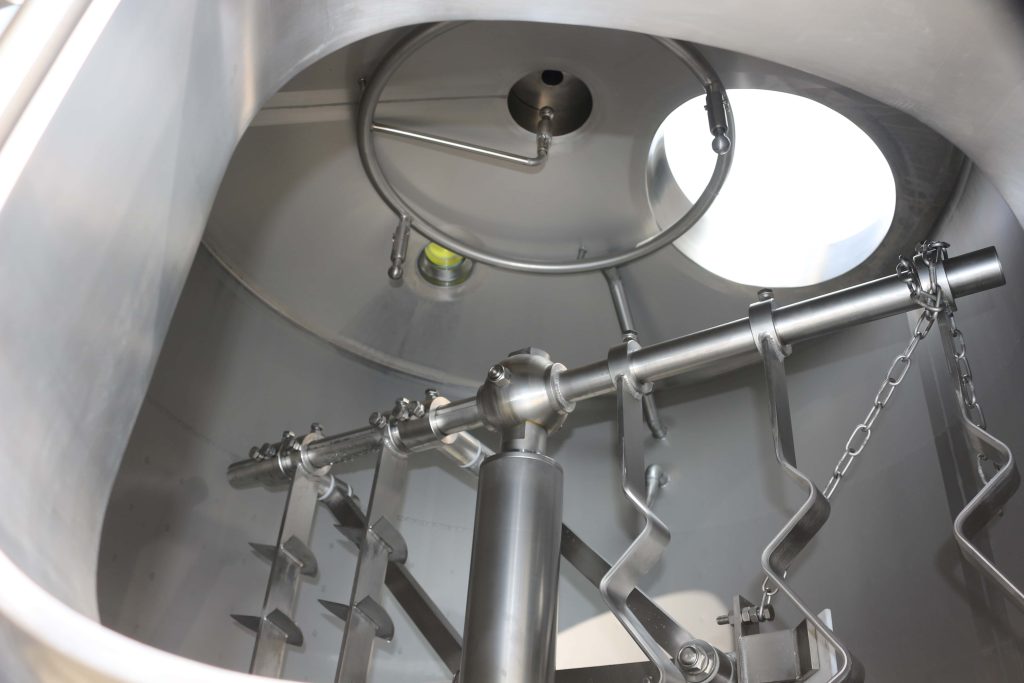
The agitator plays a major role in mixing performance. Different products may require different impeller designs and mixing speeds.
Common agitator types include:
- Paddle agitators
- Turbine agitators
- Anchor agitators
- High-shear mixers for specific applications
The tank geometry also affects mixing. Baffles can help reduce unwanted liquid rotation and improve circulation inside the vessel.
Blending Tank vs. Plant Extraction Tank
A plant extraction tank serves a different purpose from a pharmaceutical blending tank.
Plant extraction is used when active or useful compounds need to be removed from plant materials. Water, ethanol, or another suitable solvent may be used to extract target compounds from the raw material.
An extraction system may include:
- Heating
- Agitation
- Filtration
- Solid-liquid separation
- Temperature control
- Solvent handling
After extraction, the liquid extract may go through additional processing, such as filtration or concentration. It may then be used as an ingredient in a later formulation process.
The two tanks therefore have different roles.
| Feature | Pharmaceutical Blending Tank | Plant Extraction Tank |
|---|---|---|
| Main purpose | Mix prepared ingredients | Extract compounds from plant material |
| Main materials | APIs, excipients, solvents | Plant materials and extraction solvents |
| Mixing | Designed for liquid formulation | Supports extraction and solid-liquid contact |
| Filtration | May be part of downstream processing | Often important for removing plant solids |
| Temperature control | Used when required by formulation | Often important for extraction efficiency |
| Typical position | Formulation/compounding stage | Upstream extraction stage |
Plant extraction may be part of some pharmaceutical processes, but it is not required for every liquid medicine.
Why Pharmaceutical Water Quality Matters
Water is one of the most important materials in liquid pharmaceutical manufacturing. It can be used as a solvent, an ingredient, a cleaning medium, or part of the manufacturing process.
The required water grade depends on the application.
Two important pharmaceutical water categories are Purified Water (PW) and Water for Injection (WFI).
Purified Water is commonly used for applications such as non-sterile pharmaceutical products, oral liquids, and equipment cleaning, depending on the applicable regulations and process requirements.
WFI is used for applications where a higher level of control is required, especially parenteral manufacturing and other applications defined by the applicable pharmacopeia and regulations.
The key point is that the water system must be designed according to the intended use.
How Is Pharmaceutical Water Produced?
A pharmaceutical water system may use several purification technologies.
Reverse osmosis (RO) is widely used as a major purification step. It can reduce dissolved salts, organic materials, microorganisms, and other contaminants in feed water.
Electrodeionization (EDI) may be used after RO to further reduce ionic contaminants and produce high-quality purified water.
For WFI applications, distillation remains an established production technology. Suitable membrane-based systems may also be used where allowed by the applicable regulations and system design.
The complete water treatment process may therefore include:
Pretreatment → RO → EDI or other polishing → Storage → Distribution
The exact configuration depends on feed-water quality, required water grade, production capacity, and applicable standards.
How Blending Tanks Connect to Pharmaceutical Water Systems
A blending tank and pharmaceutical water system should be considered as part of one production process.
A typical system may work as follows:
Raw Water → Pretreatment → RO → EDI/Polishing → Pharmaceutical Water Storage → Distribution Loop → Blending Tank
The purified water is transferred through hygienic piping to the blending or compounding area.
The water system must provide the required quality and flow at the point of use. The blending tank must also be designed to receive and use that water without creating new contamination risks.
This is why equipment selection should not focus on the tank alone.
CIP and SIP for Pharmaceutical Blending Tanks
Cleaning is a critical part of pharmaceutical manufacturing.
CIP (Clean-in-Place) allows the internal surfaces of a tank and connected equipment to be cleaned without removing the equipment from the process line.
A CIP process may use water, cleaning agents, controlled temperature, flow, and contact time to remove product residues and other contaminants.
A pharmaceutical blending tank may include a spray ball or rotary spray device to distribute the cleaning solution across the internal surfaces.
For suitable sterile applications, SIP (Sterilization-in-Place) may also be used. SIP normally uses steam under controlled conditions to sterilize equipment and piping after cleaning.
CIP and SIP are not interchangeable.
- CIP focuses on cleaning.
- SIP focuses on sterilization.
The exact cleaning and sterilization process should be developed and validated according to the equipment design, product, process, and applicable GMP requirements.

Purified Water vs. Water for Injection
The following table provides a practical comparison. Exact requirements should always be checked against the current pharmacopeia and applicable regulations for the target market.
| Parameter | Purified Water (PW) | Water for Injection (WFI) |
|---|---|---|
| Main application | Non-sterile pharmaceutical products and process use | Parenteral and other applications requiring WFI |
| Microbial control | Controlled according to the applicable standard | More stringent microbial and endotoxin control |
| Endotoxin requirements | Depend on application and applicable standard | Strict endotoxin requirement |
| Typical production | RO, RO + EDI, and other validated systems | Distillation or suitable validated membrane-based systems |
| Storage and distribution | Hygienic storage and distribution | High-control hygienic storage and distribution |
The correct water grade should always be selected according to the product, process, pharmacopeia, and regulatory requirements.
Frequently Asked Questions
1.What is the main difference between a blending tank and a plant extraction tank?
A blending tank combines prepared ingredients into a uniform formulation. A plant extraction tank is used to extract target compounds from plant materials using a suitable solvent. They normally serve different stages of production.
2.Can one blending tank be used for different pharmaceutical products?
Potentially, but this depends on the equipment design, products, cleaning process, and cleaning validation. Manufacturers must ensure that residues from one product do not create contamination or cross-contamination risks for another product.
3.Why is 316L stainless steel commonly used?
316L stainless steel provides good corrosion resistance and is widely used for hygienic pharmaceutical process equipment. Its surface and weld quality can also be designed to support effective cleaning, following hygienic design practices such as those in ASME BPE.
4.Does every pharmaceutical blending tank require SIP?
No. SIP requirements depend on the product and process. Sterile applications may require sterilization-in-place, while some non-sterile processes may rely on validated cleaning and other contamination-control measures.
5.Why is pharmaceutical water important for blending?
Water can be a major component of a liquid formulation. If the water contains unsuitable chemical, microbial, or other contaminants, it may affect product quality and process control. The water grade must therefore match the intended pharmaceutical application.
6.How does a blending tank connect to a pharmaceutical water system?
A pharmaceutical water system produces, stores, and distributes the required water grade. Hygienic piping then supplies water to the blending tank or point of use. The tank and water system should be designed together to maintain water quality during transfer and processing.
Written by Mandy, Marketing Specialist at SKE&EAGLE with two years of experience covering the company’s pharmaceutical water and steam equipment. Technical details in this guide were reviewed by SKE&EAGLE’s engineering team before publication.
Conclusion
A pharmaceutical blending tank is an important part of liquid medicine manufacturing, but it is only one part of the complete process.
The tank must provide effective mixing, temperature control, hygienic operation, and suitable cleaning. The pharmaceutical water system must provide the correct water quality for the intended application. CIP and, where required, SIP must support controlled and validated processing.
For manufacturers, the best equipment design starts with the complete process rather than a single vessel. Batch size, formulation, water grade, mixing requirements, cleaning strategy, and regulatory expectations should all be considered before equipment selection.
SKE&EAGLE specializes in pharmaceutical water equipment and water purification systems, supporting pharmaceutical manufacturers with solutions for Purified Water and Water for Injection production, storage, and distribution. By connecting reliable pharmaceutical water treatment with hygienic production equipment, manufacturers can build a more controlled and consistent liquid manufacturing process.
Contact SKE & Eagle for Advanced Solutions
For customized system engineering solutions or integration of high-performance water treatment technologies, please contact SKE & Eagle. Our professional team collaborates closely with industrial partners to design, implement, and maintain solutions tailored to your operational needs.
Official Website: https://www.ske-eagle.com/
Contact Email: info@ske-eagle.com
Follow us on Facebook for the latest industry insights: SKE & Eagle Facebook
Business Inquiries: Visit our official website and submit the contact form at the bottom.