


In pharmaceutical manufacturing, water is an important part of many liquid products. But purified water or water for injection (WFI) is only one part of the process. The water must be combined with active ingredients, excipients, buffers, or other materials under controlled conditions.
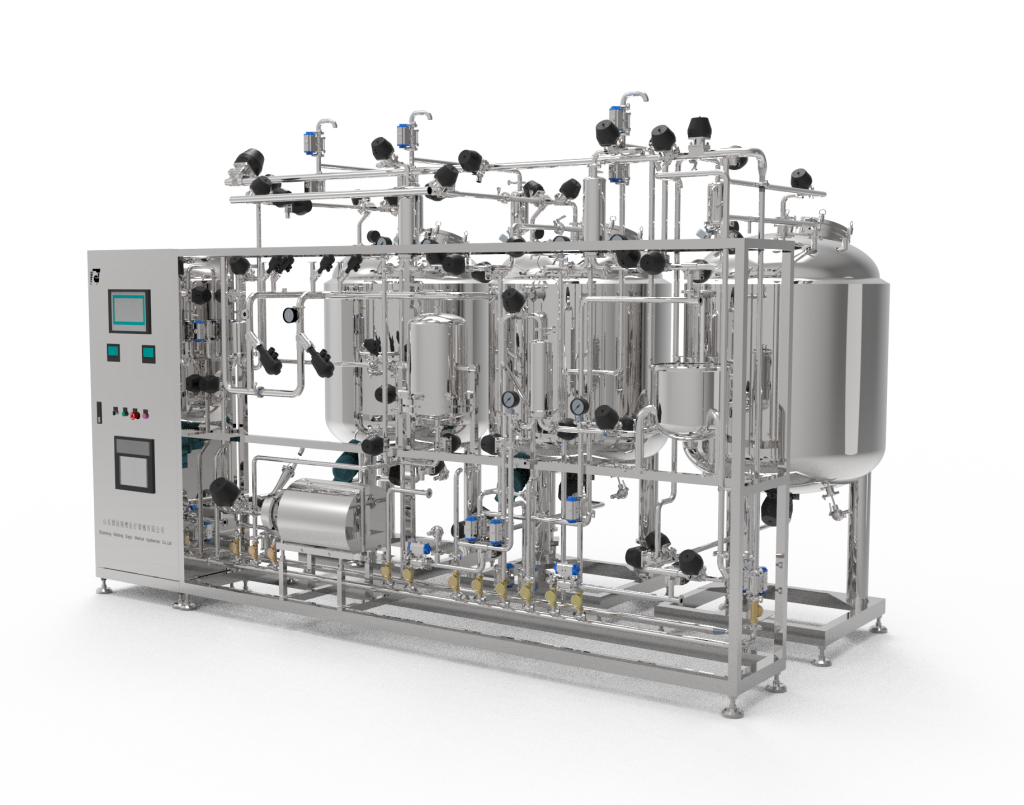
A Liquid System provides this controlled preparation process. It is more than a mixing tank. A complete Liquid Preparation System can combine mixing, dosing, temperature control, transfer, cleaning, filtration, and automation in one process unit.
For pharmaceutical manufacturers, choosing the right system is important for product quality, process consistency, cleaning, and GMP compliance.
Key Takeaways
- A pharmaceutical Liquid System is a complete process unit, not just a tank — mixing, dosing, temperature control, transfer, CIP/SIP, and automation are engineered together around one formulation.
- Mixing and dosing methods have to match the product: syrups need anchor/frame agitation and careful heat control, suspensions need controlled shear, buffers need accurate dosing, and high-viscosity liquids often need dual-shaft mixing.
- Purified water and WFI systems supply qualified water to the Liquid System — the two are connected but serve different functions and should not be treated as one system.
- Electronic batch records and signatures on automated systems may need to meet FDA 21 CFR Part 11, depending on the target market.
What Is a Pharmaceutical Liquid System?
This is the process system used to prepare liquid products or process solutions.
The system receives qualified water and other raw materials. It then mixes and processes these materials according to a defined recipe and process procedure.
A typical Liquid Preparation System may include a preparation tank, an agitator, dosing and metering equipment, a transfer pump, a heating or cooling system, a heat exchanger, a CIP/SIP system, a filtration system, sensors and instruments, and a PLC control system.
The exact configuration depends on the product, batch size, viscosity, temperature requirements, and required process control.
This is why a Liquid System should not be treated as a standard tank with a mixer. It is a complete process unit designed around the needs of a specific liquid product.
How Does a Liquid Preparation System Work?
The basic process is simple, but each step needs controlled conditions.
A typical preparation process includes water and raw material feeding, dosing, mixing, temperature control, process adjustment, filtration or transfer, and then downstream production.
First, purified water or WFI is transferred into the preparation tank when required by the product and process. Raw materials are then added according to the approved formulation.
The agitator keeps the materials evenly distributed. If heating or cooling is required, a jacket or heat exchanger can control the product temperature.
Sensors can monitor important process parameters such as temperature, pressure, level, and pH. The PLC system can control the sequence and record process data according to the automation design.
After preparation, the liquid can be transferred to the next production stage, such as holding, filtration, or filling.
The actual process varies between products. Therefore, the system should be designed around the formulation and manufacturing process rather than using the same configuration for every liquid.
Preparation Challenges for Different Liquids
Different pharmaceutical liquids have different process requirements. Mixing speed, dosing accuracy, temperature control, and cleaning methods must be selected according to the product.
Syrup Preparation
Syrups often contain a high level of sugar and can have medium to high viscosity.
The main challenge is achieving uniform mixing while controlling temperature. Too much local heating may affect product quality.
Anchor or frame agitators are often suitable for higher-viscosity liquids because they provide good movement near the tank wall.
Cleaning is also important because sugar residues can remain on equipment surfaces and may increase the risk of microbial growth if not removed properly.
Drug Solution and Suspension Preparation
Drug solutions and suspensions require good distribution of active ingredients and excipients.
A solution needs the ingredients to dissolve and distribute evenly. A suspension has an additional challenge because solid particles can settle during processing.
The mixing system therefore needs to provide enough movement without creating unnecessary shear.
Depending on the formulation, the Liquid Preparation System may also need accurate pH control, temperature control, or controlled addition of specific ingredients.
Buffer Preparation
Buffers are widely used in pharmaceutical manufacturing and laboratory processes.
Their preparation requires accurate dosing and good mixing. The order in which components are added can also affect the final solution.
A Liquid System for buffers may use accurate dosing pumps, flow meters, load cells, or other measurement devices. Online pH monitoring can also be included when required by the process.
High-Viscosity Liquid Preparation
High-viscosity products create greater mixing and transfer challenges.
A standard single-shaft agitator may not provide enough movement throughout the tank. Product near the tank wall can move more slowly than the product in the center.
Depending on the formulation, a dual-shaft mixing system can be used. One agitator can provide slow wall movement while another provides higher-speed mixing or dispersion.
Heating can also reduce viscosity when the product is temperature-sensitive and the process allows heating.
For accurate dosing, gravimetric measurement can be useful because it measures material by weight rather than relying only on volume.
Key Configuration Differences
The correct configuration depends on the liquid and the production process.
| Liquid Type | Mixing Approach | Metering Approach | Temperature Control | Main Cleaning Focus |
|---|---|---|---|---|
| Syrup | Anchor or frame agitator | Flow meter or gravimetric dosing | Heating or cooling jacket | Sugar and product residue |
| Drug Solution | Paddle or suitable agitator | Dosing pump or gravimetric system | Depends on formulation | Active ingredient residue |
| Suspension | Suitable agitator with controlled shear | Accurate dosing system | Depends on formulation | Particle and product residue |
| Buffer | Propeller or other gentle agitator | Accurate dosing pump or flow meter | Usually ambient | Cross-contamination control |
| High-Viscosity Liquid | Dual-shaft or high-torque mixing | Gravimetric dosing can be useful | Heating may reduce viscosity | Wall residue and difficult-to-clean areas |
This comparison shows why there is no single mixing system that is suitable for every pharmaceutical liquid.
The equipment should be selected based on viscosity, solids content, mixing behavior, temperature sensitivity, batch size, and cleaning requirements.
The Role of the Liquid System in Pharmaceutical Production
A pharmaceutical water system and a Liquid Preparation System perform different functions, but they are closely connected.
A purified water system produces qualified purified water for processes that require this water quality.
A WFI system produces water that meets the required WFI quality standard for applicable pharmaceutical processes.
The Liquid System then uses qualified water and other raw materials to prepare a specific liquid product or process solution.
The relationship can be understood as: water system, qualified process water, liquid preparation, downstream processing, and then filling or dispensing.
This distinction is important. The Liquid Preparation System is not simply another level of the pharmaceutical water system. Instead, it is a production process system that can use water supplied by the pharmaceutical water system.
For pharmaceutical manufacturers, both systems need to work together. The materials, sanitary design, piping, instrumentation, cleaning strategy, and automation interfaces should be considered as part of the overall production process.

Hygienic Design and GMP Considerations
A pharmaceutical Liquid System must be designed with product quality and hygienic control in mind.
Material Selection
Product-contact parts are commonly designed with suitable stainless steel and sanitary finishes according to the application.
The material selection should consider product compatibility, corrosion resistance, surface finish, cleaning requirements, process temperature, and pressure conditions.
The exact material and surface requirements should be determined by the product and applicable standards.
Dead-Leg Control
Poor piping design can create areas where liquid remains trapped.
These areas can make cleaning more difficult and increase contamination risks. Sanitary piping and valve arrangements should therefore minimize unnecessary dead legs and difficult-to-clean sections.
CIP and SIP
Cleaning requirements depend on the product and process.
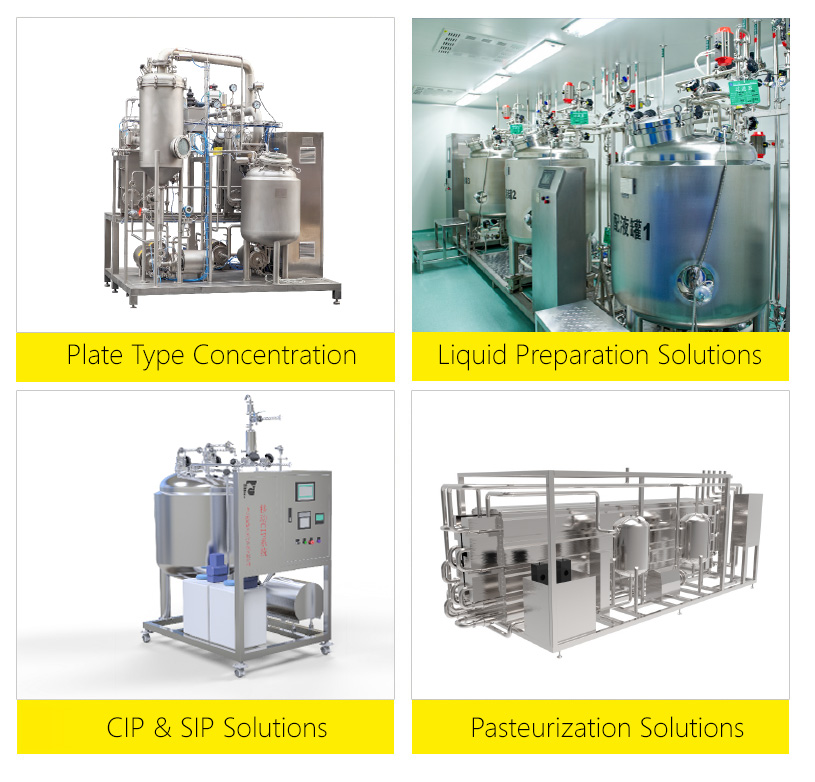
A CIP system can circulate cleaning solutions through tanks, pipes, valves, and other product-contact surfaces without requiring complete equipment disassembly.
Where sterile processing is required, SIP may also be included as part of the Liquid Preparation System design.
Cleaning validation should demonstrate that the selected cleaning procedure can consistently remove product residues and cleaning agents to the required level. In the US, 21 CFR 211.67 requires written cleaning and maintenance procedures, a defined schedule, and inspection of equipment for cleanliness before use.
Automation and Process Control
Modern Liquid Systems can use PLC-based automation to control and monitor the preparation process.
Typical parameters may include temperature, tank level, mixing speed, flow rate, pressure, pH, and dosing quantity.
The automation system can also support recipe management, alarm handling, batch records, user permissions, and process traceability when these functions are required.
For regulated pharmaceutical production, electronic records and electronic signatures may need to meet applicable regulatory requirements, such as FDA 21 CFR Part 11, depending on the market and system design.
Why an Integrated Liquid System Can Be Better Than a Standalone Tank
A standalone preparation tank may be suitable for simple applications. However, pharmaceutical production often requires more than mixing.
An integrated system can connect material dosing, mixing, temperature control, transfer, filtration, CIP/SIP, and automation.
This approach can improve process consistency and make the equipment easier to manage as one production unit. It can also simplify the connection between the pharmaceutical water system and downstream production equipment.
For larger pharmaceutical plants, this integrated approach can be especially useful when the production process requires repeatable batches, automated control, and detailed process records.
Frequently Asked Questions
1. What is a Liquid System?
A Liquid System is an integrated process unit used to prepare liquid products or process solutions. It can include mixing, dosing, temperature control, transfer, filtration, cleaning, and automation functions.
2. What is the difference between a Liquid System and a preparation tank?
A preparation tank is mainly a vessel for holding and mixing liquid. A Liquid System is a complete process solution. It can include the tank, agitator, dosing system, pumps, temperature control, CIP/SIP, instruments, and PLC automation.
3. Can one Liquid Preparation System handle different products?
It can, depending on the system design and product requirements. The products must be compatible with the equipment, and the cleaning and changeover procedures must be properly designed and validated where required.
4. Why is mixing important in pharmaceutical liquid preparation?
Good mixing helps distribute active ingredients and excipients evenly. It also helps maintain a consistent product composition from one part of the batch to another. The mixing method should match the product’s viscosity, solids content, and sensitivity to shear.
5. Does every Liquid System need CIP?
Not every system has exactly the same cleaning configuration. However, pharmaceutical systems generally require a controlled and repeatable cleaning strategy. CIP is commonly used when the equipment and process are designed for automated in-place cleaning.
Written by Mandy, Marketing Specialist at SKE&EAGLE with two years of experience covering the company’s pharmaceutical water and steam equipment. Technical details in this guide were reviewed by SKE&EAGLE’s engineering team before publication.
Conclusion
A pharmaceutical Liquid System is more than a mixing tank. It is a process system that brings together mixing, dosing, temperature control, transfer, cleaning, and automation to support consistent liquid production.
The right configuration depends on the product. Syrups may require strong wall movement and careful temperature control. Suspensions need controlled mixing to keep particles evenly distributed. Buffers require accurate dosing and mixing. High-viscosity liquids may need high-torque or dual-shaft agitation and carefully selected dosing methods.
For pharmaceutical manufacturers, Liquid Preparation System design should also consider hygienic construction, CIP/SIP, validation, automation, and integration with the pharmaceutical water system.
Contact SKE&EAGLE now. Let us design the proper liquid preparation system for you.
Official Website: https://www.ske-eagle.com/
Contact Email: info@ske-eagle.com
Follow us on Facebook for the latest industry insights: SKE & Eagle Facebook
Business Inquiries: Visit our official website and submit the contact form at the bottom.