


Water is a key material in drug making. It is used as an ingredient, a cleaning agent, and a processing medium. Since water quality affects patient safety, drug companies need a reliable commercial water purifier.
A commercial water purifier for pharmaceutical use is more than a large filter. It is a complete system that produces, stores, and monitors water to strict quality standards. This type of system is called a pharmaceutical water system.
Depending on the product, a facility may need Purified Water (PW) or Water for Injection (WFI) . The treatment may include pretreatment, reverse osmosis (RO), electrodeionization (EDI), ultrafiltration (UF), UV treatment, storage tanks, and sanitization.
SKE&EAGLE provides water solutions for pharmaceutical manufacturing. We focus on reliable design, easy operation, and long-term quality.
Key Takeaways
Water for Injection (WFI) must meet a conductivity limit below 1.3 µS/cm at 25°C, TOC below 500 ppb, and a bacterial endotoxin limit of 0.25 EU/mL under USP <1231> (USP water specifications, US Validation Services).
Reverse osmosis has been an accepted WFI production method under USP for more than three decades; the European Pharmacopoeia formally added RO as an alternative to distillation in its Water for Injections monograph 0169, revised 1 April 2017 (Manufacturing Chemist).
The current USP <1231> revision lowers the recommended hot-sanitization range to 65-80°C (from an 80°C minimum) and adds a nitrosamine risk-assessment section (ECA Academy).
What Is a Pharmaceutical Water System?
A pharmaceutical water system produces and controls water for drug making. It is a special type of commercial water purifier.
Unlike a drinking water filter, it covers the full process:
Feed Water → Pretreatment → Purification → Storage → Distribution → Sanitization → Monitoring → Point of Use
The goal is to remove contaminants and prevent recontamination. A good system treats water production and delivery as one complete solution.
Key areas include:
-
Feed-water quality
-
Required water grade
-
Treatment technology
-
Production capacity
-
Storage and pipes
-
Microbial control
-
Sanitization
-
Monitoring
-
Documentation

Water Grades: PW and WFI
Two main water grades are used in drug making: Purified Water (PW) and Water for Injection (WFI) .
| Water Type | Uses | Key Concerns |
|---|---|---|
| PW | Product making, cleaning, non-sterile products | Conductivity, TOC (USP <645>/<643>), microbes |
| WFI | Injectable products, high-risk uses | Conductivity <1.3 µS/cm, TOC <500 ppb, endotoxins ≤0.25 EU/mL (USP <1231>) |
Purified Water (PW)
PW is used widely in production. It is used as an ingredient and for cleaning.
A PW system often includes:
-
Pretreatment
-
Reverse osmosis
-
EDI
-
UV
-
Ultrafiltration
-
Storage and distribution
Water for Injection (WFI)
WFI is for injectable products. It needs stricter control of microbes and endotoxins.
Distillation has long been the traditional method. Reverse osmosis has also been an accepted USP method for WFI production for more than 30 years, and the European Pharmacopoeia formally added RO as an alternative to distillation in its WFI monograph 0169 in 2017. An ultra pure reverse osmosis system is often part of these modern systems.
Note: RO alone is not a full WFI system. The whole process must work together.
How Does a Commercial Water Purifier Work?
There is no single design for every facility. A typical system may follow this path:
Raw Water → Pretreatment → RO → EDI → UV → UF → Storage → Distribution → Use
Not every step is always needed. The design depends on:
-
Incoming water quality
-
Required water grade
-
Flow rate
-
Production schedule
-
Microbial control needs
-
Facility layout
-
Rules and regulations
1. Pretreatment
Pretreatment protects the main equipment. It may include:
-
Multimedia filters (remove sand and dirt)
-
Carbon filters (remove chlorine)
-
Water softeners (remove hardness)
-
Fine filters
-
Chemical dosing
Good pretreatment helps RO last longer.
2. Reverse Osmosis (RO)
RO is a key technology. An ultra pure reverse osmosis system uses high-quality membranes.
RO uses pressure to push water through a membrane. The membrane blocks salts, organics, and microbes.
For higher purity, a double-pass RO can be used.
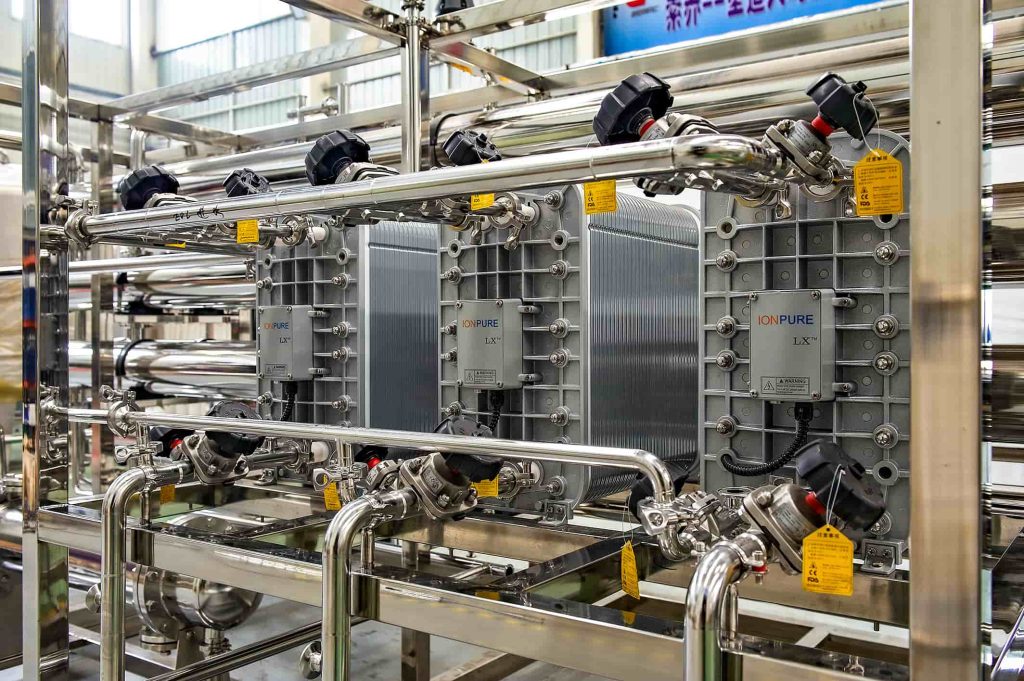
3. Electrodeionization (EDI)
EDI is a polishing step after RO. It removes ions from water.
EDI does not need chemical regeneration like older systems.
RO + EDI is a common setup for high-purity water.
4. UV Treatment
UV controls microbes. Some UV systems also reduce organics.
UV is one part of a broader control strategy.
5. Ultrafiltration (UF)
UF uses a membrane with tiny pores. It removes:
-
Microbes
-
Endotoxins
-
Particles
-
Large molecules
UF is useful for strict microbial control.
Storage and Distribution
Making pure water is only half the work. The water must stay clean in storage and pipes.
Storage Tanks
Tanks are often made of 316L stainless steel. This material is strong and easy to clean.
Good tank design includes:
-
Smooth surfaces
-
Good drainage
-
Spray devices for cleaning
-
Vent filters
-
Temperature control
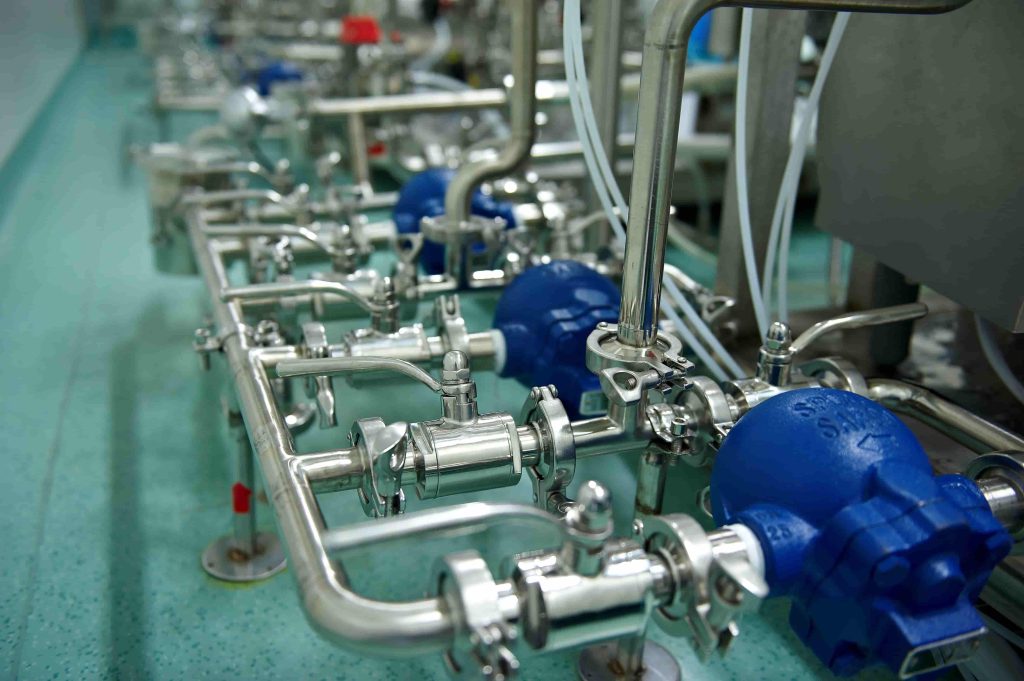
Distribution Pipes
Water moves through a circulating loop. This stops water from sitting still.
Good design considers:
-
Flow speed
-
Pipe slope
-
Drainage
-
No dead legs (stagnant water)
-
Clean connections
-
Weld quality
-
Temperature
Key point: Production, storage, and distribution must be designed as one system.
Hygienic Piping in Practice
Sanitization
Microbial control is very important. A clean and pure water system must stop bacteria from growing.
If water sits still, microbes can grow. Biofilm can form and cause long-term problems.
Common sanitization methods:
Hot Water
Hot water kills microbes. It leaves no chemicals.
Ozone
Ozone gas kills microbes and biofilm. After treatment, ozone is removed before use.
Chemicals
Some systems use approved chemicals. This needs careful rinsing.
The right method depends on the system.
Materials and Hygienic Design
Water purity depends on materials and design too.
316L stainless steel is often used. It resists rust and cleans well.
Good design also looks at:
-
Dead legs (stagnant pipe)
-
Weld quality
-
Surface finish
-
Pipe slope
-
Drainage
-
Fittings
-
Tank design
Key idea: The system should never add contamination after purification.
Monitoring and Validation
A pharmaceutical water system needs proof that it works.
Validation steps:
-
Design Qualification (DQ): Check the design
-
Installation Qualification (IQ): Check the install
-
Operational Qualification (OQ): Test operation
-
Performance Qualification (PQ): Prove consistent quality
Monitoring tracks:
-
Conductivity
-
TOC
-
Temperature
-
Flow
-
Pressure
-
Microbes
Monitoring shows daily performance. Validation gives documented proof.
How to Choose a Commercial Water Purifier
Start with your needs, not with a machine.
| Factor | Questions |
|---|---|
| Feed water | What is the quality? Does it change? |
| Water grade | PW or WFI? |
| Capacity | How much per hour and day? |
| Peak demand | What is the highest need? |
| Treatment | RO, EDI, UF, UV? |
| Storage | How much tank capacity? |
| Distribution | How far to points of use? |
| Sanitization | Which method? |
| Monitoring | What to track? |
| Validation | What documents? |
This helps avoid buying a machine without thinking about the whole system.
SKE&EAGLE Solutions
A commercial water purifier for drugs must support the full process.
SKE&EAGLE offers complete solutions:
-
Purified water systems
-
RO and RO+EDI systems
-
High-purity water treatment
-
WFI-related systems
-
Storage tanks
-
Distribution loops
-
Sanitization systems
-
Monitoring systems
-
Ultra pure reverse osmosis system options
We design around your water quality, capacity, and facility.
The goal is stable, controlled water for drug making.
FAQs
1.What is a commercial water purifier for drugs?
It is a system that makes, stores, and delivers water for drug production.
2.What is the difference between PW and WFI?
PW is used for non-injectable products and general processing; it must meet USP conductivity and TOC limits. WFI is used for injectable products and must additionally meet a bacterial endotoxin limit of 0.25 EU/mL, since it contacts the bloodstream directly.
3.Can RO be used?
Yes. RO has been an accepted USP method for pharmaceutical water for over 30 years, typically paired with EDI, UV, and UF.
4.Can RO make WFI?
RO can be part of a WFI train, and the European Pharmacopoeia formally recognized RO as an alternative to distillation for WFI in 2017 (monograph 0169). It must still be paired with the right polishing, storage, and sanitization steps to meet the full USP <1231> limits.
5.Why use 316L stainless steel?
It resists rust and cleans well.
6.Why a distribution loop?
It stops water from sitting still and helps control microbes.
7.How often to sanitize?
It depends on the system and monitoring results.
Conclusion
A good commercial water purifier is essential for drug manufacturing. Whether you call it a pharmaceutical water system, a clean and pure water system, or an ultra pure reverse osmosis system, the goal is the same: high-quality water for safe drugs.
The right system removes impurities and keeps water clean through storage, distribution, and use.
For system engineering support or integration of pharmaceutical-grade water treatment, contact SKE & Eagle or email info@ske-eagle.com.