


Introduction: Why Water Quality Matters
Water quality failures in pharmaceutical manufacturing are expensive and preventable, which is why regulators like the FDA and EMA set strict standards for it. Water is the primary raw material in drug production, used in mixing, cleaning, and testing. Ordinary tap water carries impurities that can shift a solution’s pH or introduce bacteria that trigger fever-causing reactions in patients, and a contaminated water system can force a plant to scrap an entire batch.
The financial stakes are real. According to data published in BioProcess International, a single contaminated batch in sterile drug manufacturing can cost $1 million to $2 million or more to remediate, not counting the value of the lost product itself. That risk is why the water system feeding a pharmaceutical plant needs to be purpose-built rather than adapted from general industrial equipment.
SKE&EAGLE designs and builds water systems specifically for pharmaceutical manufacturers, covering design, installation, and validation as a single turnkey service. This article walks through the technology behind these systems and what a complete purification setup typically includes.
Key Takeaways
- A commercial RO water purifier is only the first stage; pharmaceutical-grade water requires a full system combining pretreatment, RO, EDI, UV, and ultrafiltration.
- Contaminated batches are costly: BioProcess International reports remediation costs of $1-2 million or more per incident in sterile manufacturing.
- Water grade requirements differ by application; Purified Water (PW), Water for Injection (WFI), and ASTM Type I lab water each demand a different treatment train.
- Validation (DQ/IQ/OQ/PQ) is a required part of any pharmaceutical water system project, not an optional add-on.
What Is a Commercial RO Water Purifier?
A commercial RO water purifier is a large-scale treatment system built around reverse osmosis, but on its own it isn’t enough to meet pharmaceutical water standards. In reverse osmosis, water is pushed through a semi-permeable membrane under pressure, which blocks most salts, ions, and organic particles. Industry data compiled by the Water Quality Association puts typical dissolved-solids rejection for RO membranes at 90 to 99 percent, depending on membrane type and feed water quality.
Pharmaceutical-grade water needs more than RO. A complete ultra pure water purification system layers pretreatment, RO, electrodeionization (EDI), UV light, and ultrafiltration, with each stage targeting impurities the previous step leaves behind.
The finished water has to meet defined limits for conductivity, Total Organic Carbon (TOC), and bacteria counts. The theoretical maximum purity for water is a resistivity of 18.2 MΩ·cm at 25°C, and well-designed systems are built to reach or approach that benchmark consistently. Reliability matters as much as purity here: a commercial water purifier machine feeding a production line needs to run continuously, since unplanned downtime can halt manufacturing altogether.

Manufacturing Standards and Track Record
Pharmaceutical water systems live or die on materials and design discipline. The manufacturer behind this product line traces back to 1958 and has spent decades building equipment for regulated industries. Every wetted part in the current systems is stainless steel, SUS304L or SUS316L, to resist rust and contamination, and the piping is designed without dead legs so water keeps moving instead of pooling where bacteria can grow.
The product range covers Purified Water (PW), Water for Injection (WFI), pure steam systems, and liquid preparation equipment, so a facility isn’t juggling separate vendors for related systems. These commercial RO water purifier systems are used by drug makers in multiple countries.
Customized Solutions for Different Industries
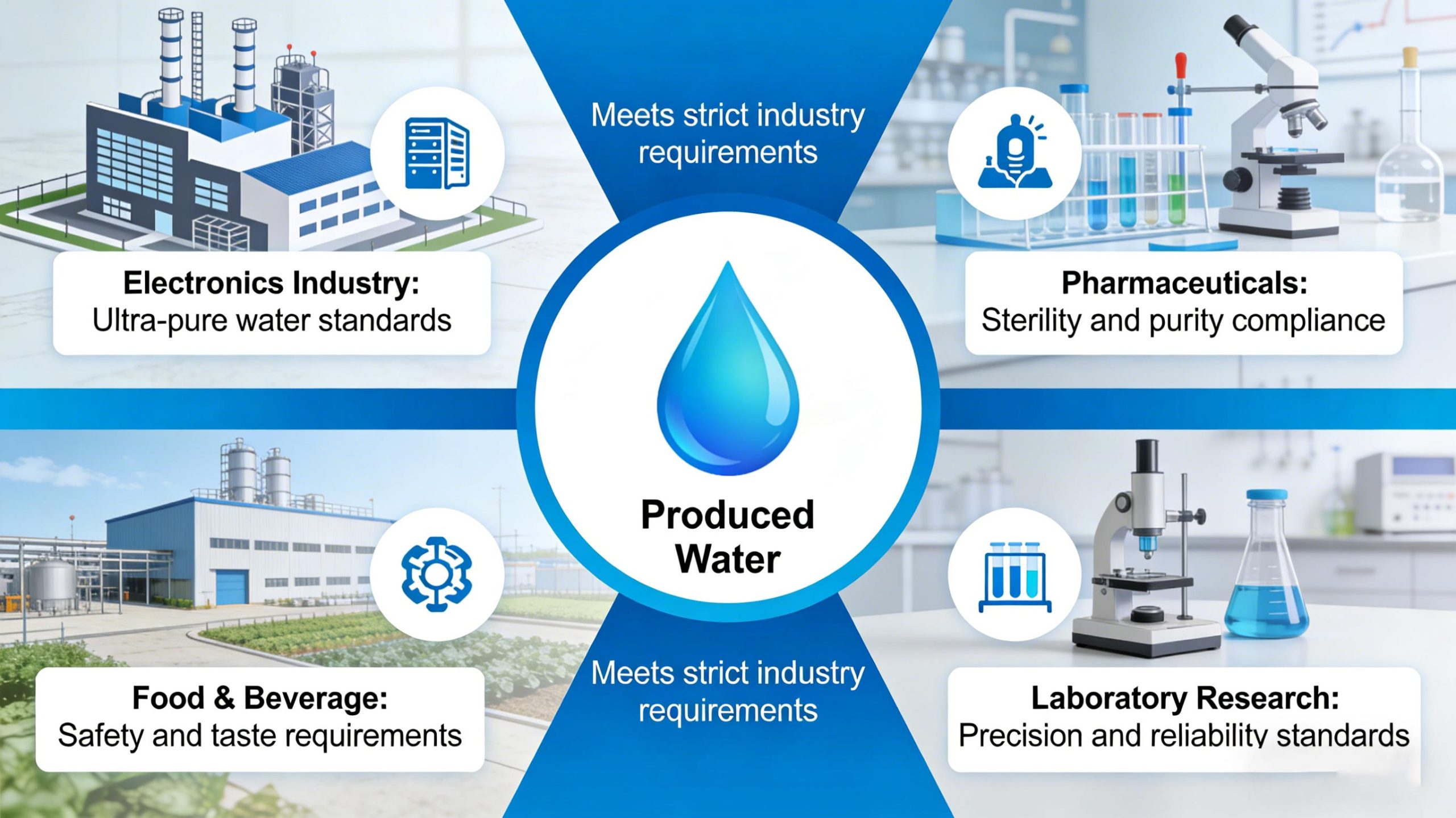
Different applications need different water grades, so a one-size-fits-all system isn’t the right approach. A research lab’s requirements look nothing like a vaccine plant’s, and the treatment train, water grade, and daily capacity should be matched to the specific process.
| Industry | Water Grade | Key Features | Daily Capacity |
|---|---|---|---|
| Pharmaceuticals | Purified Water (PW) | Double-pass RO + EDI | 500 – 20,000 L |
| Biologics / Vaccines | Water for Injection (WFI) | Distillation + Ozone | 1,000 – 20,000 L |
| Research Labs | ASTM Type I | RO + EDI + UV + UF | 50 – 500 L |
| Cosmetics | High Purity Water | Single-pass RO + EDI | 500 – 5,000 L |
Pharmaceutical Manufacturing: Oral medicines and cleaning applications typically call for PW systems, while injectable drugs require WFI, which needs distillation to remove endotoxins.
Biotech: Cell culture work needs water with very low endotoxin levels, which is why an ultra pure water purification system for this use includes an ultrafiltration stage.
Laboratories: Labs generally need compact systems for analytical instruments, often paired with real-time TOC monitoring.
Cosmetics: Pure water helps maintain product stability, and systems for this application are built to be easy to clean and sanitize.
How Customization Works
Customizing an ultra pure water machine comes down to four steps, in order: testing the incoming water, planning for capacity, selecting compatible materials, and designing a sanitization method. Every facility differs. Incoming water might carry high silica, production might run 24 hours a day, or a cleanroom might have limited floor space, and all of that shapes the design.
The process breaks down as follows:
-
Water Testing: Incoming water is tested for hardness, chlorine, silica, and organic matter.
-
Capacity Planning: Peak and average water use are calculated, with room built in for future growth.
-
Material Selection: Stainless steel grade and piping are chosen based on the cleaning agents in use.
-
Sanitization Method: Hot water or ozone sanitization is designed around the specific application.
This process is what makes a commercial water purifier machine fit a facility instead of forcing the facility to adapt around it, and it keeps costs tied to features actually needed.
Core Purification Technologies
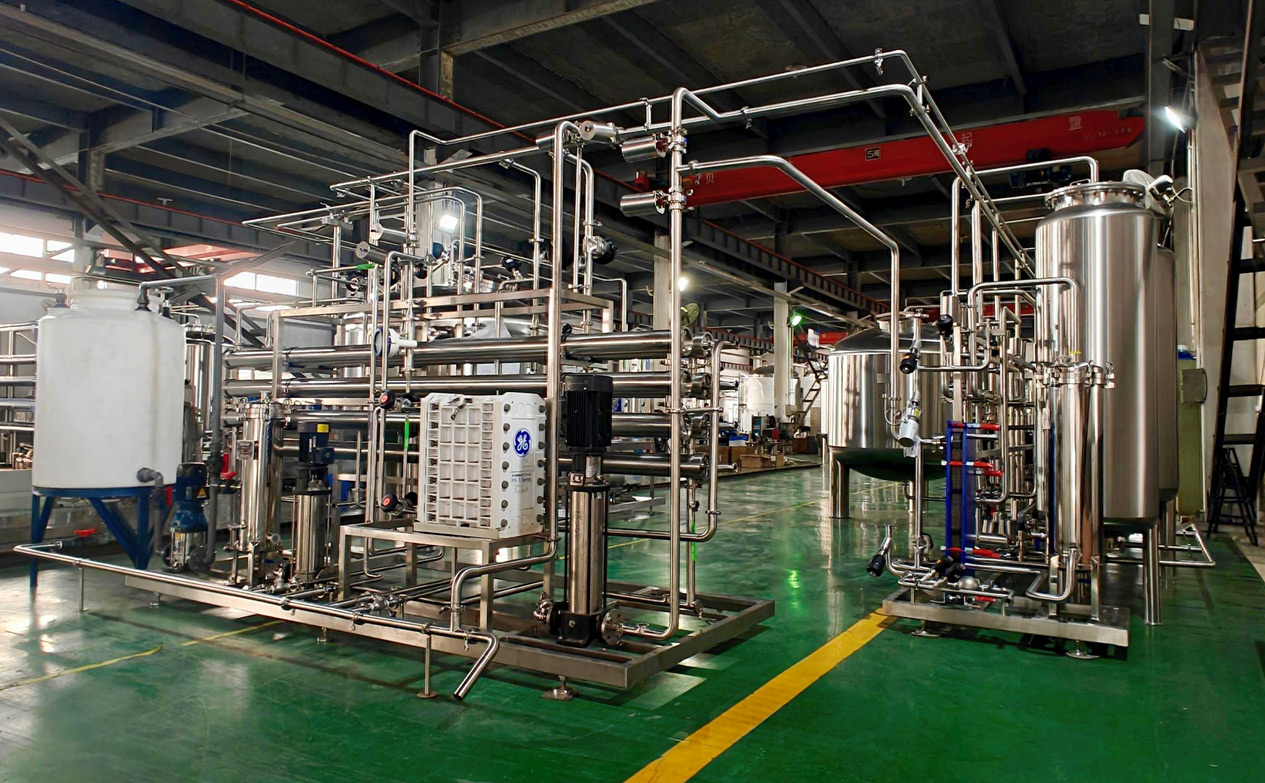
A commercial water purifier machine for pharmaceutical use combines several purification stages, because no single technology removes every type of impurity. Each stage targets specific contaminants, and together they produce consistent, high-quality water.
Pretreatment
Pretreatment protects the RO membranes from damage before water reaches the main purification step. Sand filters strip out dirt and particles, carbon filters remove chlorine, and water softeners reduce hardness.
Reverse Osmosis (RO)
RO is the main purification step, pushing water through a membrane that removes salts and organic compounds. Single-pass RO typically reduces conductivity below 10 µS/cm. For pharmaceutical applications, double-pass RO is generally recommended, since it can bring conductivity below 1 µS/cm.
Electrodeionization (EDI)
EDI removes the ions that RO leaves behind, using electricity instead of chemical regeneration. That eliminates the ongoing cost and environmental impact of chemical deionizers while keeping water quality stable over time.
UV and Ultrafiltration
UV light and ultrafiltration close out the treatment train by targeting organics and biological contaminants that earlier stages don’t fully remove. UV light at 185 nm breaks down organic molecules to reduce TOC, while ultrafiltration uses a fine membrane to remove bacteria and endotoxins, a step that’s critical for water destined for injectable drug production.
Turnkey Service: From Design to Validation
A turnkey water system project runs through four phases, design and engineering, manufacturing and factory testing, installation and commissioning, and validation support, managed under one roof instead of split across multiple contractors.
Design and Engineering
Engineers work with the facility’s team to study water needs and layout, then build a design around the production goals.
Manufacturing and Factory Testing
Systems are built and assembled on skids in-house for easier installation. Before shipping, a full wet test confirms the system works correctly, catching problems before they reach the site.
Installation and Commissioning
Installation includes connecting the system to site utilities and running tests to confirm water quality, with the goal of a smooth startup and no delays.
Validation Support
Validation is a required step for pharmaceutical water systems, since the facility has to prove the system performs consistently. A complete validation package includes Design Qualification (DQ), Installation Qualification (IQ), Operational Qualification (OQ), and Performance Qualification (PQ) protocols. Support during the PQ phase can reduce the facility’s workload and speed up approval.
| Service Phase | What We Do | Your Benefit |
|---|---|---|
| Design & Engineering | Custom design for your needs | System fits perfectly |
| Manufacturing | Build and assemble in our factory | High quality, fast delivery |
| Factory Testing | Full wet test before shipping | Problems fixed early |
| Installation & Commission | On-site setup and testing | Quick, reliable startup |
| Validation Support | DQ/IQ/OQ/PQ protocols | Easy regulatory approval |
Frequently Asked Questions
Q1: What is the difference between PW and WFI?
PW is used for oral medicines and cleaning. WFI is for injectable drugs, has stricter limits, and requires distillation to remove endotoxins.
Q2: What capacity does a commercial RO water purifier offer?
Systems typically range from around 50 L/day for lab-scale setups up to 20,000 L/day or more for production plants.
Q3: How long do RO membranes last in an ultra pure water purification system?
With good maintenance, RO membranes typically last 3 to 5 years, though the actual interval depends on feed water quality, operating pressure, and how consistently the pretreatment stage is maintained.
Q4: Are operating costs high for a commercial water purifier machine?
Systems built around EDI generally cost less to run than ones relying on chemical regeneration, since EDI doesn’t consume acid and caustic chemicals and produces less wastewater to dispose of. Energy-efficient pump and membrane selection further reduces operating costs, though the exact savings depend on local utility rates and feed water chemistry.
Q5: How do you ensure compliance with USP and EP?
Compliance is built into the design: sanitary stainless steel construction, no dead legs, and in-line TOC and conductivity monitoring consistent with USP <643> and <645>. A full DQ/IQ/OQ/PQ validation package documents that the installed system meets USP and EP requirements before it goes into production use.
Q6: What does turnkey mean for an ultra pure water machine project?
It means design, manufacturing, installation, testing, and validation are handled as one project, so the facility receives a complete system without managing multiple separate vendors.
Conclusion: Choosing a Reliable Water System Partner
The right commercial RO water purifier is a risk-management decision, not just an equipment purchase. A single failure can cost a batch and, per BioProcess International’s data, run into seven figures in remediation costs. A well-built ultra pure water purification system, paired with proper validation support, removes most of that risk before it becomes a production problem.
Ready to start your project?
Contact us today for a free consultation. Our engineers will review your needs and provide a custom proposal, along with a “Pharmaceutical Water System Validation Checklist” to help prepare for your next audit.
Official Website: https://www.ske-eagle.com/
Contact Email: info@ske-eagle.com
Follow us on Facebook for the latest industry insights: SKE & Eagle Facebook
Business Inquiries: Visit our official website and submit the contact form at the bottom.