


By the SKE&EAGLE Water Treatment Engineering Team — SKE&EAGLE designs and builds pharmaceutical-grade reverse osmosis and water purification systems and has supplied RO and RO+EDI trains for GMP-regulated drug manufacturing plants.
Key Takeaways
- Pharmaceutical water splits into two grades: Purified Water (PW) and Water for Injection (WFI), each governed by USP and European Pharmacopoeia limits on conductivity, Total Organic Carbon, and (for WFI) endotoxins.
- A standard commercial system layers pretreatment, reverse osmosis (RO), and electrodeionization (EDI); a good RO stage alone removes over 99% of dissolved salts, heavy metals, and organic contaminants.
- Since the 2017 revision, the European Pharmacopoeia permits membrane-based WFI production (RO + EDI + ultrafiltration), giving plants a lower-energy alternative to distillation.
- Storage and distribution design, especially eliminating dead legs and keeping loop water moving, matters as much as the purification train itself for preventing microbial regrowth.
Why Water Quality Matters in Pharmaceutical Manufacturing
Water touches nearly every stage of drug production: it goes into formulations, rinses equipment between batches, and dilutes samples for quality testing. Municipal tap water is not clean enough for any of these uses. It carries dissolved minerals, microorganisms, and trace organics that can compromise a batch or, worse, reach a patient.
Commercial water purification is the engineering discipline that removes those impurities to a level defined by pharmacopeial standards, not just “clean enough to drink.” At SKE&EAGLE, we design and build purification systems sized for pharmaceutical and biotech manufacturers, so this guide reflects how these systems are actually specified and operated in the field.
Two Grades of Pharmaceutical Water
Regulators recognize two main grades of process water, and mixing them up is one of the more common specification mistakes we see from first-time buyers.
Purified Water (PW)
Purified Water is the workhorse grade. It’s used for:
- Manufacturing non-sterile products such as tablets, capsules, and topical creams
- Cleaning production equipment between batches
- Preparing laboratory reagents and test solutions
PW must meet strict chemical limits. Conductivity, a proxy for dissolved salt content, must stay at or below 1.3 µS/cm at 25°C under USP <645> Stage 1 testing. Total Organic Carbon (TOC), which captures organic contamination, is capped at 500 parts per billion under USP <643>. Both limits are harmonized across USP, EP, and JP pharmacopeias.
Water for Injection (WFI)
WFI is the higher grade, reserved for parenteral (injectable) drug products. It carries the same conductivity and TOC limits as PW, plus a bacterial endotoxin ceiling of 0.25 EU/mL under USP <85>, because endotoxins that would be harmless orally can trigger a febrile reaction when injected.
Historically, pharmacopeias required WFI to be produced by distillation alone. That changed when the European Pharmacopoeia’s 2017 revision opened the door to membrane-based production, RO combined with EDI and ultrafiltration, as an accepted alternative. Membrane trains use substantially less energy than multi-effect stills, which is why more new-build plants are specifying them.

How a Commercial Water Purification System Works
A complete system removes impurities in stages. No single unit operation handles everything on its own.
Step 1: Pretreatment
Pretreatment protects downstream membranes from fouling and scaling. Raw municipal or well water typically carries dirt and sand, residual chlorine from disinfection, and hardness minerals like calcium and magnesium. Left untreated, these shorten membrane life and drive up maintenance costs.
Common pretreatment equipment includes:
- Multimedia filters, which remove suspended dirt and particulates
- Activated carbon filters, which strip chlorine and organic odors
- Water softeners, which exchange hardness ions before they can scale the RO membrane
Step 2: Reverse Osmosis (RO)
Reverse osmosis is the core of most commercial water purification trains. A semipermeable membrane lets water molecules pass while rejecting most dissolved solids: pressure pushes feed water across the membrane, permeate (clean water) continues to the next stage, and concentrate (the rejected stream) drains to waste.
A properly designed RO stage typically rejects over 99% of dissolved salts, heavy metals, organic compounds, and bacteria, according to membrane manufacturer performance data. That reliability is why RO anchors nearly every pharmaceutical purification train, whether the end product is PW or feed water for further polishing to WFI.
Step 3: Electrodeionization (EDI)
EDI is a continuous polishing step that follows RO. RO removes the bulk of dissolved ions but leaves a small residual; EDI combines ion-exchange resin, selective membranes, and an applied electric field to pull those remaining ions out continuously, without the acid and caustic regeneration that traditional ion-exchange beds require.
RO followed by EDI is one of the most common configurations for stable, low-conductivity PW and WFI feedwater today, largely because it eliminates the chemical handling and downtime associated with regenerable resin systems.

Comparing Purification Methods
Each technology has a role. The table below summarizes where each one fits.
| Method | How It Works | Strengths | Trade-offs | Typical Role |
|---|---|---|---|---|
| Reverse Osmosis | Pressure pushes water through a semipermeable membrane | Rejects >99% of dissolved impurities; energy-efficient | Needs effective pretreatment; membranes require periodic replacement | Primary purification step for PW |
| EDI | Electric field plus ion-exchange resin removes residual ions | No chemical regeneration; runs continuously | Requires RO-quality feed water; higher upfront cost | Polishing step after RO |
| Distillation | Boils water and recondenses the steam | Very high purity; thermally destroys microorganisms | High energy use; higher operating cost | Traditional WFI production |
| UV Disinfection | Ultraviolet light inactivates microorganisms | Chemical-free; simple to operate | Does not remove dissolved chemicals; lamps need periodic cleaning/replacement | Microbial control in distribution loops |
| Ozone Sanitization | Ozone gas oxidizes and kills bacteria | Highly effective; decomposes to oxygen with no residue | Requires careful handling and dedicated equipment | Storage tank and loop sanitization |
Storage and Distribution: Keeping Water Pure After Treatment
Purification is only half the job. Even correctly treated water can pick up contamination in a poorly designed tank or piping loop.
Storage Tanks
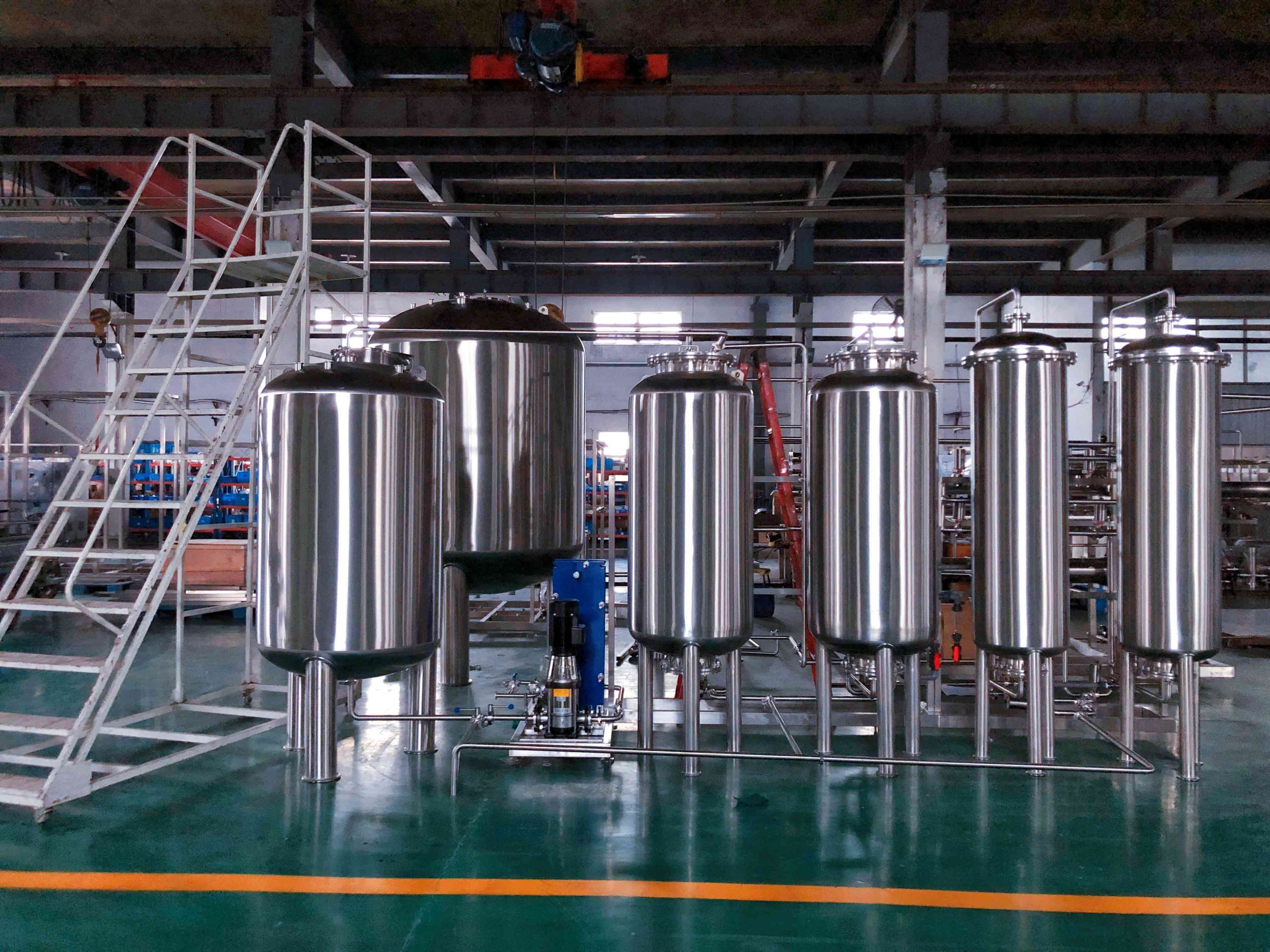
Pharmaceutical water tanks are typically fabricated from 316L stainless steel with an electropolished interior finish, smooth enough to discourage biofilm attachment. Vents are fitted with hydrophobic filters that allow air exchange during fill and draw-down while blocking bacteria and airborne particulates from entering the headspace.
Distribution Loops
Water in a distribution loop needs to keep moving. Stagnant water is where bacteria establish and multiply, so loop design targets a minimum flow velocity and avoids “dead legs,” pipe branches where water sits without circulating. Minimizing dead-leg length is one of the more scrutinized items during a GMP water system audit.
Sanitization
Loops are sanitized on a defined schedule, commonly using hot water circulated at 80–85°C or ozone gas, which breaks down to oxygen and leaves no chemical residue. SKE&EAGLE designs storage and distribution systems around easy, repeatable sanitization cycles to reduce the operational burden on plant staff.
Where Pharmaceutical Water Systems Are Headed
Membrane-Based WFI
As noted above, the European Pharmacopoeia’s acceptance of membrane-based WFI (RO + EDI + ultrafiltration) has opened a lower-energy alternative to distillation. Ultrafiltration provides the final barrier against endotoxins in this configuration.
Continuous Monitoring
Modern systems increasingly pair conductivity, TOC, and flow sensors with data historians that log readings continuously rather than at spot-check intervals. That makes it easier to catch a developing problem before it turns into an out-of-specification batch, and it simplifies audit trail review.
Modular, Skid-Mounted Systems
Skid-mounted systems arrive pre-piped and pre-wired on a single frame, cutting on-site installation time and floor space compared with field-erected builds. SKE&EAGLE’s modular commercial water purification skids bundle pretreatment, RO, EDI, and distribution controls into a single package for new plants and capacity expansions.

Frequently Asked Questions
What is commercial water purification?
It’s the process of removing dissolved and biological impurities from water for industrial use. In pharmaceutical manufacturing, that means treating water to meet the conductivity, TOC, and (where applicable) endotoxin limits set by USP and EP monographs.
How do I choose the right system for a pharma plant?
There’s no universal answer. The right configuration depends on raw water quality, the required water grade (PW or WFI), and production volume. RO, RO+EDI, and RO+EDI+UF are the three configurations we spec most often.
What’s the difference between PW and WFI?
PW is used for non-sterile products and equipment cleaning. WFI is used for injectable drugs and carries stricter limits, including a 0.25 EU/mL endotoxin ceiling that PW does not have.
Why does system validation matter?
Validation demonstrates that a system consistently produces water meeting spec under real operating conditions. It’s a regulatory expectation under GMP, and it’s the evidence an auditor will ask to see first.
How often should a water system be sanitized?
Sanitization frequency depends on system design, water grade, and usage pattern. Many loops run on a weekly-to-monthly hot water or ozone sanitization cycle; SKE&EAGLE recommends a schedule based on the client’s specific system and risk assessment.
Conclusion
Commercial water purification is foundational to pharmaceutical manufacturing: it protects product quality, supports patient safety, and determines how smoothly a plant passes regulatory inspection. RO and EDI cover most Purified Water needs, while WFI production now has a real choice between distillation and membrane-based trains. The right configuration always comes down to a specific plant’s raw water, required grade, and production volume.
If you’re specifying a new water system or evaluating an upgrade, SKE&EAGLE’s engineering team can review your requirements and recommend a configuration. Visit our website or email info@ske-eagle.com to start that conversation.