


Water is the most widely used raw material in the pharmaceutical industry. It serves as an excipient, a cleaning agent, and a component in countless formulations. However, not all water is created equal. The quality of water directly impacts product safety, efficacy, and regulatory compliance. This is where a professional pure water system becomes indispensable.
A pure water system is engineered to remove contaminants, including ions, organic compounds, microorganisms, and particulates. For pharmaceutical applications, ordinary tap water must undergo rigorous purification to meet pharmacopoeia standards such as USP, EP, or JP. Without a reliable system, manufacturers risk product recalls, contamination, and severe regulatory penalties.
At SKE&EAGLE, we specialize in designing and manufacturing high-performance water purification solutions tailored to the strict demands of life sciences. Our expertise ensures that your production line operates with zero contamination risk. In this article, we will explore the technical differences between related systems, the core treatment processes, and best practices for validation.
Key Terminology: Pure Water vs. Purified Water Systems
Before diving into technology, it is essential to clarify the terminology. Many professionals confuse a pure water system with a purified water system. While they are related, the context defines their application. In general industry, “pure water” refers to water with high resistivity and low total organic carbon (TOC). In pharmaceuticals, the term “purified water” has a specific legal definition.
A purified water system is specifically designed to produce water that meets pharmacopoeial standards for non-sterile applications. It typically uses reverse osmosis (RO) and electrodeionization (EDI). Purified water is used for tablet coating, syrup preparation, and equipment rinsing. It does not require endotoxin control unless specified.
In contrast, a purified water treatment system emphasizes the multi-step process—pretreatment, primary purification, and polishing. This term highlights the engineering behind achieving consistent quality. Similarly, a pure water treatment system is a broader term covering industrial, electronic, and pharmaceutical needs. For drug makers, however, only validated systems are acceptable.
The table below summarizes the key distinctions:
| Parameter | Pure Water System (General) | Purified Water System (Pharma) |
|---|---|---|
| Primary Application | Industrial, electronics, cosmetics | Pharmaceutical, biotechnology, medical devices |
| Quality Standard | Resistivity > 1 MΩ·cm, low TOC | USP < 645>, < 643>, < 1231>; Conductivity < 1.3 µS/cm at 25°C |
| Microbial Control | Optional | Mandatory (< 100 CFU/mL, no pathogens) |
| Endotoxin Removal | Not required | Required for WFI, optional for PW |
| Validation | Performance verification only | IQ, OQ, PQ documentation required by FDA/EMA |
| Typical Components | RO, EDI, UV, mixed-bed DI | Softener, carbon filter, RO, EDI, hot water sanitization |
The Core Components of a Purified Water Treatment System
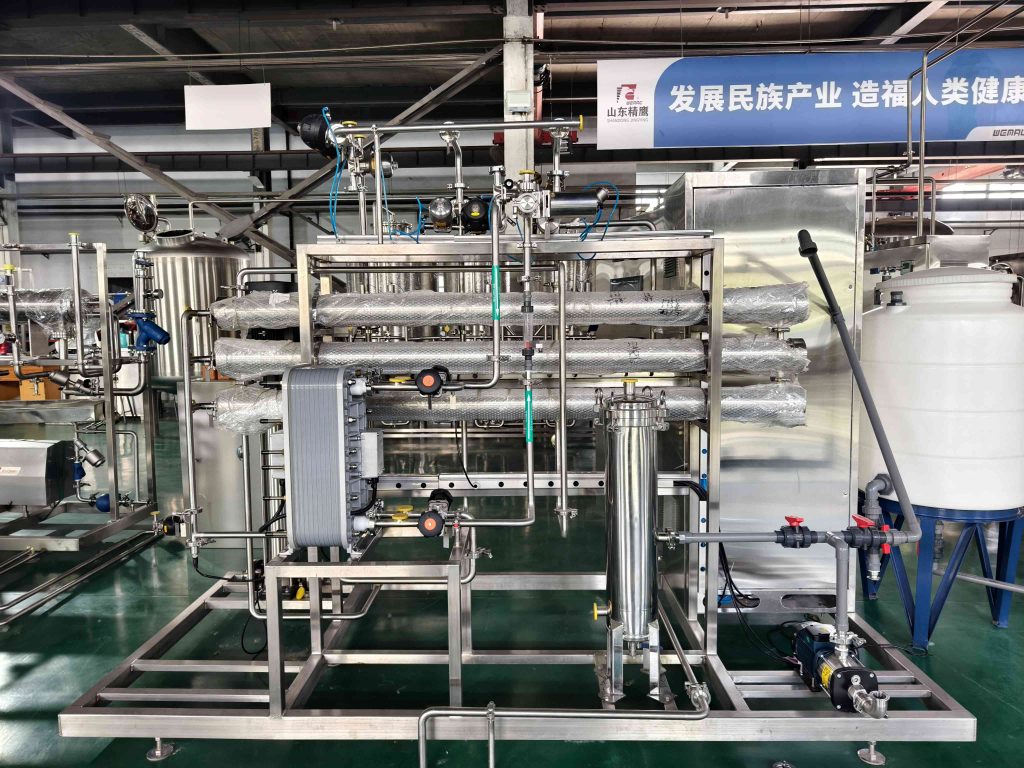
A reliable purified water treatment system integrates several unit operations. Each component serves a critical role in eliminating specific contaminants. Design must account for feed water quality, production capacity, and sanitization frequency. Below is a breakdown of the typical stages.
Pretreatment Stage: This protects downstream equipment. It includes a multimedia filter to remove suspended solids, a water softener to prevent scaling on RO membranes, and an activated carbon filter to remove chlorine and chloramines. Carbon filtration is vital because chlorine destroys RO membranes. For challenging feed water, an ultrafiltration (UF) unit may be added.
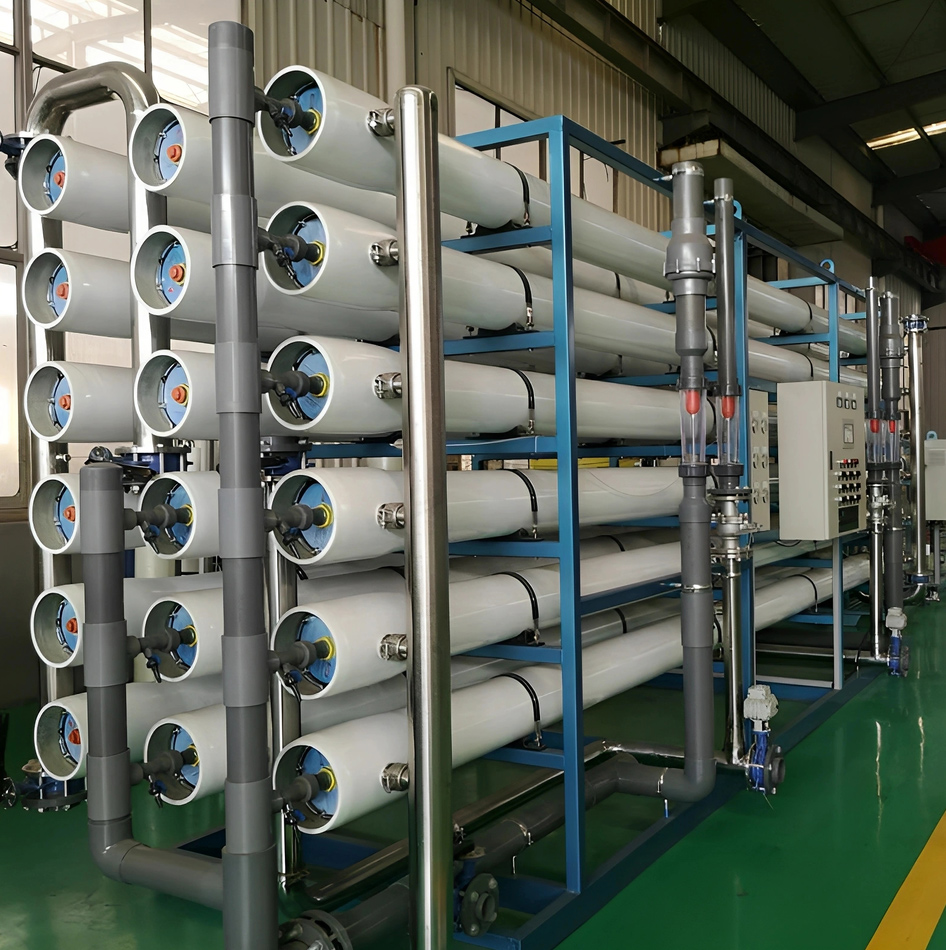
Primary Purification Stage: The heart of the system is reverse osmosis. A high-pressure pump forces water through semipermeable membranes, rejecting 99% of ions, bacteria, and pyrogens. Single-pass RO typically achieves 10-15 µS/cm conductivity. For purified water, a double-pass RO or RO followed by continuous electrodeionization (CEDI) is preferred. CEDI uses ion-exchange resins and an electric field to polish the RO permeate, reaching resistivity above 1 MΩ·cm.
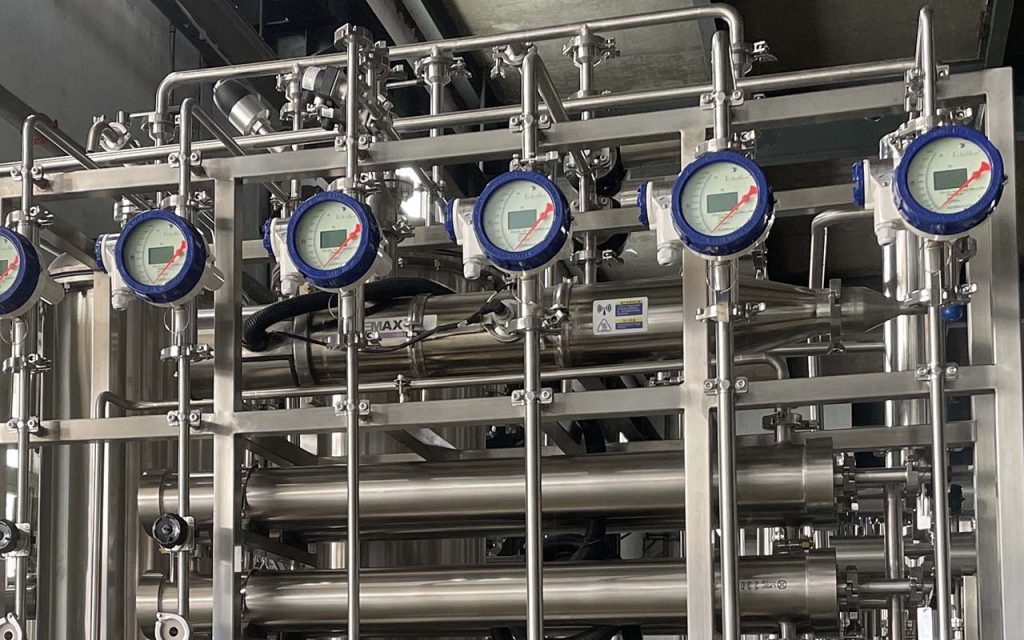
Polishing and Distribution Stage: The final water is stored in a tempered storage tank and circulated through a stainless steel (316L) loop at turbulent flow (Reynolds > 10,000). Online instruments monitor conductivity, TOC, and temperature. Sanitization methods include hot water (80°C) or ozone. Dead legs must be minimized to prevent biofilm formation.
Why Pharmaceutical Manufacturers Choose Pure Water Treatment Systems
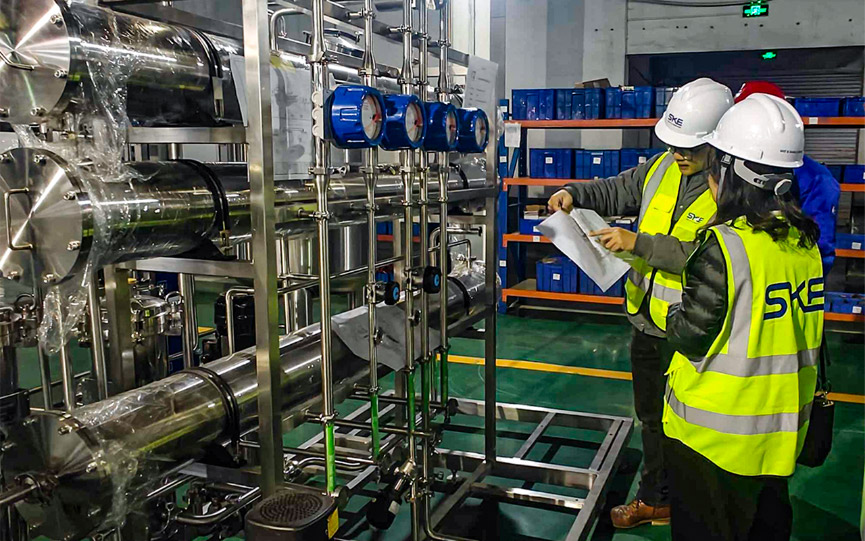
The shift toward automated pure water treatment systems is driven by regulatory scrutiny and operational efficiency. The FDA’s Process Validation Guidance (2011) requires documented evidence that water systems consistently produce quality water. Manual operations introduce variability, whereas automated systems offer reproducibility.
One major advantage is real-time monitoring. Modern systems log conductivity, flow rate, and pressure every few seconds. If a parameter drifts outside alert limits, the system sends notifications to maintenance teams. This prevents out-of-specification (OOS) water from reaching production. Additionally, automated sanitization cycles reduce human error and ensure complete biofilm eradication.
From a financial perspective, investing in a high-recovery system lowers water bills. SKE&EAGLE integrates energy-efficient pumps and RO membranes that operate at lower pressure, reducing electricity consumption by up to 25%. Furthermore, predictive maintenance algorithms forecast membrane replacement needs, avoiding unplanned downtime.
Another critical factor is material compatibility. Pharmaceutical water systems must use non-toxic, non-leaching materials. Our piping is constructed from electro-polished stainless steel (316L) with PTFE gaskets. Unlike PVC or ordinary plastics, stainless steel withstands hot water sanitization without degrading. This ensures decades of service life.
Finally, scalability matters. A laboratory-scale system producing 50 L/hour can be expanded to 5000 L/hour with modular skids. SKE&EAGLE offers design consultancy to match current and future capacity requirements. We never oversell—our engineers conduct a mass balance analysis before proposing any solution.
Design Validation: IQ, OQ, and PQ for Water Systems
No discussion of a purified water system is complete without validation. Regulatory bodies require that equipment performs as intended under real-world conditions. The validation lifecycle includes three distinct phases: Installation Qualification (IQ), Operational Qualification (OQ), and Performance Qualification (PQ).
Installation Qualification (IQ): This verifies that the system is built according to specifications. Documentation includes material certificates (e.g., 316L steel mill test reports), weld logs, pressure test results, and instrumentation calibration certificates. SKE&EAGLE provides a complete IQ package with as-built P&IDs and component datasheets. We also verify that utilities (power, drain, compressed air) meet design requirements.
Operational Qualification (OQ): During OQ, the system is tested under all normal and anticipated conditions. Engineers check alarm setpoints, valve actuation times, pump motor currents, and sanitization temperature ramp rates. For a pure water treatment system, OQ also verifies that no dead legs exceed 1.5 pipe diameters. Our technicians run challenge tests using conductivity probes and TOC analyzers to confirm removal efficiency.
Performance Qualification (PQ): PQ typically spans 2–4 weeks of continuous operation. Water samples are collected daily from the storage tank and each use point. Testing includes conductivity, TOC, microbial enumeration, and endotoxin (if required). The acceptance criteria must meet pharmacopoeia limits 100% of the time. SKE&EAGLE supports clients during PQ by providing sampling protocols and statistical process control charts.
Common Design Mistakes and How SKE&EAGLE Solves Them
Even experienced engineers sometimes specify inadequate water systems. Below are frequent errors seen in the industry, along with SKE&EAGLE solutions.
Mistake 1: Undersized Pretreatment. Many buyers focus on the RO skid and neglect the softener or carbon filter. This leads to membrane fouling within months. Our approach: We size the pretreatment for peak flow plus 30% margin. Dual alternating softeners ensure continuous operation during regeneration.
Mistake 2: Poorly Designed Distribution Loop. Long dead legs, low-flow points, or undersized return lines promote biofilm. SKE&EAGLE uses CFD modeling to guarantee turbulent flow (minimum velocity 1.5 m/s) at all points. We also slope piping to allow full drainage.
Mistake 3: Ignoring Sanitization Frequency. Some systems only sanitize monthly, allowing microbial resistance to develop. Our systems include automated daily hot water or ozone sanitization with programmable logic. No manual chemical dosing is required.
Mistake 4: Inadequate Instrumentation. Relying on single probes risks undetected failures. We install redundant conductivity sensors and TOC monitors. If one probe drifts, the system defaults to the other and triggers a calibration alert.
Mistake 5: No Future Expansion Plan. A system built for 1,000 L/day cannot easily double capacity. Our modular skids accept additional RO vessels or EDI stacks without re-piping the main loop. This future-proofs your investment.
Operational Excellence: Maintaining Your Pure Water System
Installation is only the beginning. To ensure continuous compliance, a pure water system requires a disciplined maintenance strategy. The two most critical activities are membrane care and microbial control.
Membrane Maintenance: RO membranes gradually lose permeability due to scaling and organic fouling. A cleaning-in-place (CIP) system using low-pH and high-pH detergents restores performance. SKE&EAGLE recommends cleaning every 3–6 months depending on feed water hardness. Our systems automatically log pressure differentials; when delta-P increases by 15%, a cleaning reminder appears.
Sanitization Protocols: For a purified water treatment system, microbial count must stay below 100 CFU/mL. Hot water sanitization at 85°C for 60 minutes is highly effective. Ozone is another option, but it requires UV lamps to remove residual ozone before use. We provide both methods and train your team on frequency optimization (typically weekly for hot water, daily for ozone).
Calibration Schedule: Online instruments (pH, conductivity, TOC) drift over time. Send them to an ISO 17025-accredited lab every 6 months. Alternatively, SKE&EAGLE offers field calibration services with NIST-traceable standards. We also verify temperature sensors, as conductivity readings are temperature-dependent.
Passivation of Stainless Steel: New systems or modified piping must be passivated with citric or nitric acid to restore the chromium oxide layer. This prevents corrosion and metal ion leaching. Our commissioning team performs passivation and tests with ferroxyl solution to confirm complete coverage.
With our remote monitoring portal, you receive monthly performance reports. Anomalies such as rising TOC or falling resistivity are flagged early. This predictive approach eliminates emergency breakdowns and keeps your production schedule intact.
Comparing Purified Water vs. WFI (Water for Injection)
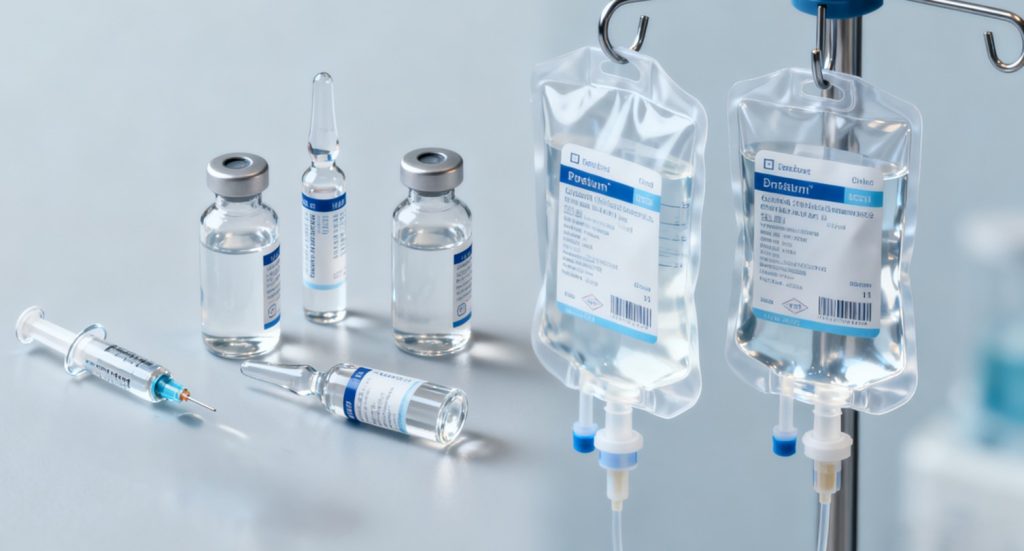
Many pharmaceutical professionals ask: Can a purified water system replace a Water for Injection (WFI) system? The answer depends on application. Purified water is suitable for oral, topical, and non-sterile products. WFI is required for parenteral (injectable) preparations and ophthalmic solutions.
The key difference is endotoxin control. WFI must contain less than 0.25 EU/mL (endotoxin units). Purified water has no official endotoxin limit unless specified. To produce WFI, a pure water treatment system must include either multi-effect distillation (MED) or a cold WFI system using RO plus UF.
SKE&EAGLE manufactures both purified water systems and WFI generators. For clients upgrading later, we design hybrid systems. A double-pass RO with EDI produces purified water. A downstream UF membrane (1,000 Dalton cutoff) removes endotoxins, achieving WFI quality. This approach saves energy compared to distillation.
However, regulatory acceptance varies. The European Pharmacopoeia now allows non-distillation methods (RO + UF) for WFI, while the USP still favors distillation for large volumes. Our consultants guide you based on your target market. We have successfully validated WFI systems for FDA and EMA inspections.
Below is a quick comparison:
| Parameter | Purified Water (PW) | Water for Injection (WFI) |
|---|---|---|
| Conductivity (25°C) | ≤ 1.3 µS/cm | ≤ 1.3 µS/cm |
| TOC | ≤ 500 ppb | ≤ 500 ppb |
| Bacteria | ≤ 100 CFU/mL | ≤ 10 CFU/100 mL (0.1 CFU/mL) |
| Endotoxins | Not specified | ≤ 0.25 EU/mL |
| Production Method | RO, EDI, Ion Exchange | Distillation or RO + UF (EP only) |
| Typical Use | Tablet granulation, equipment rinse | Injectables, ophthalmics, irrigating solutions |
Frequently Asked Questions (FAQ)
Q1: What is the difference between a pure water system and a purified water system?
A: A pure water system is a general term for any system producing high-resistivity water. A purified water system specifically meets pharmacopoeia standards (USP/EP/JP) for pharmaceutical use. SKE&EAGLE builds both, but our pharma systems include validated microbial control.
Q2: How often should a purified water treatment system be sanitized?
A: Typically weekly with hot water (85°C) or daily with ozone. Frequency depends on microbial trend data. SKE&EAGLE systems automate sanitization based on real-time bioburden monitoring.
Q3: Can I use a pure water treatment system for electronics manufacturing?
A: Yes, but electronic-grade water requires higher resistivity (18.2 MΩ·cm) and lower TOC (< 50 ppb). Pharmaceutical purified water is less stringent. Contact SKE&EAGLE for industry-specific design.
Q4: What validation documents does SKE&EAGLE provide?
A: We provide complete IQ, OQ, and PQ protocols, material certifications, weld maps, passivation reports, calibration certificates, and operator training manuals. All documents are ready for regulatory submission.
Q5: How long does installation take?
A: A standard skid-mounted pure water system (500–2000 L/hour) installs in 5–7 days. Commissioning and validation add 2–3 weeks. Our project managers coordinate with your construction team to minimize downtime.
Contact SKE & Eagle for Advanced Solutions
For customized system engineering solutions or integration of high-performance water treatment technologies, please contact SKE & Eagle. Our professional team collaborates closely with industrial partners to design, implement, and maintain solutions tailored to your operational needs.
Official Website: https://www.ske-eagle.com/
Contact Email: info@ske-eagle.com
Follow us on Facebook for the latest industry insights: SKE & Eagle Facebook
Business Inquiries: Visit our official website and submit the contact form at the bottom.