


- Pharmaceutical bioreactors split into three families: stirred-tank (STR), single-use (SUB), and wave/rocking-motion, each suited to different cell types and batch sizes.
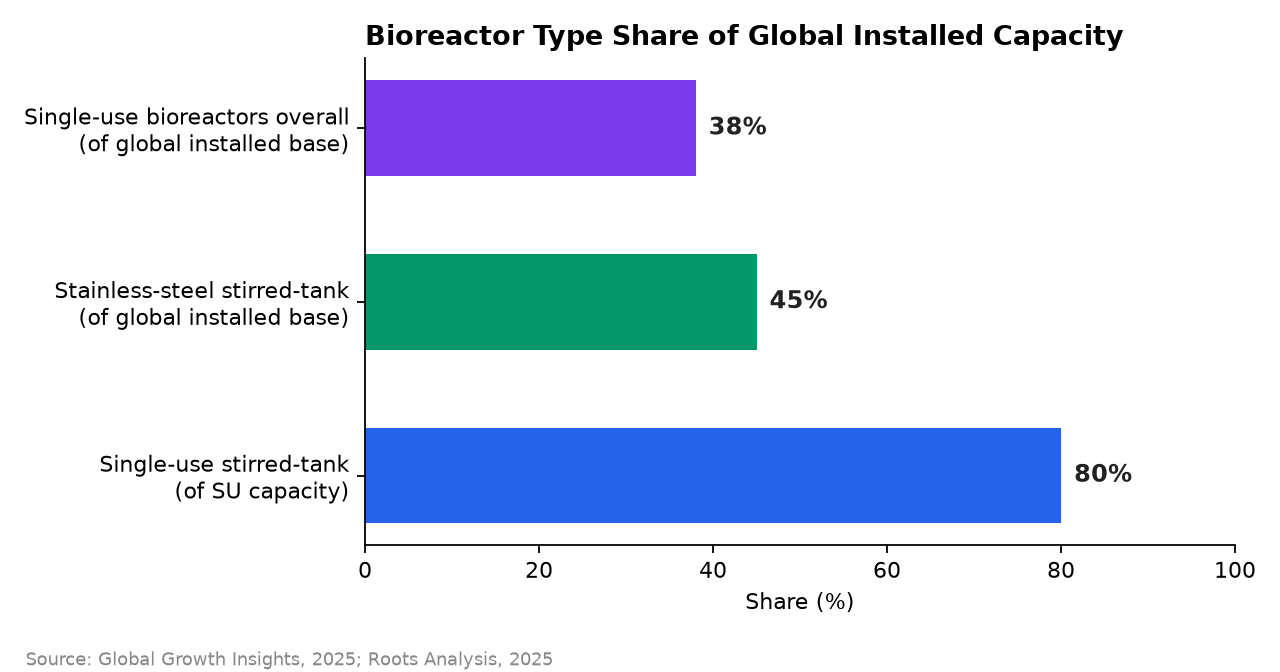
- Single-use stirred-tank systems now account for roughly 80% of installed single-use capacity by revenue, and the broader single-use bioreactor market was valued near $4.3 billion in 2025 (Roots Analysis, 2025).
- Choosing between STR, SUB, and wave designs comes down to batch size, shear sensitivity of the cell line, and how fast you need to change over between products.
What Are the Main Types of Bioreactors Used in Pharmaceutical Manufacturing?
Pharmaceutical manufacturers use three main bioreactor types: stirred-tank (STR), single-use (SUB), and wave or rocking-motion systems. Single-use stirred-tank designs alone cover close to 80% of installed single-use capacity today (Roots Analysis, 2025), which tells you a lot about where the industry has settled after two decades of debating steel versus plastic.
Each type solves a different problem. STRs give you decades of validated scale-up data and near-unlimited working volume. SUBs cut changeover time and remove cleaning validation from the critical path. Wave systems handle shear-sensitive cell lines that would get shredded by a mechanical impeller. We’ll walk through when each one actually makes sense, not just what the spec sheet says.
Stirred-Tank Bioreactors: Still the Workhorse for Large-Scale Biologics
Stirred-tank reactors (STRs) make up roughly 45% of the global installed bioreactor base (Global Growth Insights, 2025), and for large-volume monoclonal antibody production, they’re still the default choice. An impeller keeps the culture mixed, oxygenated, and at a steady temperature, and because the geometry stays constant as vessels scale up, the design space transfers cleanly from a 200 L pilot run to a 20,000 L production vessel.
That predictability is exactly why regulators like them. Decades of validation data exist for stainless-steel STRs, which shortens the IQ/OQ/PQ conversation considerably. The tradeoff is cleaning: every batch requires validated CIP/SIP cycles, and changeover between different products can eat days of downtime that a single-use system would avoid entirely.
In practice, the STR-versus-SUB decision usually isn’t philosophical, it’s a function of how many different products run through the same suite. A single-product facility running one biologic at massive scale still leans stainless steel. A multi-product CDMO switching between client programs every few weeks leans single-use, almost by default.
Single-Use Bioreactors: Why Manufacturers Keep Switching
The single-use bioreactor market reached roughly $4.3 billion in 2025 and is projected to keep growing at a compound annual rate near 9% (Roots Analysis, 2025). Monoclonal antibody production drives about 35% of that demand, and biopharma overall accounts for close to 65% of the market (IMARC Group, 2025).
Single-use systems replace the stainless vessel with a pre-sterilized, gamma-irradiated plastic bag. That one swap removes CIP/SIP validation from the schedule entirely, and typically cuts 4 to 8 hours of turnaround per batch (Sartorius, 2025). Reported operating cost savings run around 40%, with 45-50% less water and energy consumed per batch compared to a stainless equivalent.
Small biotechs and contract manufacturers have been the fastest adopters, mostly because a single-use suite avoids the capital cost of stainless tanks and the multi-week cleaning validation that comes with them. The catch is waste: disposable bags mean ongoing consumable spend and a plastic waste stream that stainless systems don’t generate, so the “no cleaning” advantage isn’t free, it’s just a different cost bucket.
Wave and Rocking-Motion Bioreactors: Built for Shear-Sensitive Cultures
Wave (rocking-motion) bioreactors mix culture by rocking a partially inflated bag back and forth instead of spinning an impeller through it. That gentler mixing action is why they’re the go-to for shear-sensitive cell lines, insect cells, some stem cell lines, and early seed-train expansion, where a stirred impeller would damage the culture (Sartorius, 2025).
The tradeoff is scale. Rocking-motion systems generally top out around 2,000 L working volume, well below what a stirred-tank or single-use STR can handle, and oxygen transfer rates (kLa) run lower too. That’s fine for seed expansion or smaller-batch products, but it rules wave systems out for large-scale commercial mAb production on their own.
Batch, Fed-Batch, and Continuous: How Bioreactor Type Interacts With Process Mode
The bioreactor type you pick (STR, SUB, or wave) is a separate decision from the operating mode you run it in. Batch mode loads all nutrients upfront and harvests at the end. Fed-batch adds nutrients incrementally to extend the growth phase and push yield higher, which is the mode most monoclonal antibody processes actually run in. Continuous (perfusion) bioprocessing keeps cells in the vessel indefinitely while continuously removing product and refreshing media, which needs tighter in-line monitoring but can shrink a facility’s overall footprint.
Any of the three bioreactor types can run in any of these three modes; a single-use STR runs fed-batch just as often as a stainless one does. What changes is the automation and sensor integration required, continuous processing in particular demands real-time monitoring that older batch-only STR installations sometimes lack.
How Do You Choose the Right Bioreactor Type for Your Process?
Start with three questions: how shear-sensitive is the cell line, how many different products will run through this suite, and what’s the target batch volume. Shear-sensitive cultures point toward wave systems for seed train and single-use STRs for production scale. Multi-product facilities favor single-use for the changeover speed. Large single-product commercial runs above roughly 2,000-6,000 L still often favor stainless STRs or large-format single-use STRs, since both scale further than wave technology allows.
| Factor | Stirred-Tank (STR) | Single-Use (SUB) | Wave / Rocking-Motion |
|---|---|---|---|
| Typical working volume | Up to 20,000+ L | Up to 4,000-6,000 L | Up to ~2,000 L |
| Cleaning validation | Full CIP/SIP required | None (pre-sterilized bag) | None (pre-sterilized bag) |
| Changeover time | Days (cleaning + validation) | Hours | Hours |
| Shear sensitivity fit | Moderate | Moderate to high (depends on impeller design) | High (gentlest mixing) |
| Best fit | Single-product, large-scale commercial | Multi-product, CDMO, fast changeover | Seed train, shear-sensitive lines, smaller batches |
| Capital cost profile | High upfront, low consumable cost | Lower upfront, ongoing consumable cost | Lower upfront, ongoing consumable cost |
In our experience specifying bioprocessing skids for pharmaceutical clients, the material compatibility and sanitary design questions (tri-clamp fittings, surface roughness, CIP/SIP readiness for hybrid lines) end up mattering as much as the bioreactor technology itself, a well-engineered stainless STR with poor peripheral piping design will underperform a mediocre bioreactor paired with properly validated utilities.
Cost isn’t just the sticker price on the vessel either. A stainless STR carries a higher capital cost but a lower long-run consumable spend, while single-use systems shift that cost into recurring bag purchases, roughly 40% lower operating cost overall according to industry estimates, but that number assumes a facility running enough batches to amortize the convenience against ongoing plastic spend (Roots Analysis, 2025). Facilities running fewer, larger batches of a single product tend to find stainless still pencils out cheaper over a five-to-ten-year horizon.
SKE & Eagle Bioreactor and Fermenter Systems
SKE & Eagle manufactures stainless-steel bioreactor and fermenter systems for pharmaceutical and biotech applications, engineered to GMP sanitary design standards with tri-clamp fittings, validated CIP/SIP cycles, and 316L electropolished surfaces. Product specifications, including working volume ranges and control system options, are available on request through our contact page.
Related reading: bioreactor vs. fermenter, what’s the difference.
Frequently Asked Questions About Bioreactor Types
What are the different types of bioreactors?
The three main types used in pharmaceutical manufacturing are stirred-tank (STR), single-use (SUB), and wave or rocking-motion bioreactors. STRs dominate large-scale stainless production, SUBs now cover around 80% of single-use installed capacity, and wave systems handle shear-sensitive cultures at smaller scale (Roots Analysis, 2025).
What is a batch type bioreactor?
A batch bioreactor loads all nutrients and inoculum at the start of the run and harvests once at the end, with no additions or withdrawals in between. It’s the simplest operating mode and still common for smaller-scale or early-phase production, though most commercial mAb processes have moved to fed-batch for higher yield per run.
What’s the difference between bioreactors and fermenters?
In practice the terms overlap, but “fermenter” traditionally refers to systems growing microbial cultures like bacteria or yeast, while “bioreactor” more often describes systems supporting mammalian or insect cell culture for biologics. See our bioreactor vs. fermenter comparison for the full technical breakdown.
Why are single-use bioreactors becoming more popular?
Single-use systems remove CIP/SIP cleaning validation from the schedule, cutting roughly 4-8 hours of turnaround per batch, and lower water and energy use by an estimated 45-50% compared to stainless equivalents (Sartorius, 2025). That’s especially valuable for multi-product facilities and contract manufacturers switching between client programs frequently.
Can wave bioreactors scale to commercial production volumes?
Generally not on their own. Wave and rocking-motion systems typically top out near 2,000 L working volume, which suits seed-train expansion or smaller-batch products but falls short of the 6,000+ L capacity that large-format stirred-tank or single-use STR systems reach for commercial-scale biologics.