

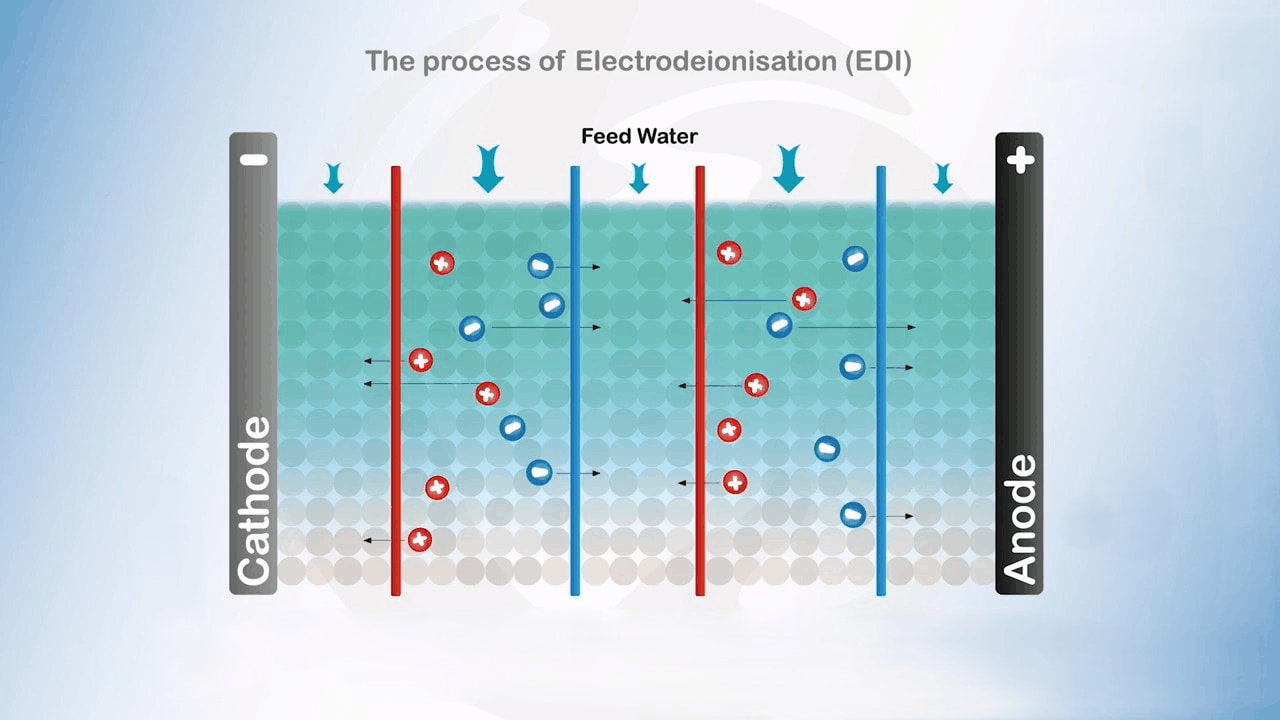
- Reverse osmosis (RO) rejects 95-99%+ of dissolved solids, ultrafiltration (UF) catches suspended particles and colloids RO membranes can’t, and electrodeionization (EDI) polishes remaining ions without chemical regeneration (Morui Water, 2025).
- Thin-film composite (TFC) membranes account for over 91% of the RO market, and typical commercial RO membrane lifespan runs 3 to 7 years before replacement (PMC, 2025).
- Modern RO systems have cut energy consumption to roughly 2.5-3.5 kWh/m³, a meaningful efficiency gain over older membrane generations (Industry membrane data, 2025).
Looking for water purity grades and pharmacopeial standards instead of the purification technology itself? See pharmaceutical water systems: types, standards, and how to choose one.
How Do RO, UF, and EDI Purification Technologies Compare?
Reverse osmosis, ultrafiltration, and electrodeionization solve different parts of the purification problem, not the same one three ways. RO rejects 95-99%+ of dissolved solids and dissolved organics. UF catches suspended particles, colloids, and larger organic molecules that pass straight through an RO membrane’s pressure-driven mechanism. EDI then strips the residual ions RO leaves behind, without the acid/caustic regeneration that traditional ion exchange resin needs.
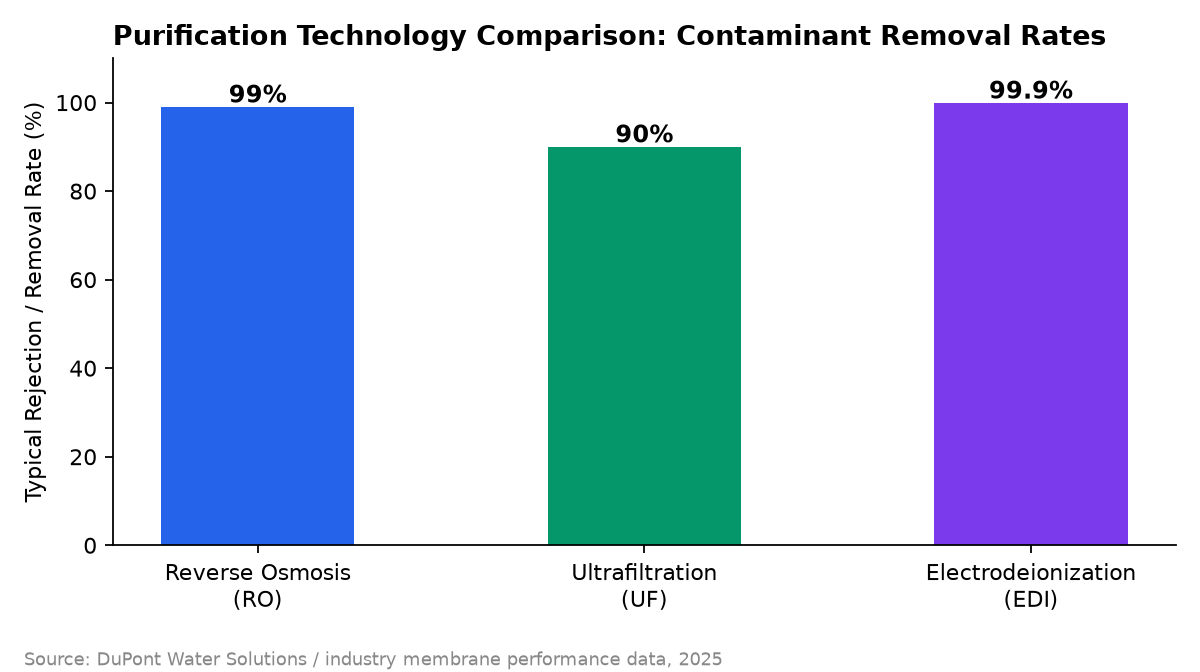
Most industrial and pharmaceutical systems don’t pick one technology, they stack RO, UF, and EDI in sequence, each stage removing what the previous one leaves behind.
How Does Reverse Osmosis Purification Work?
RO forces water through a semi-permeable membrane under pressure, rejecting dissolved solids and microorganisms while letting purified water pass through. Thin-film composite (TFC) membranes now account for over 91% of the RO market, having largely displaced older cellulose acetate membrane designs (PMC, 2025).
A typical commercial RO membrane lasts 3 to 7 years before rejection performance degrades enough to warrant replacement, and modern systems now run at roughly 2.5-3.5 kWh/m³, a real efficiency gain that lowers operating cost over the membrane’s service life (Industry membrane data, 2025). Fouling is the main enemy of RO performance, which is why pretreatment quality upstream matters as much as the membrane spec itself.
What Role Does Ultrafiltration Play in Water Purification?
Ultrafiltration uses a membrane with smaller, more uniform pores than RO to physically strain out suspended particles, colloids, bacteria, and larger organic molecules before or after the RO stage. Because UF operates on size exclusion rather than pressure-driven rejection of dissolved ions, it’s not a substitute for RO, it’s a complementary stage that protects the RO membrane from fouling and catches what RO’s chemistry-driven rejection isn’t designed to filter.
How Does Electrodeionization (EDI) Differ From Traditional Ion Exchange?
EDI combines ion exchange resin with an applied electrical field to continuously regenerate the resin, removing residual ions from RO permeate down to very low conductivity without the chemical regeneration (acid and caustic) that conventional ion exchange systems require on a scheduled basis.
That difference matters operationally: no chemical storage, no regeneration downtime, and no spent-regenerant disposal to manage. For facilities producing high-purity or pharmaceutical-grade water continuously, EDI’s chemical-free operation is often the deciding factor over ion exchange, even where ion exchange has a lower upfront cost.
How Do You Select the Right Purification Technology Stack?
Feed water quality, required output purity, and throughput volume drive the decision more than any single technology’s marketing. High-fouling feed water needs stronger UF pretreatment ahead of RO regardless of which RO membrane you choose. Applications needing very low conductivity, pharmaceutical WFI production being the clearest example, typically need the full RO-UF-EDI stack rather than RO alone.
Throughput volume affects the economics too: EDI adds capital cost that’s easier to justify in continuous, high-volume operations than in small, intermittent-use systems where periodic ion exchange cartridge replacement may be simpler to manage.
What’s Changing in Water Purification Technology?
Membrane energy efficiency keeps improving. The drop to 2.5-3.5 kWh/m³ for modern RO systems reflects real membrane and pump design advances, not just marginal tuning, and further efficiency gains are an active area of membrane R&D (Industry membrane data, 2025). Fouling-resistant membrane coatings and improved automated cleaning cycles are extending practical membrane service life closer to the upper end of that 3-to-7-year range.
SKE & Eagle Water Purification Systems
SKE & Eagle designs RO and EDI-based purified water systems for pharmaceutical manufacturing, built to integrate pretreatment, RO, and polishing stages into a single validated system. For purity grade requirements and USP/EP compliance details, see our pharmaceutical water systems guide.
Frequently Asked Questions
What is the difference between RO, UF, and EDI?
RO rejects dissolved solids and organics under pressure through a semi-permeable membrane. UF removes suspended particles and colloids by size exclusion. EDI polishes remaining ions using an electrical field instead of chemical regeneration. Most high-purity systems combine all three in sequence.
How long does a reverse osmosis membrane last?
Typical commercial RO membranes last 3 to 7 years before declining rejection performance warrants replacement, depending on feed water quality, pretreatment effectiveness, and cleaning regimen.
Why use EDI instead of traditional ion exchange?
EDI continuously regenerates its resin using an electrical field, eliminating the chemical regeneration, downtime, and spent-regenerant disposal that traditional ion exchange requires, which matters most for continuous, high-volume high-purity water production.